
TL;DR:
- AI task management saves teams up to 41% of time on repetitive work through adaptive learning and integration.
- It captures, prioritizes, and schedules tasks dynamically, improving on-time delivery and reducing routine tasks.
- Successful implementation emphasizes starting small with human oversight, iterative expansion, and leveraging existing platforms.
Most business owners and project managers assume AI task management is just a fancier version of rule-based automation. It is not. Empirical benchmarks show that AI-driven task management can save teams 26 to 41% of time spent on repetitive work, and that gap between expectation and reality is costing organizations real money. The difference lies in adaptive learning, intelligent prioritization, and cross-platform integration that traditional tools simply cannot replicate. This guide breaks down the core concepts, proven methodologies, and practical steps you need to move from confusion to confident implementation.
Table of Contents
- Understanding AI task management: What sets it apart
- Key benefits: Time savings, productivity, and on-time delivery
- How AI task management actually works
- Implementing AI task management: Best practices for business integration
- Why most businesses underestimate AI task management's potential
- Accelerate your business with AI-powered task management solutions
- Frequently asked questions
Key Takeaways
| Point | Details |
|---|---|
| AI excels beyond automation | AI task management intelligently prioritizes, schedules, and adapts tasks—more than just automating steps. |
| Proven efficiency gains | Businesses see 26-41% time savings and substantial productivity boosts with empirical benchmarks. |
| Integration is practical | AI task management connects easily with tools like email and Slack, updating workflows in real time. |
| Human oversight is vital | Achieve optimal ROI by blending AI-driven processes with careful human review and monitoring. |
Understanding AI task management: What sets it apart
AI task management is not a to-do list with reminders. It is a system that captures, organizes, prioritizes, and adapts tasks based on real-time data, team behavior, and business context. Unlike manual tools or basic rule-based automation, AI task management learns from patterns and adjusts its recommendations over time.
Here is how it compares to conventional approaches:
| Feature | Traditional tools | AI task management |
|---|---|---|
| Task capture | Manual entry | Automatic, multi-channel |
| Prioritization | User-defined rules | Adaptive, context-aware |
| Scheduling | Fixed calendars | Dynamic, real-time |
| Learning | None | Continuous improvement |
| Integration | Limited | Email, Slack, APIs, cloud |
The AI workforce productivity guide explains how this shift from static rules to adaptive intelligence changes the entire operating model for teams. The core of this shift rests on four AI productivity methods: intelligent task capture, smart prioritization, automated scheduling, and continuous adaptation.
Key capabilities that separate AI task management from older tools:
- Intelligent task capture: Pulls tasks from emails, messages, and documents automatically
- Context-aware prioritization: Ranks tasks based on deadlines, dependencies, and team capacity
- Adaptive scheduling: Adjusts timelines when conditions change, without manual intervention
- Cross-platform integration: Works across email, Slack, project management tools, and APIs
- Continuous learning: Improves recommendations based on outcomes and team feedback
"The real ROI from AI task management comes not from replacing human judgment, but from freeing teams to apply that judgment where it matters most. Systems that learn and adapt create compounding efficiency gains that rule-based tools simply cannot achieve."
Pro Tip: Do not try to automate everything at once. Start with the two or three highest-volume, most repetitive task categories in your workflow. Quick wins build team confidence and generate the data the AI needs to improve.
Understanding managing AI efficiency at the team level is just as important as the technology itself. The best implementations combine smart tools with clear human ownership of outcomes.
Key benefits: Time savings, productivity, and on-time delivery
The numbers behind AI task management adoption are hard to ignore. Empirical benchmarks show 26 to 41% time savings on repetitive tasks, 37% faster task completion, and productivity gains ranging from 15 to 30% across teams that implement AI-driven workflows.
| Metric | Benchmark result |
|---|---|
| Time saved on repetitive tasks | 26 to 41% |
| Task completion speed | 37% faster |
| Productivity improvement | 15 to 30% |
| On-time delivery improvement | 18% to 80% depending on complexity |
| Reduction in routine PM tasks | 20 to 30% |
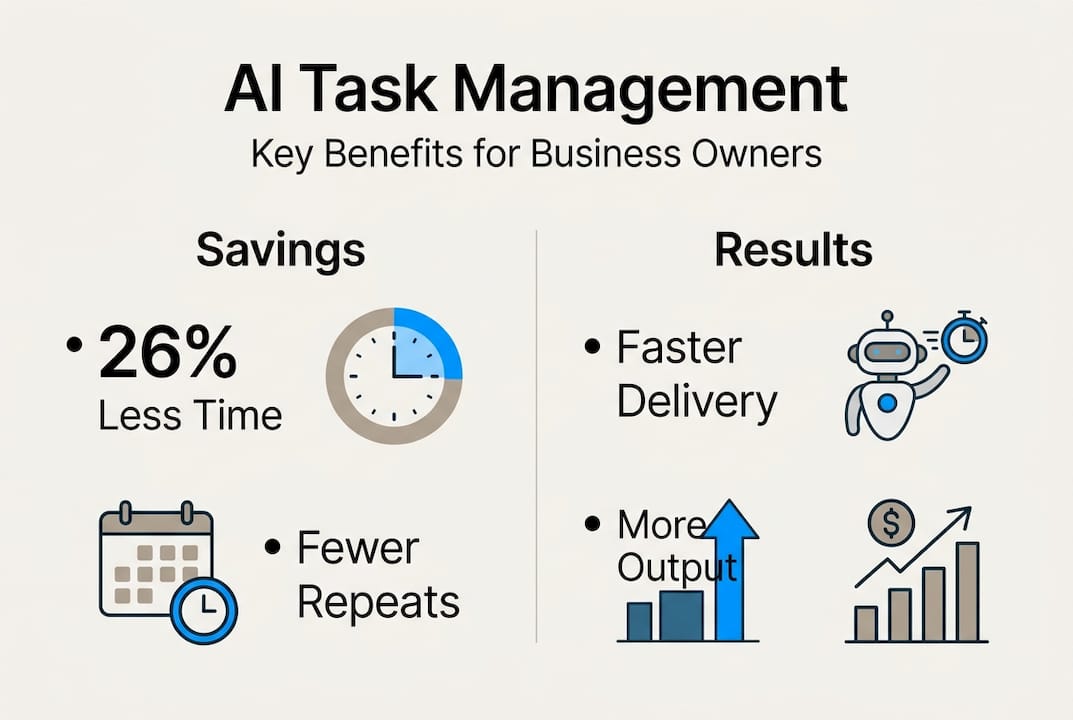
Key stat: Teams using AI task management report a reduction of routine project management tasks by up to 20 to 30%, freeing managers to focus on strategy and stakeholder communication instead of status updates.
The AI agent productivity benefits extend beyond raw speed. On-time delivery improvements are particularly significant for project managers. Organizations that have moved from manual scheduling to AI-assisted workflows report delivery rate improvements from as low as 18% better on straightforward projects to as high as 80% on complex, multi-team initiatives.
Measurable business gains from AI task management include:
- Fewer missed deadlines due to real-time schedule adjustments
- Reduced context-switching because tasks are surfaced at the right moment
- Lower administrative overhead from automated status reporting
- Better resource allocation through capacity-aware scheduling
- Faster onboarding because the system guides new team members through priorities
The AI automation guide outlines how these gains compound over time. The first month might show modest improvements, but as the system learns your team's patterns, the efficiency curve accelerates. That compounding effect is what separates AI task management from a one-time productivity hack.
How AI task management actually works
Understanding the mechanics helps you deploy these systems with confidence. The workflow follows a clear sequence, though each step is more nuanced than it first appears.
- Task capture: The system monitors connected channels, including email, Slack, project boards, and meeting notes, and automatically extracts actionable items. No manual logging required.
- Contextualization: Each captured task is tagged with metadata: source, deadline signals, related projects, and team members involved. This context powers smarter decisions downstream.
- Prioritization: The AI ranks tasks using a combination of urgency, business impact, dependencies, and team capacity. Unlike static priority labels, this ranking updates in real time as conditions change.
- Scheduling: Tasks are slotted into team calendars and workflows based on available bandwidth, not just due dates. The system avoids overloading individuals while keeping projects on track.
- Execution support: Team members receive focused task lists rather than overwhelming backlogs. The AI surfaces the right work at the right time.
- Adaptation: The system tracks outcomes, completion rates, and delays. It uses this data to refine future prioritization and scheduling recommendations continuously.
The AI task capture and prioritization process works best when connected to the platforms your team already uses. Forcing teams to adopt a new interface defeats the purpose. Integration is the foundation.

Creating AI workflows that connect to existing tools requires some upfront configuration, but the payoff is a system that operates largely in the background. You can also explore configuring AI brains to match the specific decision logic your business needs.
Pro Tip: After your first 30 days of deployment, audit the tasks the AI flagged as high priority but your team deprioritized manually. These discrepancies reveal either a configuration gap or a genuine blind spot in your team's workflow. Both are valuable to know.
Implementing AI task management: Best practices for business integration
Rolling out AI task management successfully is less about the technology and more about the rollout strategy. Most failed implementations share one trait: they tried to do too much too fast.
Here is what actually works:
- Start with task capture and prioritization only. These two functions deliver immediate, visible value and require the least organizational change. Teams see results within weeks, not months.
- Keep humans in the loop during the first phase. Have team leads review AI-generated priority lists before they go live. This catches edge cases and builds trust in the system's recommendations.
- Monitor for bias in prioritization. AI systems can inadvertently deprioritize tasks from certain channels or team members if the training data is skewed. Regular audits prevent this from compounding.
- Set clear ROI benchmarks before launch. Define what success looks like: time saved per week, reduction in missed deadlines, or decrease in status meeting frequency. Measure from day one.
- Expand iteratively. Once task capture and prioritization are stable, add automated scheduling. Then time blocking. Then full workflow management. Each layer builds on the last.
The scalable AI deployment approach works because it gives teams time to adapt their habits alongside the technology. Staying current with AI workforce trends also helps you anticipate where these tools are heading so your investments stay relevant.
Following AI integration best practices means combining high-impact automations with human oversight from the start, not as an afterthought.
Pro Tip: Track the number of manual task reprioritizations your team makes each week. If that number drops significantly within 60 days, your AI system is calibrating well. If it stays high, revisit your configuration and data inputs.
Why most businesses underestimate AI task management's potential
Here is the uncomfortable truth: most organizations treat AI task management as a productivity tool when it is actually a strategic asset. They automate the obvious tasks, see a modest efficiency bump, and declare success. They never reach the second layer of value.
The second layer is adaptive intelligence. When your AI system has enough data to predict which project types consistently run late, which team members are overloaded before they say so, and which task categories drain disproportionate time, you are no longer just saving hours. You are making better strategic decisions.
The misconception is that more automation equals more value. It does not. Combining AI with human oversight prevents the blind spots that pure automation creates. A system that runs without human review will optimize for the wrong things eventually.
Cultural adoption matters as much as configuration. Teams that resist AI task management usually do so because they were not included in the rollout. When managers impose the system from the top without explaining the reasoning, teams work around it. When they co-design the implementation, they protect it.
Managing AI at scale requires treating your AI system as a team member that needs feedback, not a machine that runs itself. The organizations that understand this consistently outperform those that do not.
Accelerate your business with AI-powered task management solutions
If you are ready to move beyond basic automation and build a genuinely intelligent task management system, the right platform makes all the difference. AgentsBooks gives business owners and project managers the tools to deploy autonomous AI agents that capture tasks, prioritize work, and integrate across your existing digital ecosystem.
Whether you need AI domain expert operators that specialize in specific business functions or AI multi-agent teams that coordinate complex workflows across departments, AgentsBooks has a solution built for your scale. Explore the full range of AgentsBooks solutions and connect with the team to design an implementation plan tailored to your business goals.
Frequently asked questions
What types of tasks can AI task management automate for businesses?
AI task management automates repetitive tasks, data capture, prioritization, scheduling, and adaptive workflow management across digital platforms. Core methodologies include intelligent task capture, smart prioritization, and automated scheduling that adjust in real time.
How much time and productivity can businesses realistically expect to gain?
Businesses can realistically save 26 to 41% of time on repetitive tasks and achieve up to 15 to 30% productivity gains based on empirical benchmarks. Results compound as the system learns your team's patterns over time.
What is the best way to start implementing AI task management?
Start with high-impact automations like task capture and prioritization, then add human oversight to review outputs during the first phase. High-impact automations combined with human review deliver the fastest and most reliable ROI.
How can AI task management integrate with existing digital platforms?
Modern solutions connect to emails, Slack, and project management platforms, capturing tasks and updating priorities in real time. AI task management adapts across channels and digital ecosystems without requiring teams to abandon their existing tools.
Is human oversight still necessary for AI-managed tasks?
Yes, combining AI decision-making with human review prevents biases and maximizes long-term effectiveness. Human oversight is especially important during the first 60 to 90 days of deployment when the system is still calibrating to your team's workflow.