
AI brain configuration is transforming how businesses automate tasks and optimize marketing in 2026, but many companies struggle with technical complexity and unclear steps. Businesses using AI marketing automation report up to an 81% boost in productivity within months, yet implementation failures remain common due to poor planning and unrealistic expectations. This guide breaks down AI brain configuration into clear, practical steps designed for businesses with minimal technical expertise, showing you exactly how to build autonomous AI agents that drive measurable results.
Table of Contents
- Prerequisites And Tools Needed
- Core Steps To Configure AI Brains For Business Automation And Marketing
- Common Mistakes And Troubleshooting In AI Brain Configuration
- Expected Outcomes And Success Metrics After AI Brain Deployment
- Unlock AI Automation With AgentsBooks
- Frequently Asked Questions
Key takeaways
| Point | Details |
|---|---|
| No-code platforms democratize AI | Modern platforms enable businesses to configure AI brains without coding skills, reducing technical barriers by over 90%. |
| Strategic configuration drives ROI | Aligning AI brain setup with clear business goals maximizes automation impact and marketing performance within months. |
| Avoid common deployment pitfalls | Poor data quality and unrealistic expectations cause up to 30% of AI projects to fail, but proper planning prevents these issues. |
| Measurable gains within 6-12 months | Businesses typically achieve significant productivity improvements and revenue growth after initial deployment phase. |
Prerequisites and tools needed
Before diving into AI brain configuration, you need foundational elements in place to ensure smooth implementation and avoid costly missteps. Start by identifying clear business objectives and securing cross-functional stakeholder alignment. Your marketing, operations, and IT teams should agree on what tasks the AI will automate and what success looks like.
Next, select accessible platforms that match your technical capacity. Low-code/no-code platforms like Zapier, Make.com and direct integration with large language models (such as GPT and Claude) enable businesses with minimal technical skills to customize and deploy AI agents efficiently. These no-code AI agent configuration tools eliminate the need for deep programming knowledge while maintaining powerful automation capabilities.
Prepare your business data for AI integration. Quality data is the foundation of effective AI brains, so audit your existing data sources, clean inconsistencies, and establish secure access protocols. Technical readiness also means ensuring your current systems can connect with AI platforms through APIs or native integrations.
Finally, understand basic AI capabilities and limitations to set realistic expectations. AI excels at pattern recognition, data analysis, and repetitive task automation, but it cannot replace human judgment in complex strategic decisions. Review this no-code AI brain creation guide to familiarize yourself with what autonomous AI agents can achieve for your business.
Essential prerequisites include:
- Clear business goals with measurable KPIs for automation and marketing
- Stakeholder buy-in across departments that will interact with AI systems
- Access to no-code platforms with GPT or Claude model integration
- Clean, organized business data ready for AI training
- Basic understanding of AI strengths and limitations
Core steps to configure AI brains for business automation and marketing
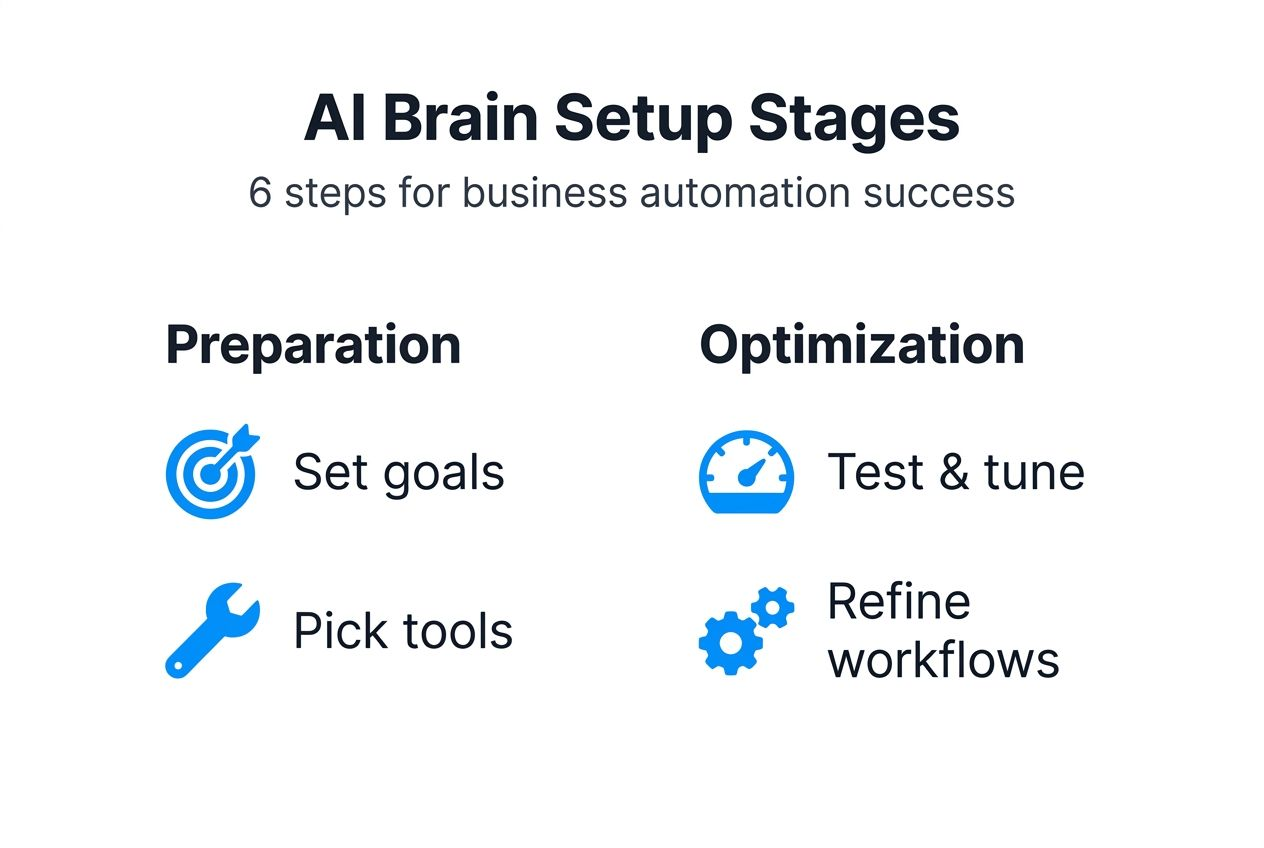
Configuring AI brains requires a systematic approach that transforms business needs into automated workflows and intelligent marketing systems. Follow these steps to build AI agents that deliver measurable results aligned with your goals.
Step 1: Assess business needs and set measurable AI goals
Start by mapping your current workflows to identify automation opportunities. Which tasks consume the most time? Where do manual errors occur most frequently? Which marketing processes could benefit from personalization at scale? Document specific metrics you want to improve, such as reducing email response time by 75% or increasing lead qualification accuracy by 50%.
Step 2: Prepare tools, data, and workflows for integration
Gather the platforms and data sources your AI brain will connect with. This includes your CRM, email marketing software, social media accounts, analytics tools, and internal databases. Map how data flows between these systems and identify any gaps that need bridging. Ensure you have API access credentials ready for each platform.

Step 3: Build autonomous AI workflows combining multiple AI tools
A practical step-by-step process to create a fully autonomous AI brain includes idea input, AI-driven research, data analysis, and output generation via interconnected AI tools like ChatGPT and Claude, integrating no-code platforms such as Zapier for automation. Use visual workflow builders to connect your AI models with business applications. For example, configure an AI brain to monitor customer inquiries, analyze sentiment, generate personalized responses, and route complex cases to human agents.
Step 4: Tune AI brains with business data and iterative feedback
Feed your AI brain with historical business data, brand guidelines, product information, and customer insights. Start with small data sets to test accuracy, then expand as performance improves. Implement feedback loops where human reviewers correct AI outputs, allowing the system to learn from mistakes and refine its decision-making.
Step 5: Enable real-time marketing optimization with adaptive AI agents
AI marketing platforms reduce cost and improve campaign precision by enabling real-time adjustments based on user behavior and predictive analytics, shortening optimization cycles from weeks to minutes. Configure your AI brain to monitor campaign performance continuously and adjust messaging, targeting, and budget allocation without manual intervention. This represents how AI marketing is shifting from rule-based automation to autonomous agents that learn and optimize campaigns continuously, reflecting a major industry transition in 2026.
Step 6: Test and refine workflows before full deployment
Run pilot tests with limited scope before rolling out AI brains across your entire organization. Monitor outputs closely, measure against your predefined KPIs, and gather user feedback. Adjust configurations based on real-world performance rather than theoretical assumptions.
| Configuration Stage | Primary Focus | Success Indicator |
|---|---|---|
| Assessment | Business needs mapping | Clear KPIs defined |
| Preparation | Data and tool readiness | All integrations tested |
| Build | Workflow automation | AI completes tasks end-to-end |
| Tuning | Learning and accuracy | Error rate below 5% |
| Optimization | Marketing performance | Real-time campaign adjustments |
| Testing | Quality assurance | Pilot meets or exceeds KPIs |
Pro Tip: Start with one high-impact, low-complexity workflow to build confidence and demonstrate value quickly. Success with a focused pilot makes it easier to secure resources for broader AI brain deployment across your organization.
When integrating AI brains with marketing platforms and APIs, prioritize connections that drive immediate business value. Learn more about step-by-step AI brain creation, real-time marketing optimization, and autonomous AI marketing agents to deepen your implementation strategy.
Common mistakes and troubleshooting in AI brain configuration
Even well-planned AI deployments encounter obstacles that can derail projects or limit their effectiveness. Understanding common pitfalls helps you anticipate challenges and implement solutions before they become critical failures.
Overestimating AI capabilities creates unrealistic expectations that lead to disappointment and abandoned projects. AI brains excel at specific, well-defined tasks but struggle with ambiguous situations requiring human intuition. Set clear boundaries for what your AI will and will not handle, and communicate these limitations to stakeholders early. Common mistakes include overestimating AI capabilities, insufficient data quality, lack of integration planning, and ignoring user training, leading to up to 30% failure rate in AI projects.
Insufficient data quality undermines AI performance from the start. Garbage in, garbage out applies directly to AI brain configuration. Invest time in data cleaning, validation, and normalization before feeding information to your AI systems. Establish ongoing data quality checks to catch errors before they propagate through automated workflows.
Lack of integration planning causes friction when AI brains cannot access needed information or execute actions across your tech stack. Map all required integrations before configuration begins, test API connections thoroughly, and build fallback procedures for when third-party services experience downtime.
Ignoring user training creates resistance and reduces adoption rates. Even the best AI brain fails if your team does not understand how to work alongside it. Develop clear documentation, provide hands-on training sessions, and designate internal champions who can support colleagues during the transition.
Pro Tip: Schedule regular review sessions where your team shares AI brain outputs that missed the mark. Use these examples to refine prompts, adjust parameters, and improve training data rather than viewing them as failures.
Privacy and data security best practices in AI deployments require techniques like data anonymization, minimal data transmission to AI, and compliance with regional regulations to protect business reputation. Implement encryption for data in transit and at rest, limit AI access to only necessary information, and conduct regular security audits. Ensure your AI brain configuration aligns with best practices for AI integration to avoid legal and reputational risks.
Key troubleshooting strategies include:
- Monitor AI outputs daily during the first month to catch patterns of errors early
- Maintain detailed logs of AI decisions to enable root cause analysis when issues arise
- Build human review checkpoints for high-stakes decisions or customer-facing communications
- Create a feedback mechanism where users can flag problematic AI outputs easily
- Update training data quarterly to reflect evolving business needs and customer preferences
For deeper insights, review common AI implementation mistakes and AI data privacy best practices to strengthen your deployment strategy.
Expected outcomes and success metrics after AI brain deployment
Properly configured AI brains deliver measurable improvements across automation, productivity, and marketing performance. Understanding realistic timelines and benchmarks helps you track progress and justify continued investment in AI systems.
Task automation improvements typically reach 50% or higher within the first three to six months of deployment. Routine processes like data entry, email sorting, customer inquiry routing, and report generation become fully automated, freeing your team to focus on strategic work. Businesses implementing AI marketing automation report up to 81% higher productivity and 83% revenue growth, showing significant ROI within a few months of deployment.
Marketing productivity gains prove even more dramatic as AI brains enable personalization at scale. Instead of creating one campaign for all customers, your AI generates tailored messaging for microsegments based on behavior, preferences, and predictive analytics. AI-driven marketing automation campaigns can improve lead conversion rates by up to 4.4 times and increase customer engagement due to personalized, adaptive strategies.
Successful AI implementation roadmaps typically span 6-12 months for smaller businesses, involving phases of readiness assessment, pilot project execution, scaling, and measurement to manage risk and maximize value realization. This timeline allows for proper testing, refinement, and organizational adaptation without rushing critical steps.
| Metric Category | Expected Improvement | Typical Timeline |
|---|---|---|
| Task automation rate | 50-70% reduction in manual work | 3-6 months |
| Marketing productivity | 80%+ efficiency gain | 4-8 months |
| Lead conversion rate | 4-5x improvement | 6-12 months |
| Revenue growth | 50-83% increase | 6-12 months |
| Customer engagement | 2-3x higher interaction | 3-9 months |
Ongoing metrics tracking enables continuous optimization and scaling. Establish dashboards that monitor AI brain performance against your original KPIs, and review these metrics monthly. Look for patterns indicating where AI excels and where human oversight remains necessary.
Key success metrics to track:
- Automation completion rate (percentage of tasks completed without human intervention)
- Error rate (percentage of AI outputs requiring correction)
- Time savings (hours reclaimed per employee per week)
- Cost per lead (reduction in customer acquisition costs)
- Customer satisfaction scores (impact on experience quality)
"The businesses seeing the greatest returns from AI brain deployment share a common trait: they measure everything. They track not just outcomes but also the quality of AI decisions, user satisfaction with automated processes, and the time required for human review. This data-driven approach allows them to optimize continuously rather than deploying AI and hoping for the best."
Discover how AI success measurement tools can help you track these metrics effectively. For additional context, explore ROI from AI marketing automation, AI-driven marketing conversion uplift, and AI implementation timeline best practices.
Unlock AI automation with AgentsBooks
Configuring AI brains becomes dramatically simpler when you use a platform designed specifically for businesses without deep technical expertise. AgentsBooks offers a comprehensive solution for building custom AI agents tailored to your automation and marketing needs, eliminating the coding barriers that prevent many companies from deploying AI effectively.
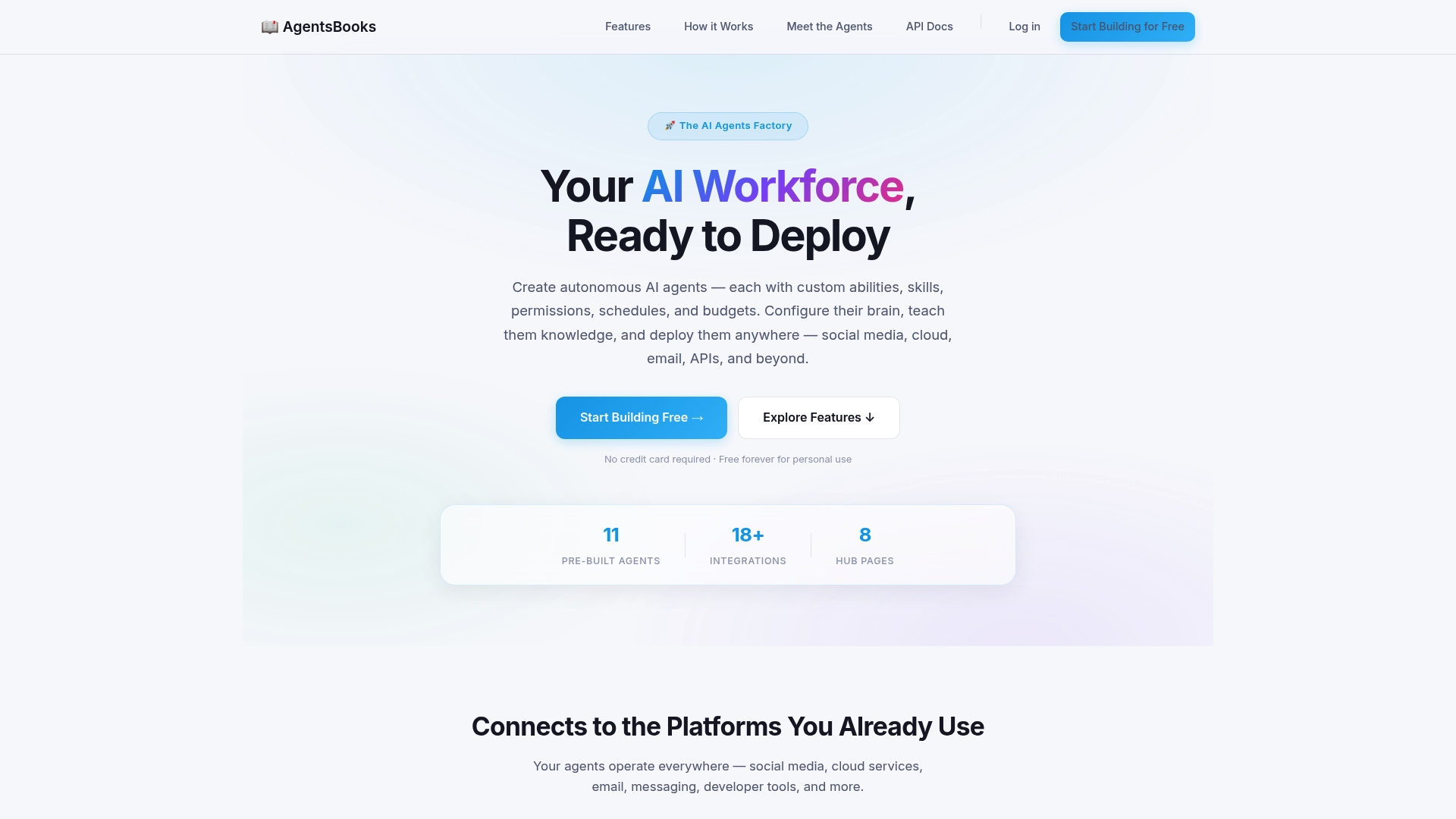
The platform combines drag-and-drop workflow builders with integration to GPT and Claude models, allowing you to configure intelligent AI brains in hours rather than months. Connect your existing business tools through prebuilt integrations, feed your AI agents with company knowledge, and deploy autonomous workflows that run 24/7 without constant supervision.
Speed matters when competitors are already leveraging AI for competitive advantage. AgentsBooks enables rapid deployment cycles with templates for common business processes, reducing time to value and helping you achieve measurable productivity gains faster than custom-coded solutions.
Pro Tip: Leverage the AgentsBooks no-code AI platform templates and expert support to accelerate your AI automation journey. Start with proven workflows for your industry, then customize them as you gain confidence and identify unique optimization opportunities specific to your business.
Frequently asked questions
What is an AI brain in the context of business automation?
An AI brain is an autonomous agent configured to automate workflows and optimize digital marketing by making intelligent decisions with minimal human intervention. It integrates multiple AI tools, business data, and large language models to execute tasks end-to-end. Deploying an AI brain improves efficiency, reduces manual errors, and enables personalized marketing campaigns at scale.
How can businesses with minimal technical expertise configure AI brains effectively?
Modern no-code platforms like AgentsBooks, Zapier, and Make.com simplify AI agent setup through visual workflow builders and prebuilt connectors. They provide drag-and-drop tools that integrate foundational AI models such as GPT and Claude without requiring programming skills. This approach reduces technical barriers by over 90%, making sophisticated AI automation accessible for business users focused on outcomes rather than code.
What are realistic timelines for achieving ROI from AI brain deployment?
Full AI implementation typically spans six to twelve months for small and mid-sized businesses, progressing through readiness assessment, pilot testing, scaling, and ongoing measurement. Businesses often see productivity boosts and revenue growth beginning within the first three to six months of deployment. The phased approach manages risk while maximizing value realization and organizational adoption.
What data quality standards do AI brains require to function effectively?
AI brains need clean, consistent, and properly formatted data to generate accurate outputs and make reliable decisions. This includes removing duplicates, standardizing formats, filling critical gaps, and validating information accuracy before feeding it to AI systems. Ongoing data quality monitoring prevents degradation over time and ensures AI brains continue performing at optimal levels.
How do businesses measure the success of AI brain implementations?
Track automation completion rates, error rates, time savings per employee, cost per lead, and customer satisfaction scores to measure AI brain effectiveness. Establish baseline metrics before deployment, then monitor improvements monthly using dashboards that visualize performance against predefined KPIs. Successful businesses review these metrics regularly and adjust AI configurations based on data-driven insights rather than assumptions.