
You've probably heard the warnings that AI will replace human workers overnight. That's not what's happening. The real story is about AI workforce: digital agents that work alongside your team, automating repetitive tasks and amplifying human expertise. These autonomous systems handle everything from customer inquiries to data analysis, letting your people focus on strategic work that drives growth. Business owners who deploy AI workforce effectively see measurable productivity gains while maintaining human oversight. This guide breaks down what AI workforce means, how it operates, and exactly how to implement it in your organization for maximum impact.
Table of Contents
- Understanding The AI Workforce: What It Is And How It Works
- Mechanics And Deployment Methodologies Of AI Workforce
- Measuring Impact And Navigating Challenges Of AI Workforce Adoption
- Practical Steps To Deploy And Scale Your AI Workforce In 2026
- Discover Agentsbooks Solutions For Building Your AI Workforce
Key takeaways
| Point | Details |
|---|---|
| AI workforce definition | Digital agents and autonomous software that automate human tasks using agentic AI, RPA, machine learning, and natural language processing. |
| Deployment approach | Requires strategic planning with human oversight, phased implementation, and clear governance boundaries for agent autonomy. |
| Productivity impact | Empirical studies show 15-31% productivity gains across functions, with largest improvements for entry-level workers and routine tasks. |
| Key challenges | Hallucination errors, verification costs, potential job displacement for entry roles, and organizational change management needs. |
| Implementation strategy | Start with high-impact use cases, build infrastructure, train teams on human-AI collaboration, and scale with continuous governance. |
Understanding the AI workforce: What it is and how it works
The AI workforce refers to digital agents and autonomous software systems that perform tasks traditionally done by humans. These systems combine multiple AI technologies to handle work that previously required human judgment, creativity, or decision making. Think of them as software employees that never sleep, never take breaks, and scale instantly when workload increases.
Several core technologies power this digital workforce. Robotic process automation handles rule-based tasks like data entry and form processing. Machine learning algorithms identify patterns in data and make predictions without explicit programming. Natural language processing enables agents to understand and generate human language for customer interactions. Agentic AI brings it all together, allowing systems to perceive context, plan multi-step actions, and adapt to new situations autonomously.
These AI agents tackle a wide range of business functions:
- Customer service inquiries and support ticket resolution
- Data analysis, reporting, and insight generation
- Content creation for marketing and communications
- Financial transaction processing and reconciliation
- Scheduling, coordination, and administrative workflows
- Quality control and compliance monitoring
The operational advantages are substantial. AI agents work continuously without fatigue, processing thousands of tasks simultaneously. They scale instantly during peak demand periods without hiring delays or training costs. When properly configured, they maintain consistent quality standards and follow protocols exactly as programmed.
Industries from healthcare to finance already deploy AI workforce solutions. Banks use agents for fraud detection and loan processing. Healthcare providers automate appointment scheduling and patient follow-ups. Retailers deploy chatbots for customer inquiries and inventory management. Manufacturing facilities use AI for predictive maintenance and quality inspection.
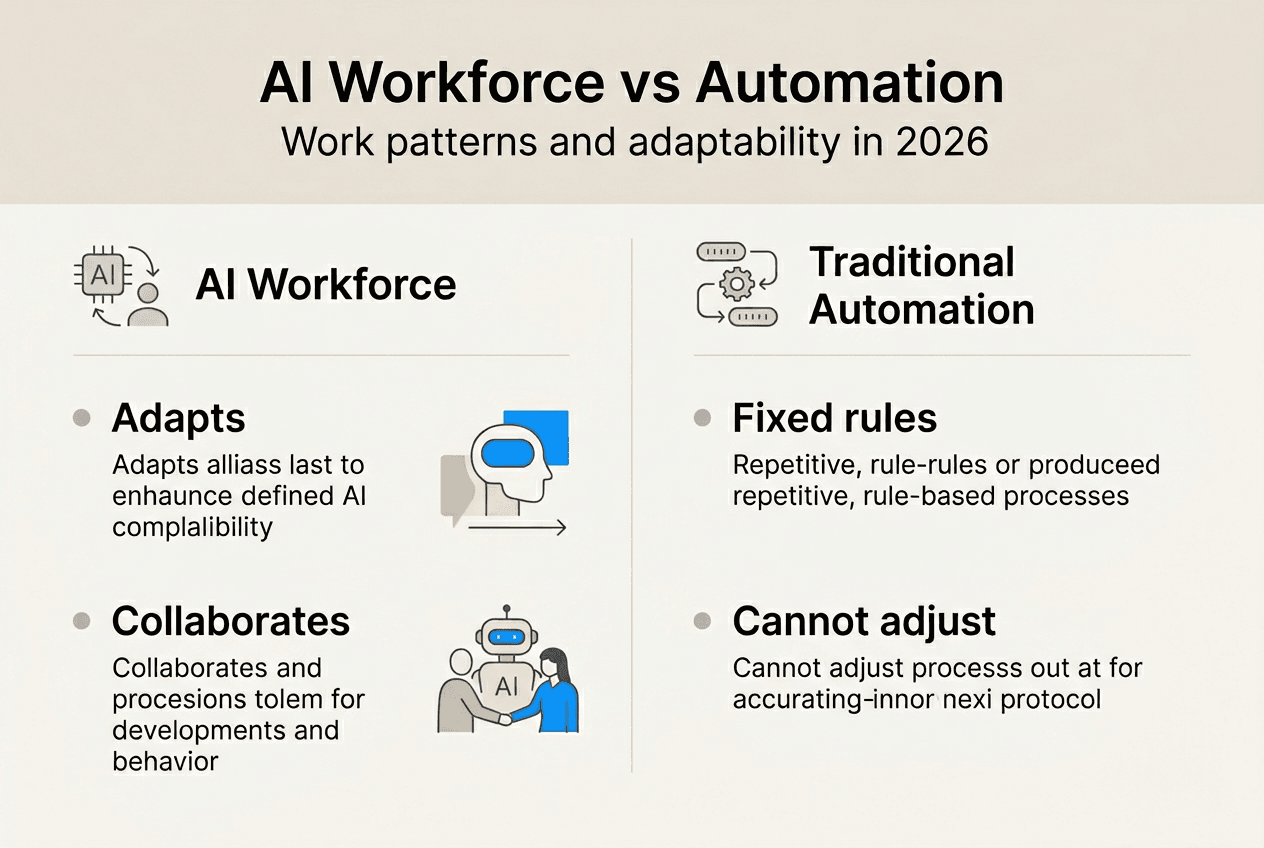
The key distinction from traditional automation is adaptability. Earlier automation required rigid programming for specific scenarios. Modern AI workforce management systems learn from experience, handle ambiguous situations, and improve performance over time without constant reprogramming. This flexibility makes them suitable for complex, variable tasks that previously required human workers.
Mechanics and deployment methodologies of AI workforce
Agentic AI systems operate through sophisticated perception and action cycles. These agents continuously perceive context from their environment, accessing data from multiple sources like databases, APIs, and user inputs. They plan multi-step actions to achieve goals, breaking complex objectives into executable tasks. When needed, they use external tools and services through API integrations, extending their capabilities beyond built-in functions.
Multi-agent systems take this further by enabling collaboration between specialized agents. One agent might handle data gathering while another performs analysis, and a third generates reports. These agents share information, coordinate actions, and learn from collective feedback. The system improves through reinforcement learning, adjusting strategies based on outcomes and human corrections.
Deployment typically happens through low-code platforms that simplify agent creation. You describe what you want the agent to do, configure its knowledge sources, and set behavioral parameters. The platform handles the technical complexity of integrating language models, managing data flows, and orchestrating agent interactions. Human oversight remains essential. You establish approval workflows for high-stakes decisions, monitor agent performance through dashboards, and intervene when agents encounter edge cases.
Successful deployment follows a structured methodology:
- Define strategic objectives and identify high-impact use cases where automation delivers clear ROI.
- Prepare data infrastructure by cleaning datasets, establishing access protocols, and ensuring quality standards.
- Configure initial agents with narrow, well-defined scopes to minimize risk and build confidence.
- Test extensively in controlled environments with human reviewers validating outputs before production use.
- Scale gradually by expanding agent responsibilities and deploying to additional use cases as trust builds.
- Implement governance frameworks with clear autonomy boundaries, audit trails, and performance metrics.
Pro Tip: Set conservative autonomy levels initially, requiring human approval for consequential actions. As agents prove reliable through audit trail analysis, gradually expand their decision-making authority. This builds organizational trust while protecting against costly errors.
The AI domain expert operators approach assigns agents to specific functional domains like sales, support, or operations. Each operator develops deep expertise in its area through targeted training data and domain-specific tools. This specialization improves accuracy and makes agents more valuable than generalist systems.
Integration with existing systems requires careful planning. Agents need secure access to relevant databases, communication platforms, and business applications. API connections enable agents to retrieve information, execute actions, and update records across your technology stack. Proper authentication and permission controls ensure agents only access data necessary for their assigned tasks.
For detailed implementation guidance, explore our AI agent deployment guide 2026 which covers technical setup, security considerations, and change management strategies.
Measuring impact and navigating challenges of AI workforce adoption
Empirical research demonstrates significant productivity improvements from AI workforce deployment. A comprehensive MIT study found customer service teams increased productivity 15% when using AI assistants. Software developers completed 26% more tasks with AI pair programming tools. Knowledge workers spent 31% less time on email management when AI agents handled routine correspondence.

The gains vary by worker skill level. Entry-level employees and those performing routine tasks see the largest improvements, sometimes doubling their output. Experienced workers gain less in raw productivity but report higher job satisfaction as AI handles tedious work. Mid-career professionals use AI to punch above their weight, delivering expert-level work faster.
| Function | Productivity Gain | Implementation Complexity |
|---|---|---|
| Customer support | 15-25% | Low |
| Software development | 20-30% | Medium |
| Content creation | 30-40% | Low |
| Data analysis | 25-35% | Medium |
| Administrative tasks | 40-50% | Low |
However, serious challenges temper this optimism. AI hallucinations, where systems confidently generate false information, create costly verification requirements. Analysts estimate hallucinations cost businesses over $60 billion annually in wasted time and corrected errors. Every AI output requires human review until agents prove consistently reliable in specific contexts.
Employment impacts raise legitimate concerns. Research shows entry-level roles in AI-exposed occupations experienced 16% employment drops between 2023 and 2025. Junior positions that traditionally served as training grounds now face automation pressure. This creates a deskilling risk where fewer workers gain hands-on experience needed for career advancement.
Key implementation challenges include:
- Verification overhead negating productivity gains when output quality is inconsistent
- Context window limitations preventing agents from handling complex, long-running tasks
- Integration complexity with legacy systems lacking modern APIs
- Change resistance from employees fearing job displacement
- Regulatory uncertainty around AI decision making in regulated industries
Perspectives on AI workforce impact split between optimists and skeptics. Proponents emphasize augmented intelligence, where AI amplifies human capabilities rather than replacing them. They point to new job categories emerging around AI management, training, and oversight.
"The question isn't whether AI will change work, but whether we'll use it to enhance human potential or simply cut labor costs. Organizations that focus on augmentation rather than replacement will build sustainable competitive advantages." - Leading workforce transformation researcher
Skeptics warn against over-reliance on systems we don't fully understand. They note that productivity gains often come with hidden costs in verification time, error correction, and managing AI-related incidents. The long-term societal impact of widespread AI workforce adoption remains uncertain.
Pro Tip: Invest heavily in data quality before deploying AI agents. Clean, well-structured data dramatically reduces hallucinations and verification costs. Many organizations discover their data infrastructure bottlenecks limit AI effectiveness more than the technology itself.
For strategies on building teams that work effectively with AI, review our guide on must-have AI skills 2026 to prepare your workforce for successful human-AI collaboration.
Balancing these opportunities and risks requires thoughtful managing AI at scale approaches that prioritize governance, transparency, and continuous improvement.
Practical steps to deploy and scale your AI workforce in 2026
Successful AI workforce implementation follows a structured deployment methodology that balances ambition with pragmatism. Start by defining clear business outcomes you want to achieve. Vague goals like "improve efficiency" fail. Specific targets like "reduce customer inquiry response time from 4 hours to 30 minutes" provide measurable success criteria.
Prioritize use cases based on impact and feasibility:
| Use Case | Business Impact | Technical Complexity | Recommended Priority |
|---|---|---|---|
| Customer inquiry routing | High | Low | Start here |
| Invoice processing | High | Low | Start here |
| Content summarization | Medium | Low | Early phase |
| Predictive maintenance | High | High | Later phase |
| Strategic planning support | Medium | High | Later phase |
Your deployment roadmap should follow these phases:
- Strategy development: Assemble cross-functional teams including business leaders, IT, legal, and frontline workers. Map current workflows to identify automation opportunities. Set realistic timelines and budget allocations.
- Infrastructure preparation: Audit data quality and accessibility. Establish secure API connections to necessary systems. Create testing environments that mirror production without risk.
- Agent configuration: Build initial agents with narrow scopes focused on single, well-defined tasks. Load relevant knowledge from documentation, past interactions, and domain expertise. Set conservative autonomy boundaries.
- Adoption enablement: Train employees on working alongside AI agents. Explain what agents can and cannot do. Establish clear escalation paths when agents encounter problems. Address concerns about job security transparently.
- Iterative scaling: Monitor agent performance closely during initial deployment. Gather user feedback and identify improvement opportunities. Gradually expand agent capabilities and deploy to additional use cases as confidence builds.
- Governance implementation: Create oversight committees that review agent decisions regularly. Establish audit trails capturing all agent actions. Define clear accountability when things go wrong. Update policies as you learn.
Change management deserves special attention. Employees fear being replaced by AI, creating resistance that undermines adoption. Frame AI workforce as augmentation that eliminates tedious work and enables people to focus on higher-value activities. Involve frontline workers in agent design so they feel ownership rather than displacement.
Human-AI collaboration training teaches employees how to work effectively with digital teammates. Workers learn to prompt agents clearly, interpret outputs critically, and identify when human judgment should override AI recommendations. This collaborative skill set becomes increasingly valuable as AI capabilities expand.
Best practices for sustainable scaling include:
- Start small with pilot projects that deliver quick wins and build organizational confidence
- Maintain human oversight for all consequential decisions until agents prove consistently reliable
- Document everything so you can replicate successes and avoid repeating mistakes
- Establish feedback loops where agent performance data informs continuous improvement
- Review autonomy boundaries regularly, expanding agent authority as trust and capability increase
- Invest in explainability tools that help humans understand why agents made specific decisions
For comprehensive guidance on the technical and organizational aspects of deployment, consult our AI agent deployment guide 2026 which covers security, integration, and change management in depth.
As your AI workforce matures, focus shifts from initial deployment to optimization and expansion. Analyze which agents deliver the most value and why. Replicate successful patterns across similar use cases. Continuously refine agent training data and behavioral parameters based on performance metrics and user feedback.
The AI workforce management strategies you establish now will determine whether your AI initiatives deliver sustained competitive advantage or become expensive experiments that fail to scale.
Discover AgentsBooks solutions for building your AI workforce
Now that you understand AI workforce fundamentals and implementation strategies, you need practical tools to bring these concepts to life. AgentsBooks provides a comprehensive platform for creating, managing, and scaling customizable AI agents tailored to your business needs. Our AI domain expert operators enable you to deploy specialized agents for sales, support, operations, and other critical functions without extensive technical expertise.
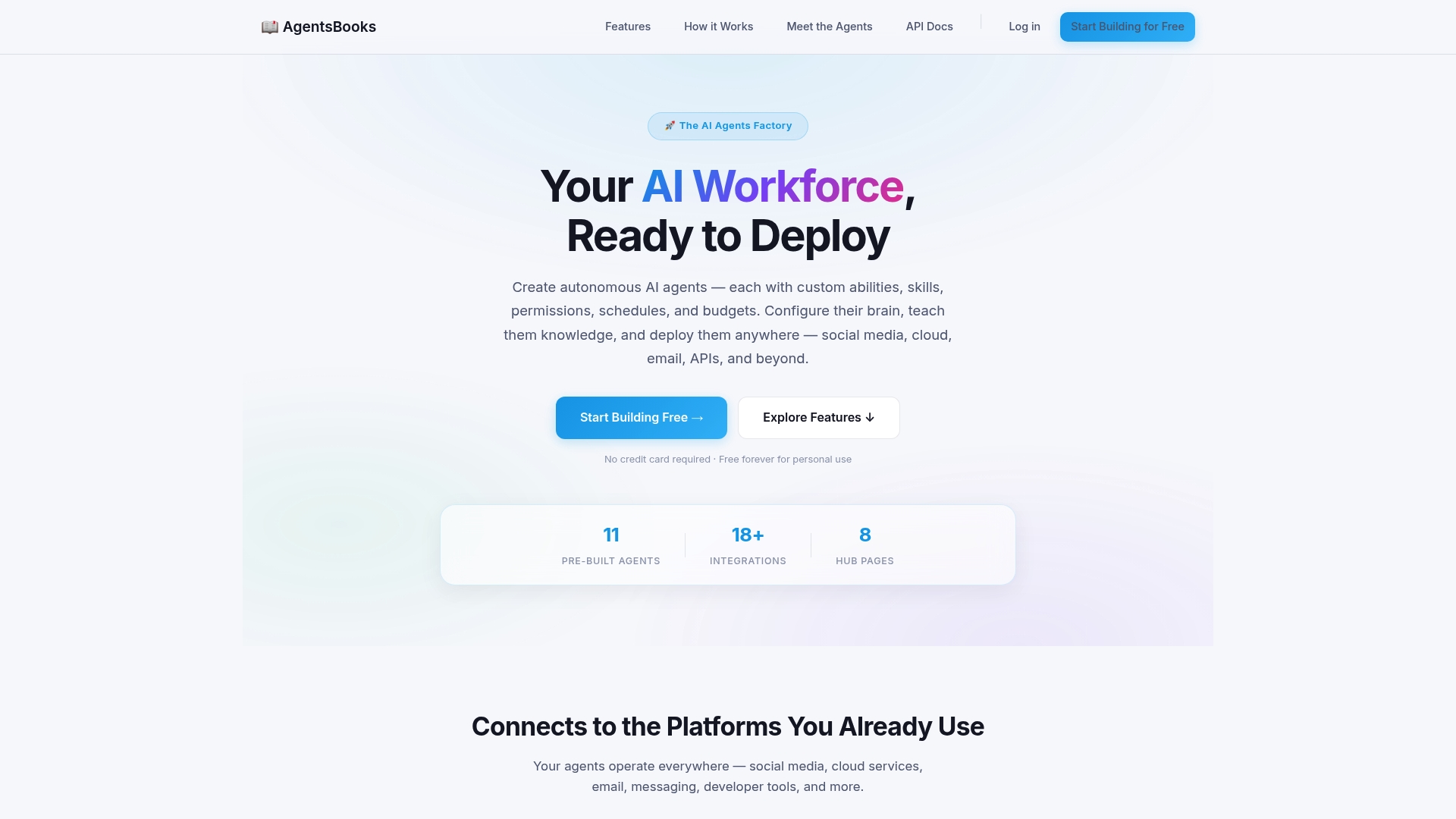
The platform supports collaborative AI multi-agent teams where specialized agents work together on complex workflows, sharing information and coordinating actions automatically. With intuitive agent creation features, you can build and deploy functional AI workforce members in minutes, not months. Whether you're automating customer interactions, streamlining internal operations, or scaling content production, AgentsBooks provides the infrastructure and tools to transform your productivity through intelligent automation.
Frequently asked questions
What is an AI workforce?
An AI workforce consists of digital agents and autonomous software systems that perform tasks traditionally requiring human workers. These agents use artificial intelligence technologies like machine learning, natural language processing, and agentic AI to handle everything from customer service to data analysis. Unlike traditional automation that follows rigid rules, AI workforce systems adapt to new situations and improve through experience.
How does AI workforce differ from regular automation?
Traditional automation executes predefined rules for specific scenarios and breaks when encountering unexpected situations. AI workforce systems perceive context, make decisions based on learned patterns, and handle ambiguous cases that would stump rule-based automation. They learn from feedback and improve over time without constant reprogramming. This adaptability makes them suitable for complex, variable tasks requiring judgment rather than just repetitive execution.
What business functions benefit most from AI workforce deployment?
Customer service sees immediate gains through AI agents handling inquiries, routing tickets, and providing instant responses. Administrative tasks like scheduling, data entry, and document processing automate easily with high accuracy. Content creation for marketing, reporting, and communications scales dramatically. Data analysis and insight generation accelerate when AI processes large datasets. Financial operations including invoice processing, reconciliation, and basic accounting benefit substantially from AI workforce implementation.
Will AI workforce replace human employees?
AI workforce augments rather than completely replaces human workers in most scenarios. Entry-level positions performing routine tasks face the highest displacement risk, with some roles seeing significant employment declines. However, new jobs emerge around AI management, training, oversight, and handling complex cases that exceed AI capabilities. Organizations that focus on human-AI collaboration rather than pure replacement typically achieve better outcomes. The key is retraining workers for higher-value activities while AI handles repetitive tasks.
What are the main risks of implementing AI workforce?
Hallucinations where AI generates false information confidently create costly verification requirements and potential errors. Integration complexity with existing systems can delay implementation and inflate costs. Change resistance from employees fearing job loss undermines adoption if not addressed through transparent communication. Regulatory uncertainty around AI decision making poses compliance risks in regulated industries. Organizations must balance these challenges against productivity benefits through careful governance and phased implementation.
Where can I learn more about deploying AI workforce effectively?
Start with vendor resources from AI platform providers offering deployment guides and best practices. Industry research from consulting firms like PwC and academic institutions provides empirical data on outcomes and challenges. Professional communities and forums where practitioners share real-world experiences offer practical insights. Consider pilot projects with narrow scopes to build internal expertise before large-scale deployment. Engage consultants specializing in AI transformation if your organization lacks in-house expertise for strategic planning and change management.