
Business leaders face a critical challenge in 2026: identifying which AI skills truly matter for competitive advantage. With 78% of organizations reporting skill gaps that limit AI adoption, choosing the wrong capabilities wastes resources and leaves teams unprepared. This guide cuts through the noise to deliver a practical framework for selecting essential AI skills that drive automation and productivity. You'll discover the technical, strategic, and ethical competencies your team needs, learn to avoid common pitfalls like unclear problem definition, and gain actionable criteria to build a future-ready workforce capable of maximizing AI investments.
Table of Contents
- Critical Criteria For Must-Have AI Skills In 2026
- Top Foundational And Core Technical AI Skills Every 2026 Team Needs
- Applied And Emerging AI Skills Reshaping Business Automation And Leadership
- Comparing And Prioritizing Must-Have AI Skills For Your 2026 Team
- Future-Proof Your AI Capabilities With AgentsBooks
- Frequently Asked Questions About Must-Have AI Skills
Key takeaways
| Point | Details |
|---|---|
| AI literacy forms the foundation | Understanding AI capabilities, limitations, and ethical use enables effective leadership and risk management |
| Integration beats building | Focus on deploying and orchestrating pre-trained models rather than building AI systems from scratch |
| Meta-skills drive adoption | Domain expertise, strategic communication, and ethical judgment separate successful AI teams from struggling ones |
| Continuous learning is mandatory | Rapid technology evolution requires ongoing skill development to maintain competitive advantage |
Critical criteria for must-have AI skills in 2026
Selecting the right AI skills requires a clear framework that balances immediate business needs with long-term strategic value. Start by defining AI literacy as the ability to understand what AI can and cannot do, recognize ethical implications, and translate technical capabilities into business outcomes. Managers need AI literacy to evaluate options, manage risk, and convert AI investments into measurable results.
The most common mistake organizations make is attempting AI projects without clearly defined problems. Before investing in any skill development, ensure your team can articulate specific business challenges that AI will address. This problem-first approach prevents wasted effort on technically impressive but commercially useless solutions.
Evaluate potential skills using these criteria:
- Practical impact on current business processes and automation opportunities
- Scalability across teams and projects without exponential cost increases
- Integration ease with existing systems and workflows
- Ethical considerations and alignment with regulatory requirements
- Learning curve relative to expected return on investment
Balance technical prowess with meta-skills like cross-functional communication and domain knowledge. A data scientist who cannot explain model outputs to stakeholders delivers less value than one with moderate technical skills but exceptional business acumen. Similarly, managing AI at scale requires orchestration abilities that transcend pure coding expertise.
Avoid the trap of applying AI outside its core strengths. AI excels at pattern recognition, prediction, and automation of repetitive cognitive tasks. It struggles with context understanding, causal reasoning, and situations requiring genuine creativity or ethical judgment. Skills that help teams recognize these boundaries prevent costly missteps.
Top foundational and core technical AI skills every 2026 team needs
Foundational skills create the bedrock for AI competency across your organization. Statistics and probability enable teams to interpret model outputs, understand confidence intervals, and make data-driven decisions. Linear algebra provides the mathematical framework for understanding how AI models process information. Python programming remains the dominant language for AI work, but your team needs only practical proficiency, not computer science mastery.
The skills framework includes foundation and core technical layers essential for competitive candidates in 2026. Core technical skills have shifted dramatically from building models to orchestrating them. Your team should focus on deploying and integrating pre-trained AI models like large language models and vision transformers rather than training neural networks from scratch.
Key core technical capabilities include:
- API integration for connecting AI services to business applications
- Fine-tuning foundation models for specific use cases and domains
- Prompt engineering to maximize output quality from generative AI tools
- Model evaluation to assess performance, bias, and reliability
- Data pipeline management for feeding AI systems quality information
MLOps fundamentals have become essential for maintaining AI systems in production. Your team needs to understand model versioning, monitoring for drift, automated retraining pipelines, and rollback procedures. These operational skills prevent the common scenario where promising proof-of-concept projects fail during real-world deployment.

Pro Tip: Invest 80% of your technical training budget in integration and deployment skills rather than model architecture. Building new AI models from scratch costs millions and rarely outperforms existing foundation models fine-tuned for your specific needs. Your competitive advantage comes from applying AI effectively, not reinventing it.
Consider specializing team members as AI domain expert operators who combine technical AI skills with deep knowledge of your business domain. This hybrid approach delivers faster results than hiring pure AI specialists who lack industry context. Explore the AI model showcase to understand which pre-trained models align with common business use cases.
Applied and emerging AI skills reshaping business automation and leadership
Applied AI skills translate technical capabilities into business outcomes. Generative AI tool proficiency has become table stakes for knowledge workers in 2026. Your team should master prompt engineering, output validation, and creative application of tools like ChatGPT, Claude, and industry-specific AI assistants. Understanding agentic AI concepts, where autonomous agents complete multi-step tasks, unlocks new automation possibilities.
AI literacy is a core leadership requirement to guide AI-driven change and deliver measurable outcomes. Leaders must translate between technical teams and business stakeholders, making strategic communication a critical skill. The ability to explain AI capabilities and limitations to non-technical executives determines whether projects receive funding and organizational support.
Meta-skills that separate high-performing AI teams from struggling ones:
- Domain expertise that identifies high-value AI applications others miss
- Ethical reasoning to navigate bias, privacy, and fairness challenges
- Change management to drive adoption across resistant teams
- Strategic thinking to prioritize AI investments for maximum ROI
- Collaborative problem-solving across technical and business functions
MLOps at scale requires understanding how to maintain dozens or hundreds of AI models simultaneously. Your team needs skills in automated testing, performance monitoring, incident response, and continuous improvement cycles. The pace of technology change creates a need for continuous skill evolution and strategic leadership.
Steps to foster AI literacy within teams:
- Establish baseline assessments to identify current skill levels and gaps
- Create learning paths tailored to different roles and responsibilities
- Implement hands-on projects that apply new skills to real business problems
- Build communities of practice for knowledge sharing and peer learning
- Measure skill development impact through business metrics, not just completion rates
Pro Tip: Allocate 10% of each team member's time to continuous AI education through courses, conferences, and experimentation. Organizations that treat AI skill development as ongoing investment rather than one-time training see 3x higher adoption rates and faster time to value.
Explore AI workforce management strategies to coordinate human and AI capabilities effectively. The cloud AI management guide provides frameworks for scaling AI operations without overwhelming your technical teams.
Comparing and prioritizing must-have AI skills for your 2026 team
Different skill categories deliver value at different stages of AI maturity. Use this comparison to prioritize development based on your organization's current state and strategic goals.
| Skill category | Acquisition difficulty | Business impact | Best for | Key consideration |
|---|---|---|---|---|
| Foundational (statistics, Python basics) | Moderate | Medium | All team members | Essential baseline, enables informed AI discussions |
| Core technical (model integration, MLOps) | High | Very high | Engineers, technical leads | Directly enables AI deployment and maintenance |
| Applied (generative AI tools, prompt engineering) | Low | High | Knowledge workers, managers | Fastest ROI, immediate productivity gains |
| Meta-skills (domain expertise, ethics, communication) | Moderate | Very high | Leaders, domain experts | Differentiates successful adoption from technical experiments |
Engineers require deep core technical skills to build and maintain AI systems. Managers need strong applied and meta-skills to guide strategy and drive adoption. Domain experts should combine foundational knowledge with advanced meta-skills to identify high-value use cases. The gap is widening between organizations reimagining work versus those limited to rote AI automation.
Prioritize skills that address your most pressing constraints. If you struggle with AI project failures, invest in problem definition and ethical reasoning. If deployment bottlenecks slow progress, focus on MLOps and integration capabilities. If adoption lags despite available tools, strengthen change management and communication skills.
Ethical considerations must inform every skill development decision. Teams need capabilities to identify bias in training data, assess fairness of model outputs, protect privacy, and maintain human oversight of critical decisions. Understanding AI limitations prevents overreliance and ensures appropriate human involvement. The collaborative AI guide explores frameworks for effective human-AI partnership.
Future-proof your AI capabilities with AgentsBooks
Transforming AI skills into business results requires the right platform and tools. AgentsBooks empowers your team to apply must-have AI skills through practical automation solutions that scale with your needs.
Deploy AI domain expert operators that combine technical AI capabilities with deep industry knowledge, automating complex workflows while maintaining quality standards. These agents handle repetitive cognitive tasks, freeing your human experts for strategic work that requires creativity and judgment.
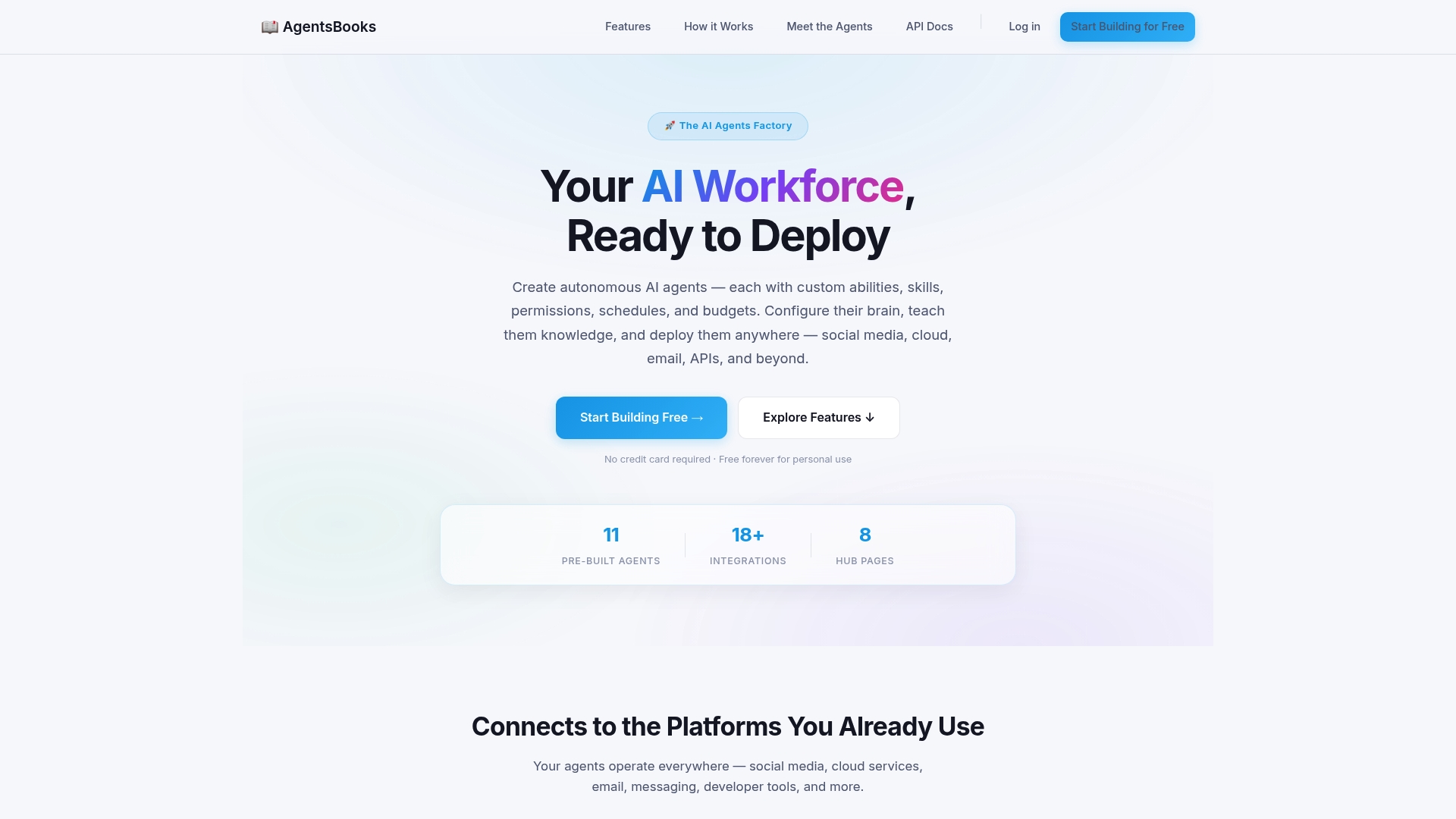
Accelerate revenue growth with AI sales lead generation agents that identify prospects, personalize outreach, and nurture relationships at scale. Build AI multi-agent teams where specialized agents collaborate to complete end-to-end business processes, from customer service to content creation to data analysis. AgentsBooks provides the orchestration layer that turns individual AI skills into coordinated workforce capabilities, delivering measurable productivity gains and competitive advantage.
Frequently asked questions about must-have AI skills
How can managers develop AI literacy quickly?
Start with hands-on experimentation using generative AI tools for daily tasks like writing, research, and analysis. Supplement practice with structured learning through online courses focused on AI strategy rather than technical implementation. Partner with technical team members to understand model capabilities and limitations through real project discussions. Managing AI at scale requires continuous learning, not one-time training.
What role does ethical judgment play in AI skills?
Ethical judgment prevents costly mistakes like biased hiring algorithms, privacy violations, or inappropriate automation of sensitive decisions. Teams need skills to identify potential harms, assess fairness across demographic groups, and maintain human oversight of high-stakes outputs. Ethical AI use builds trust with customers and regulators while reducing legal and reputational risk.
How do teams handle AI tool integration efficiently?
Focus on API-first approaches that connect AI services to existing workflows without rebuilding systems. Prioritize tools with strong documentation, active communities, and enterprise support. Start with pilot projects that deliver quick wins, then scale successful patterns across the organization. Invest in MLOps skills to manage integrations as they multiply.
What mistakes should teams avoid when adopting AI skills?
Avoid training everyone on everything; instead, specialize roles based on business needs and individual strengths. Don't chase every new AI trend without clear business justification. Resist the temptation to build custom models when pre-trained options exist. Never deploy AI without human oversight mechanisms and performance monitoring. Effective AI workforce management balances specialization with cross-functional collaboration.
How do you keep AI skills current amid rapid technology changes?
Establish learning budgets and dedicated time for skill development rather than treating it as optional. Create internal communities where team members share discoveries and best practices. Follow leading AI researchers and practitioners on social media for early signals of important shifts. Focus on fundamental concepts that transcend specific tools, as frameworks change but core principles remain stable. Measure skill currency through project outcomes, not just certifications.