
By 2026, over 60% of cloud operations run on AI automation, up from less than 30% in 2023. Cloud AI management transforms how businesses deploy autonomous AI agents across multi-cloud environments, making complex workflows scalable, secure, and cost-effective. This guide helps business leaders and developers understand how to leverage these platforms for intelligent operations.
Table of Contents
- Understanding Autonomous AI Agents In Cloud Management
- The Rise Of Cloud AI Management Platforms
- Security And Governance In Cloud AI Management
- Cost Optimization And Workflow Automation With Cloud AI Management
- Comparison Of Leading Cloud AI Management Platforms
- Common Misconceptions In Cloud AI Management
- Implementing Cloud AI Management Solutions
- Explore AI Agent Solutions With AgentsBooks
- Frequently Asked Questions
Key takeaways
| Point | Details |
|---|---|
| Autonomous deployment | Cloud AI management enables deploying autonomous AI agents across multiple cloud platforms with security and scalability. |
| Workflow automation | AI agents automate complex workflows and reduce manual intervention, improving operational efficiency. |
| Platform diversity | Leading platforms like Google Cloud Vertex AI, AWS SageMaker, and Azure AI offer diverse tools for AI agent lifecycle management. |
| Governance priority | Effective governance and cost optimization are critical to successful cloud AI management. |
| Common pitfalls | Misconceptions about AI autonomy and platform parity can hinder deployment success. |
Understanding autonomous AI agents in cloud management
AI agents combine advanced large language model intelligence with tool access to autonomously complete multi-step tasks under human guidance, transforming business workflows beyond traditional chatbots. These agents function as intelligent workers within cloud environments, processing requests, analyzing data, and executing complex operations without constant manual oversight.
Autonomous AI agents automate multi-step workflows across cloud platforms with minimal human input. They handle everything from customer service interactions to infrastructure management tasks. Enterprise implementations show reducing manual query times by up to 95%, saving 40 minutes per interaction.
The real power emerges when multiple agents coordinate. AI multi-agent teams enable comprehensive business process automation where specialized agents collaborate on complex initiatives. One agent might handle data gathering while another performs analysis and a third generates reports.
Key capabilities include:
- Natural language understanding for processing unstructured requests
- Tool integration enabling API calls, database queries, and system actions
- Context retention maintaining conversation history across sessions
- Learning adaptation improving responses based on interactions
- Multi-platform operation executing tasks across cloud services
Pro Tip: Start with single-agent workflows before scaling to multi-agent systems. This allows you to refine governance models and understand agent behavior patterns before adding coordination complexity.
The rise of cloud AI management platforms
Cloud AI management platforms act as intelligent control planes, unifying traditionally siloed cloud infrastructure, optimizing costs, and automating remediation with minimal human intervention. These platforms represent a fundamental shift from reactive manual operations to predictive autonomous management.
The transformation is dramatic. By 2026, over 60% of cloud operations will be driven by AI automation, up from less than 30% in 2023. This shift reflects growing recognition that human operators cannot match the scale and speed required for modern cloud environments.
Cloud AI management platforms deliver multiple benefits:
- Cost optimization through intelligent resource allocation
- Increased operational efficiency via automated remediation
- Unified hybrid cloud control across multiple providers
- Predictive analytics preventing issues before they impact operations
- Governance integration ensuring compliance and security
These platforms transform how organizations approach cloud operations. Instead of managing individual resources, teams focus on defining policies and outcomes while AI handles execution. The AgentsBooks platform exemplifies this approach, enabling businesses to create and deploy autonomous agents without deep technical expertise.
Cloud AI management isn't just about automation. It's about creating intelligent systems that understand business context, learn from operations, and continuously improve decision-making without human bottlenecks.
Emerging capabilities include self-healing infrastructure, automated capacity planning, and intelligent workload placement across hybrid environments. These features reduce operational overhead while improving reliability and performance.
Security and governance in cloud AI management
Effective cloud AI management requires integration of strong governance frameworks, data access controls, and permission models to securely deploy autonomous AI agents at scale. Without proper governance, autonomous agents can become security liabilities rather than business assets.
Governance frameworks ensure secure AI agent deployment and operational auditability. They define who can create agents, what data agents can access, and what actions agents can perform. This becomes critical when agents operate across multiple cloud platforms with varying security models.
Data access controls and permission management form the foundation. Every agent needs precisely defined permissions matching its role. An agent analyzing sales data shouldn't access HR records. An agent deploying infrastructure changes needs restricted write access, not full administrative privileges.
Key risks include:
- Data breaches from overprivileged agents accessing sensitive information
- Unauthorized actions when agents exceed intended scope
- AI hallucinations leading to incorrect decisions or outputs
- Compliance violations from inadequate audit trails
- Shadow AI deployments bypassing governance controls
Best practices require human-in-the-loop oversight and continuous monitoring. Critical decisions should require human approval. Audit logs must track every agent action for compliance review. Anomaly detection systems should flag unusual agent behavior patterns.
Pro Tip: Implement role-based access control (RBAC) for AI agents just like human users. Create agent roles with minimal necessary permissions and review access quarterly. This limits blast radius if an agent is compromised or malfunctions.
Managing AI at scale governance requires balancing autonomy with control. Too much restriction limits agent effectiveness. Too little oversight creates risk. The goal is enabling agents to operate efficiently while maintaining security boundaries.
Cost optimization and workflow automation with cloud AI management
AI-driven cloud cost optimization can reduce compute costs by around 33% while improving performance reliability and reducing performance incidents up to 45%. These savings come from intelligent resource management that human operators struggle to match.
AI algorithms analyze cloud resource usage patterns to identify and reduce unnecessary costs. They detect idle resources, right-size over-provisioned instances, and recommend reserved capacity purchases. This continuous optimization operates 24/7, finding savings opportunities humans would miss.

Automation of cloud operations improves performance reliability and reduces incidents. AI agents monitor system health, predict failures before they occur, and automatically remediate issues. This proactive approach prevents downtime rather than just reacting to problems.
Impact on business bottom line:
- Direct cost savings through optimized resource consumption
- Reduced incident costs from fewer outages and faster resolution
- Improved productivity as teams focus on strategy instead of operations
- Better capacity planning preventing over-provisioning waste
- Enhanced performance consistency driving customer satisfaction
Use cases span infrastructure management. AI-powered remediation automatically restarts failed services, scales resources during demand spikes, and rebalances workloads across availability zones. Predictive scaling provisions capacity before traffic increases, eliminating performance degradation.
Cost Reduction: 33% Cloud AI management platforms deliver average compute cost reductions of 33% while simultaneously improving reliability by 45%, demonstrating that optimization and performance are complementary rather than competing goals.
The key is moving from reactive to predictive operations. Traditional monitoring alerts humans to problems. AI management predicts and prevents problems before they impact users. This shift fundamentally changes cloud economics and operational efficiency.
Comparison of leading cloud AI management platforms
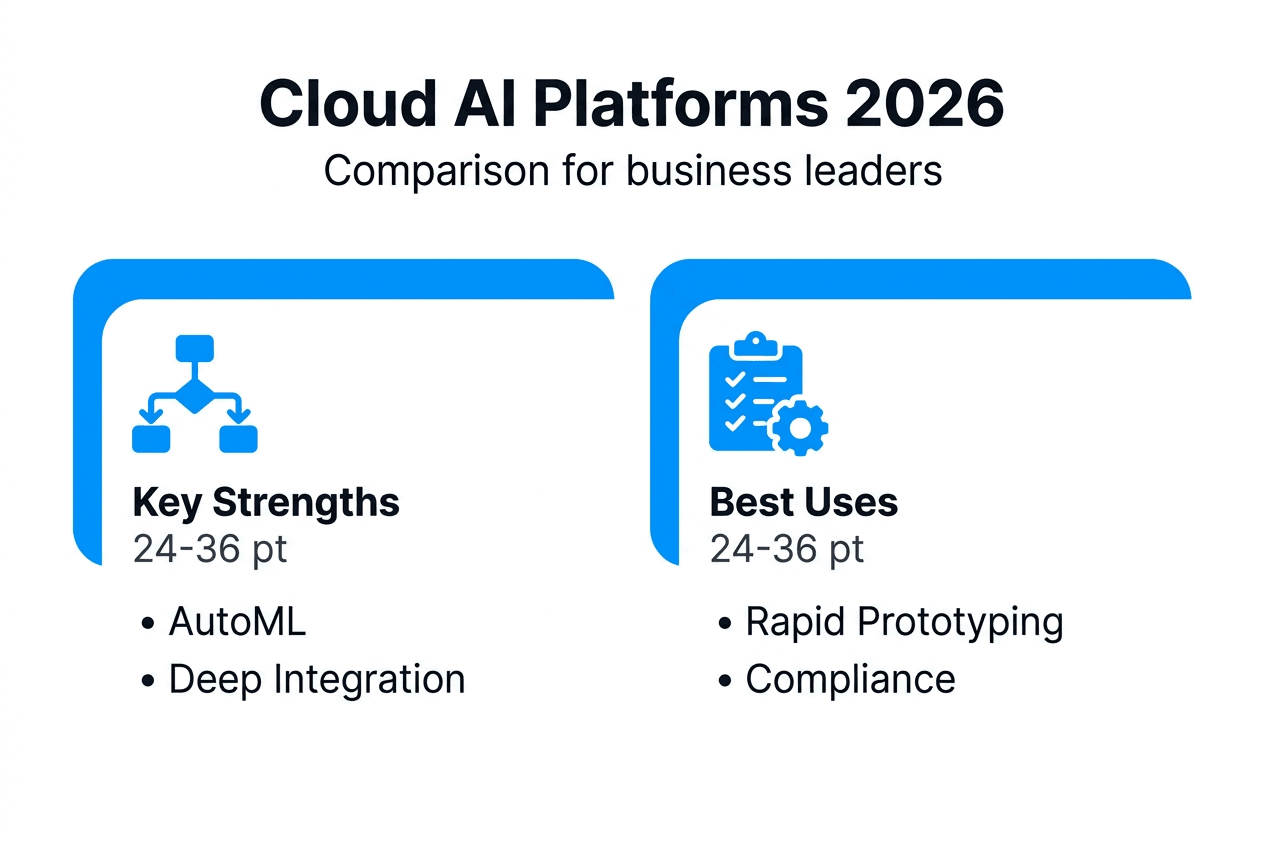
Leading cloud AI platforms for agent deployment in 2026 include Google Cloud Vertex AI, AWS SageMaker, Microsoft Azure AI, IBM Watsonx, and Oracle Cloud AI, each offering distinct features supporting model training, deployment, scalability, and governance. Selecting the right platform depends on your specific requirements and existing infrastructure.
| Platform | Key Strengths | Best For | Governance Features |
|---|---|---|---|
| Google Cloud Vertex AI | Integrated MLOps pipeline, AutoML capabilities, multi-model support | Rapid prototyping and experimentation | Enterprise-grade security, model versioning, audit logging |
| AWS SageMaker | Comprehensive tooling, extensive integrations, cost optimization | Large-scale production deployments | IAM integration, compliance certifications, data encryption |
| Microsoft Azure AI | Enterprise integration, hybrid cloud support, responsible AI tools | Organizations using Microsoft ecosystem | Built-in compliance, explainable AI, content filtering |
| IBM Watsonx | Industry-specific models, governance focus, regulatory compliance | Regulated industries like finance and healthcare | Advanced governance, bias detection, audit trails |
| Oracle Cloud AI | Cost-effective pricing, database integration, autonomous operations | Data-intensive applications | Database-level security, autonomous patching, encryption |
Each platform specializes differently. Google Cloud Vertex AI excels at rapid prototyping with AutoML features that accelerate model development. AWS SageMaker provides the most comprehensive tooling for production-scale deployments across diverse use cases.
Microsoft Azure AI integrates deeply with enterprise Microsoft services, making it ideal for organizations already invested in that ecosystem. IBM Watsonx stands out for regulated industries requiring robust governance and compliance features. Oracle Cloud AI offers strong database integration for data-heavy applications.
Governance and security capabilities vary significantly. All platforms provide encryption and access controls, but depth differs. IBM Watsonx and Azure AI lead in responsible AI features like bias detection and explainability. This matters when deploying agents making business-critical decisions.
The AgentsBooks AI platform overview demonstrates an alternative approach focused on ease of use and rapid deployment. Rather than requiring deep technical expertise, it enables business users to create and deploy agents through descriptive profiles and simple configuration.
Integration with enterprise data ecosystems is crucial. Platforms offering native connectors to existing databases, data warehouses, and business applications reduce implementation complexity. AI lifecycle management tools for monitoring, versioning, and updating deployed agents ensure long-term operational success.
Common misconceptions in cloud AI management
Common misconceptions include beliefs that AI agents do not require human oversight, that all AI cloud platforms offer equal capabilities, and that large monolithic models are always best for enterprise AI agent management. These false beliefs lead to deployment failures, security gaps, and inefficient implementations.
AI agents still require human oversight to avoid errors and security issues. While they operate autonomously for routine tasks, critical decisions need human approval. Agents can hallucinate incorrect information or misinterpret instructions. Without oversight, these errors propagate through systems causing operational problems.
Cloud AI platforms vary widely in capabilities and specialization. No one-size-fits-all solution exists. Some excel at model training, others at deployment and monitoring. Governance features, pricing models, and integration options differ dramatically. Choosing based on vendor reputation alone leads to mismatches between platform capabilities and business needs.
Larger AI models are not always better for enterprise tasks. Specialized smaller models often outperform large general-purpose models in specific domains. They run faster, cost less, and produce more accurate results for targeted use cases. A 7-billion parameter model fine-tuned for your industry can outperform a 175-billion parameter general model.
Other misconceptions to avoid:
- AI agents can operate without governance frameworks and security controls
- All platforms provide equal data privacy and compliance features
- Agent deployment is a one-time setup rather than continuous management
- Cost optimization happens automatically without configuration and monitoring
- Multi-cloud agent deployment is identical to single-cloud deployment
Ignoring these realities leads to deployment risks, inefficiencies, and compliance gaps. Organizations rushing into AI agent deployment without proper planning face security incidents, cost overruns, and failed implementations. The key is approaching cloud AI management with clear understanding of both capabilities and limitations.
Implementing cloud AI management solutions
Successful implementation requires systematic workflows combining agent creation, configuration, testing, and deployment with ongoing governance. Following structured steps ensures agents operate securely and deliver intended business value.
-
Agent creation with descriptive profiling: Define agent purpose, skills, permissions, and behavioral parameters. Specify what tasks the agent performs, what data it accesses, and what actions it can take. Clear profiling prevents scope creep and security issues.
-
Configuration and knowledge ingestion: Tailor agents to business data and workflows. Ingest relevant knowledge bases, connect to necessary APIs, and configure integration points with existing systems. This contextual grounding ensures agents understand your specific business environment.
-
Testing and validation: Ensure compliance, security, and correct agent behavior before production deployment. Run test scenarios covering expected use cases and edge cases. Validate permission boundaries and verify audit logging works correctly.
-
Deployment across multi-cloud platforms: Roll out agents with continuous monitoring and policy enforcement. Start with limited scope and gradually expand as confidence grows. Implement alerting for anomalous behavior and maintain human oversight for critical operations.
-
Ongoing governance and optimization: Review agent performance regularly, update knowledge bases, and refine permissions based on actual usage patterns. Retire underperforming agents and scale successful ones.
Pro Tip: Create a center of excellence for AI agent management. Designate a cross-functional team responsible for governance standards, best practices, and agent lifecycle management. This prevents fragmented deployments and ensures consistent security controls.
Best practices integrate AI agents with existing enterprise systems rather than creating isolated islands. AI domain expert operators demonstrate this integration, connecting agents to business workflows where they add value. AI content social media agent examples show multi-platform coordination.
For specialized applications, consider domain-specific agents like AI clone yourself agent for personal productivity or AI DevOps engineering agent for infrastructure automation. Each requires tailored configuration matching its operational context.
External integrations expand agent capabilities. Connecting to services like AI trading strategy optimization enables specialized financial workflows. The key is maintaining security boundaries while allowing necessary data access.
Explore AI agent solutions with AgentsBooks
AgentsBooks offers a comprehensive platform to create, customize, and deploy autonomous AI agents across multiple digital and cloud environments. The platform simplifies AI management for business leaders and developers who need scalable solutions without extensive technical overhead.
Use cases span business functions. AI domain expert operators provide specialized knowledge access across teams. AI sales lead generation agent implementations automate prospect identification and outreach. Multi-agent teams coordinate complex workflows that previously required manual orchestration.
The platform emphasizes ease of use through a three-step process: creation via descriptive profiles, configuration with business knowledge, and deployment across platforms. This approach accelerates time to value while maintaining governance controls. Visit AgentsBooks AI agents factory to explore how autonomous agents can transform your operations.
Frequently asked questions
What is the difference between autonomous AI agents and traditional AI tools?
Autonomous AI agents can independently execute multi-step workflows with human oversight, while traditional AI tools perform specific, limited tasks. Agents interact across platforms and continuously adapt their behavior based on context. Traditional tools require explicit programming for each action and lack the intelligence to navigate complex multi-step processes.
Which cloud AI management platform is best for regulated industries?
IBM Watsonx is designed with robust governance and compliance features tailored for regulated sectors, ensuring responsible AI use. It provides advanced audit trails, bias detection, and industry-specific compliance certifications. Other platforms offer varying governance levels, so assess tools carefully against your specific regulatory requirements before selection.
How do I ensure security when deploying AI agents across multi-cloud environments?
Implement strong governance frameworks with data access controls, permission models, and continuous monitoring across all cloud platforms. Maintain human oversight with comprehensive audit trails to detect unusual AI behavior and prevent unauthorized operations. Use role-based access control limiting each agent to minimum necessary permissions for its intended function.