
Most businesses believe that deploying more AI agents automatically scales automation effectively. In reality, unmanaged AI scaling creates fragmented workflows, inconsistent outcomes, and costly inefficiencies that undermine business objectives. This article explains why strategic AI management at scale is essential for achieving sustainable automation success, improved customer engagement, and regulatory compliance.
Table of Contents
- Introduction To AI Management At Scale
- Why Managing AI At Scale Is Critical
- How Scalable AI Management Enhances Workflow Efficiency
- Benefits For Customer Engagement And Security Compliance
- Common Misconceptions About AI Management At Scale
- Conceptual Frameworks For AI Management
- Real-World Case Studies And Practical Implementation
- Conclusion And Next Steps For Managing AI At Scale
- Discover AgentsBooks: The AI Agents Factory
Key takeaways
| Point | Details |
|---|---|
| Operational efficiency | Coordinated AI orchestration reduces workflow inefficiencies by up to 40% and eliminates costly redundancies. |
| Customer engagement | Centralized AI governance ensures consistent messaging and tailored responses that improve satisfaction scores. |
| Compliance and security | Structured permission frameworks minimize regulatory risks and ensure data privacy adherence across GDPR and CCPA. |
| Scalability frameworks | Agent profiling, behavioral configuration, and collaborative networking create sustainable multi-agent systems. |
| Implementation strategy | Define clear roles, establish centralized governance, and deploy automated triggers for optimal performance. |
Introduction to AI management at scale
Managing AI at scale means coordinating multiple autonomous agents across interconnected systems while maintaining performance standards and regulatory compliance. As organizations adopt AI to handle customer inquiries, automate workflows, and streamline operations, the complexity of managing these digital workforces grows exponentially. Without proper oversight, businesses face fragmented systems where agents duplicate efforts, produce contradictory outputs, or fail to meet compliance requirements.
Several challenges emerge when scaling AI without strategic management. Fragmented systems cause agents to work in isolation, creating information silos that reduce overall effectiveness. Inconsistent results damage customer trust when different agents provide conflicting information. Resource drain occurs as teams spend excessive time troubleshooting agent conflicts and correcting errors instead of focusing on strategic initiatives.
Market trends drive the urgent need for scalable AI solutions. Digital transformation initiatives push companies to automate more processes across departments. Customer expectations for instant, personalized service require sophisticated AI coordination. Regulatory scrutiny increases as data privacy laws evolve, demanding transparent governance frameworks. Business leaders and developers must address these complexities to extract maximum value from AI investments.
Key operational challenges include:
- Agent overlap where multiple AI entities attempt identical tasks simultaneously
- Knowledge fragmentation preventing agents from accessing shared organizational intelligence
- Permission conflicts creating security vulnerabilities in multi-platform deployments
- Performance degradation as uncoordinated agents consume excessive computational resources
Understanding these foundational concepts prepares organizations to implement AI agents management best practices that transform scattered automation efforts into cohesive digital workforces. The following sections explore specific reasons why management becomes indispensable as AI deployments grow.
Why managing AI at scale is critical
Unmanaged AI scaling creates operational chaos that negates automation benefits. When organizations deploy agents without coordination frameworks, workflows become inefficient as multiple agents duplicate tasks or miss critical handoffs. Scaling AI deployments without proper management increases operational inefficiencies by up to 40%, according to research analyzing enterprise AI adoption patterns. These inefficiencies translate directly into higher operational costs and slower response times.
Inconsistent AI behavior severely damages customer experience and erodes brand trust. Imagine a customer receiving conflicting product recommendations from different chatbots or experiencing varied service quality across channels. These inconsistencies signal poor organizational coordination and undermine confidence in your brand. Without centralized governance, each agent operates according to isolated training data and configuration settings, creating unpredictable customer interactions.
Regulatory compliance risks multiply exponentially in unmanaged multi-agent environments. Data privacy regulations like GDPR and CCPA require transparent data handling practices, audit trails, and user consent mechanisms. When agents operate independently without unified governance, tracking data flows becomes impossible. Organizations face substantial fines and legal exposure when they cannot demonstrate compliance across their AI ecosystem.
Resource allocation challenges escalate as agent populations grow. Computational resources get wasted when agents compete for processing power without coordination. Development teams spend excessive time troubleshooting conflicts instead of building new capabilities. Maintenance becomes unsustainable as each agent requires individual monitoring and updates.
Critical risks of unmanaged AI scaling:
- Financial losses from duplicated efforts and resource waste
- Customer churn due to inconsistent service experiences
- Security breaches from uncontrolled data access permissions
- Competitive disadvantage as agile competitors deploy coordinated AI faster
Effective AI agent orchestration and governance addresses these risks systematically. Centralized management reduces operational inefficiencies, ensures consistent customer experiences, maintains compliance standards, and optimizes resource utilization. Organizations that implement robust AI management frameworks position themselves for sustainable long-term success rather than short-term tactical wins that create technical debt.
Pro Tip: Establish governance frameworks before scaling agent deployments to avoid costly retroactive fixes and compliance violations.
How scalable AI management enhances workflow efficiency
Coordinated AI agent orchestration transforms chaotic automation into streamlined operations that deliver measurable business value. Role-specific agent profiling prevents task overlap by assigning clear responsibilities to each agent based on specialized capabilities. A customer service agent handles inquiries while a scheduling agent manages appointments, eliminating confusion about task ownership. This clarity reduces processing time and improves accuracy across workflows.

Triggers, schedules, and automated workflows create seamless task execution without manual intervention. Configure agents to respond automatically when specific conditions occur, such as initiating follow-up sequences after customer purchases or escalating complex issues to human specialists. Schedule routine tasks like report generation or data synchronization to run during off-peak hours, optimizing resource utilization and maintaining consistent operations.
Collaborative agent networking dramatically increases task completion rates by enabling agents to share information and coordinate efforts. When one agent encounters a task beyond its capabilities, it can seamlessly hand off to a specialized colleague rather than failing or providing inadequate responses. This inter-agent communication creates a cohesive digital workforce that handles complex multi-step processes efficiently.
Measured improvements from proper AI management include:
- Response time reductions of 60-70% through parallel agent processing
- Cost savings of 30-45% by eliminating redundant operations
- Error rate decreases of 50% due to consistent behavioral configurations
- Customer satisfaction increases of 25-35% from reliable service delivery
These quantitative benefits stem from systematic automation with multiple AI agents rather than ad-hoc deployments. Organizations achieve peak efficiency when agents operate according to defined protocols that specify communication patterns, escalation procedures, and performance standards.
Pro Tip: Regularly monitor agent performance metrics and adjust configurations to maintain peak efficiency as business requirements evolve.
Workflow optimization requires continuous refinement based on operational data. Track key performance indicators like task completion time, error rates, and customer satisfaction scores. Use these metrics to identify bottlenecks, refine agent responsibilities, and optimize collaboration patterns. This data-driven approach ensures AI management strategies remain aligned with business objectives and adapt to changing market conditions.
Benefits for customer engagement and security compliance
Dynamic AI agents tailored to customer needs create personalized interactions that significantly increase engagement scores. When agents access unified customer data and maintain conversation context across channels, they deliver relevant recommendations and anticipate needs proactively. This personalization transforms generic automated responses into meaningful conversations that build loyalty and drive conversions.
Centralized permission and governance frameworks ensure data privacy compliance across GDPR, CCPA, and industry-specific regulations. Configure access controls that specify exactly which customer data each agent can access and how long it can be retained. Implement consent management systems that respect user preferences and provide transparent data handling practices. These controls protect both customer privacy and organizational liability.
Security risks diminish through controlled access and comprehensive lifecycle management. Define agent permissions based on principle of least privilege, granting only necessary access to complete assigned tasks. Implement authentication mechanisms that verify agent identity before allowing system access. Monitor agent behavior for anomalies that might indicate security breaches or unauthorized activities.
Key security and compliance benefits:
- Audit trails documenting every AI decision and data access event
- Automated compliance reporting reducing manual documentation burden
- Encryption standards protecting data in transit and at rest
- Version control enabling rapid rollback when agents malfunction
AI governance fosters consistent and reliable customer experiences by ensuring agents adhere to brand guidelines and communication standards. Define behavioral configurations that specify tone, language complexity, and response patterns appropriate for your audience. Maintain knowledge bases that provide accurate, up-to-date information across all agents. This consistency builds customer confidence and strengthens brand reputation.
Pro Tip: Implement audit logging for AI decisions to facilitate compliance monitoring and provide evidence during regulatory inquiries.
AI governance for compliance and security becomes increasingly critical as regulatory scrutiny intensifies. Organizations that proactively implement robust governance frameworks avoid costly violations and demonstrate commitment to ethical AI practices. This proactive approach differentiates responsible businesses from competitors who treat compliance as an afterthought.
Common misconceptions about AI management at scale
Many organizations believe deploying more AI agents automatically solves scaling challenges. This myth ignores the coordination complexity that emerges as agent populations grow. Without governance frameworks, additional agents create more conflicts, duplicate efforts, and consume resources inefficiently. Quality deteriorates as the system becomes increasingly chaotic and unpredictable.
Another pervasive misconception suggests more agents guarantee better customer satisfaction. Reality proves coordination matters more than quantity. Three well-orchestrated agents delivering consistent, accurate responses outperform ten unmanaged agents providing conflicting information. Customer satisfaction depends on reliability, accuracy, and personalization rather than response speed alone.
Some leaders fear governance frameworks slow innovation by adding bureaucratic overhead. This belief misunderstands governance as restrictive rather than enabling. Properly designed governance accelerates sustainable growth by providing clear guidelines that speed decision-making and reduce rework. Teams innovate faster when they understand boundaries and can build upon stable foundations rather than constantly fixing coordination issues.
Common myths debunked:
- Myth: AI agents self-coordinate effectively without intervention
- Reality: Agents require explicit communication protocols and task definitions
- Myth: More sophisticated models eliminate need for management
- Reality: Advanced models amplify coordination challenges without governance
- Myth: Small deployments don't require formal management
- Reality: Establishing governance early prevents costly technical debt
The necessity of centralized orchestration becomes apparent when examining failed scaling attempts. Organizations that skip governance foundations experience exponentially increasing maintenance costs as agent populations grow. They struggle to implement compliance requirements retroactively and face customer satisfaction declines from inconsistent experiences.
Debunking AI management myths helps business leaders make informed decisions about AI investments. Understanding that coordination matters more than quantity, governance enables innovation, and proactive management prevents problems guides strategic planning. These insights shift focus from tactical agent deployment to building sustainable AI workforces that deliver long-term value.
Conceptual frameworks for AI management
Effective AI management rests on four interconnected components that work together to create scalable, reliable systems. Agent profiling defines each agent's capabilities, knowledge domains, and operational boundaries. This profiling ensures agents understand their roles and avoid stepping into territories where they lack expertise. Clear profiles enable efficient task routing and prevent conflicts.
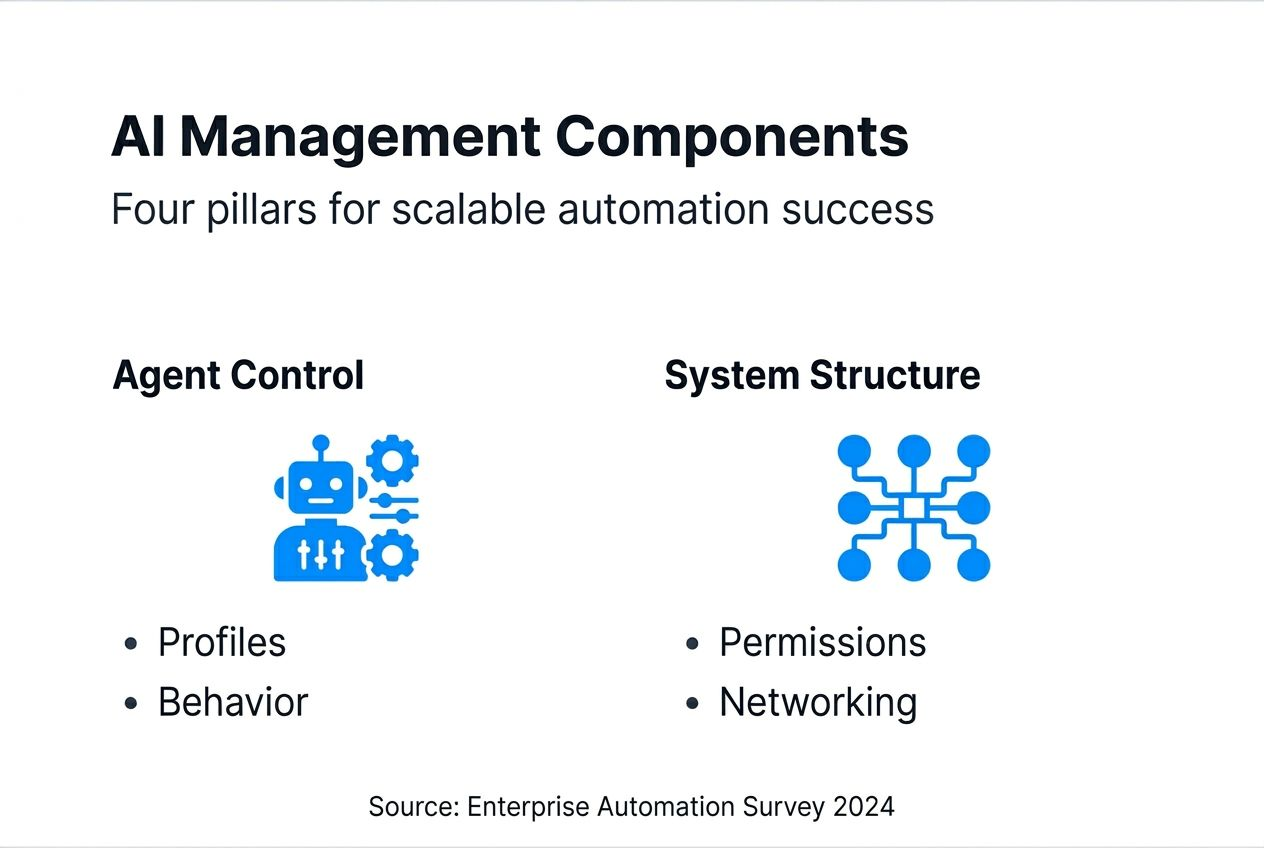
Behavioral configuration specifies how agents interact with users and other systems. Configure response tone, communication style, escalation triggers, and decision-making parameters. These configurations ensure brand consistency and appropriate responses across diverse scenarios. Behavioral standards transform generic AI into branded digital employees that reflect organizational values.
Permission and lifecycle management controls what agents can access and when they should be deactivated. Implement granular access controls based on task requirements and data sensitivity. Define lifecycle policies that specify when agents should be updated, retrained, or retired. This management prevents security vulnerabilities and ensures agents remain effective as business needs evolve.
Collaborative networking layers enable agents to share information, coordinate tasks, and escalate complex issues. Define communication protocols that specify how agents exchange data, request assistance, and hand off tasks. Implement coordination mechanisms that prevent duplicate efforts and ensure comprehensive coverage of customer needs.
| Management Approach | Agent Coordination | Compliance Tracking | Resource Efficiency | Maintenance Burden |
|---|---|---|---|---|
| Manual Management | Poor, frequent conflicts | Difficult, error-prone | Low, significant waste | High, unsustainable |
| Centralized Orchestration | Excellent, seamless collaboration | Automated, comprehensive | High, optimized allocation | Low, systematic updates |
These architectural layers interact to create robust AI ecosystems. Agent profiles inform permission settings, ensuring access aligns with responsibilities. Behavioral configurations reference collaborative protocols, enabling coordinated multi-agent workflows. Lifecycle policies trigger updates to profiles and behaviors as business requirements change. This interconnection creates adaptive systems that evolve with organizational needs.
Key architectural principles:
- Modularity enabling independent agent updates without system-wide disruptions
- Scalability supporting growth from dozens to thousands of agents
- Observability providing visibility into agent performance and interactions
- Resilience ensuring system stability when individual agents fail
Understanding AI management architecture helps technical teams design implementations that balance flexibility with control. These frameworks provide mental models for planning deployments, anticipating challenges, and building systems that deliver sustained business value.
Real-world case studies and practical implementation
A major North American retailer transformed customer support operations by implementing centralized AI orchestration across 50+ specialized agents. Before implementation, response times averaged 12 minutes with 35% of inquiries requiring human escalation due to agent confusion. Manual coordination consumed 40 staff hours weekly resolving conflicts and correcting errors.
The company took systematic steps to achieve transformation. First, they defined clear agent roles based on inquiry types such as product information, order tracking, returns processing, and technical support. Each agent received specialized training data and explicit boundaries preventing overlap. Second, they established centralized governance with unified customer data access, consistent behavioral standards, and automated compliance monitoring. Third, they implemented continuous performance tracking with dashboards showing response times, resolution rates, and customer satisfaction scores.
Results exceeded expectations across multiple metrics. Average response time dropped to 3 minutes while escalation rates fell to 12%. Customer satisfaction scores increased 28% based on post-interaction surveys. The coordination effort decreased to 8 staff hours weekly as automated orchestration eliminated most conflicts. These improvements generated annual savings exceeding $2.3 million while simultaneously improving customer experience.
Lessons learned for efficient multi-agent scaling:
- Start with thorough capability mapping before agent deployment
- Invest in robust monitoring infrastructure from day one
- Establish feedback loops connecting customer satisfaction to agent configurations
- Plan for iterative refinement rather than perfect initial deployment
- Prioritize inter-agent communication protocols early in architecture design
Another financial services company improved compliance documentation by 90% through automated audit logging across their AI workforce. Previously, manual compliance tracking required 15 staff members working full-time. Centralized governance automated most documentation while providing real-time compliance dashboards that simplified regulatory reporting.
These successful AI orchestration examples demonstrate concrete benefits available to organizations willing to invest in proper management infrastructure. The key insight across implementations is that upfront governance investment pays dividends through reduced operational costs, improved customer experiences, and simplified compliance management.
Conclusion and next steps for managing AI at scale
Effective AI management represents a strategic imperative rather than a technical nicety for organizations scaling automation initiatives. The evidence clearly demonstrates that unmanaged AI deployments create operational inefficiencies, compliance risks, and customer experience problems that undermine business objectives. Conversely, centralized orchestration with robust governance frameworks delivers measurable improvements in workflow efficiency, customer engagement, and regulatory adherence.
Strategic gains from proper AI management extend beyond immediate operational metrics. Organizations build competitive advantages through faster innovation cycles enabled by stable foundations. They reduce technical debt by implementing governance early rather than retrofitting coordination mechanisms. They attract and retain customers through consistent, personalized experiences that build trust and loyalty.
Business leaders should evaluate current AI deployments against the frameworks discussed in this article. Assess whether existing agents operate with clear role definitions, consistent behavioral standards, appropriate access controls, and effective collaboration mechanisms. Identify gaps that create risks or limit performance. Develop implementation roadmaps that prioritize governance foundations before expanding agent populations.
Call to action for sustainable AI scaling: Begin by documenting current agent capabilities and identifying coordination gaps. Establish governance committees with representation from operations, compliance, and technical teams. Pilot centralized orchestration with small agent groups before enterprise-wide rollout. Commit to continuous learning as AI management practices evolve alongside technology capabilities.
Discover AgentsBooks: the AI agents factory
AgentsBooks provides the premier platform for organizations ready to transform scattered AI efforts into coordinated digital workforces. Our comprehensive solution enables centralized governance, workflow automation, and compliance management across unlimited agent deployments. Create agents with specialized skills, configure behavioral standards, and deploy across social media, email, APIs, and messaging platforms through intuitive interfaces requiring minimal technical expertise.
The AgentsBooks platform simplifies complex orchestration through automated triggers, scheduled tasks, and collaborative agent networking. Developer-friendly APIs, SDKs, and extensive documentation support programmatic management for technical teams while visual interfaces empower business users. Join leading organizations leveraging scalable AI agent orchestration to achieve automation success, improve customer engagement, and maintain regulatory compliance as they grow.
FAQ
What challenges arise when scaling AI without management?
Unmanaged AI scaling creates fragmented workflows where agents duplicate efforts or miss critical handoffs between tasks. Inconsistent performance emerges as agents operate with different configurations and knowledge bases. Compliance risks multiply when organizations cannot track data flows or demonstrate governance across their AI ecosystem. These challenges translate into higher operational costs and customer dissatisfaction.
How does centralized AI management improve customer engagement?
Centralized management ensures consistent messaging across all customer touchpoints by maintaining unified behavioral standards and knowledge bases. Orchestrated agent collaboration enables personalized responses that consider complete customer context rather than isolated interactions. This consistency reduces contradictions that erode trust while personalization increases relevance and satisfaction. Engagement scores improve as customers receive reliable, accurate assistance regardless of channel.
What are the essential components of a scalable AI management framework?
Agent profiling establishes clear roles, capabilities, and boundaries for each digital worker. Behavioral configurations define communication standards, decision-making parameters, and brand alignment. Permission and lifecycle controls manage data access, security protocols, and agent retirement policies. Collaborative networking layers enable information sharing and task coordination across the agent ecosystem. Together these components create efficient, secure, and compliant AI systems.
Which steps should businesses take first to implement AI management at scale?
Start by defining clear agent roles based on business processes and customer needs rather than technical capabilities. Establish centralized governance frameworks specifying behavioral standards, access controls, and compliance requirements. Deploy automated triggers and schedules that enable seamless task execution without manual intervention. Implement comprehensive monitoring dashboards tracking performance metrics and continuously optimize configurations based on operational data.