
Most AI workflows focus on individual users but deliver minimal team value. That's the paradox costing businesses real productivity gains. Collaborative AI harnesses multiple agents and human teamwork to unlock broader business advantages. This guide explores how collaborative AI transforms workflows, improves decision systems, and drives measurable outcomes for modern businesses.
Table of Contents
- Understanding Collaborative AI And Its Impact On Business Workflows
- Redesigning Workflows: From Individual Tasks To Collective Decision Systems
- Practical Benefits And Challenges Of Implementing Collaborative AI
- How To Start Applying Collaborative AI In Your Business Workflows
- Explore Collaborative AI Solutions With Agentsbooks
- Frequently Asked Questions
Key takeaways
| Point | Details |
|---|---|
| Collaborative AI amplifies team intelligence | Multiple AI agents working with humans streamline workflows and boost collective productivity beyond individual tools. |
| Work shifts from tasks to decision systems | Success requires redesigning how information flows and choices are made, not just automating existing processes. |
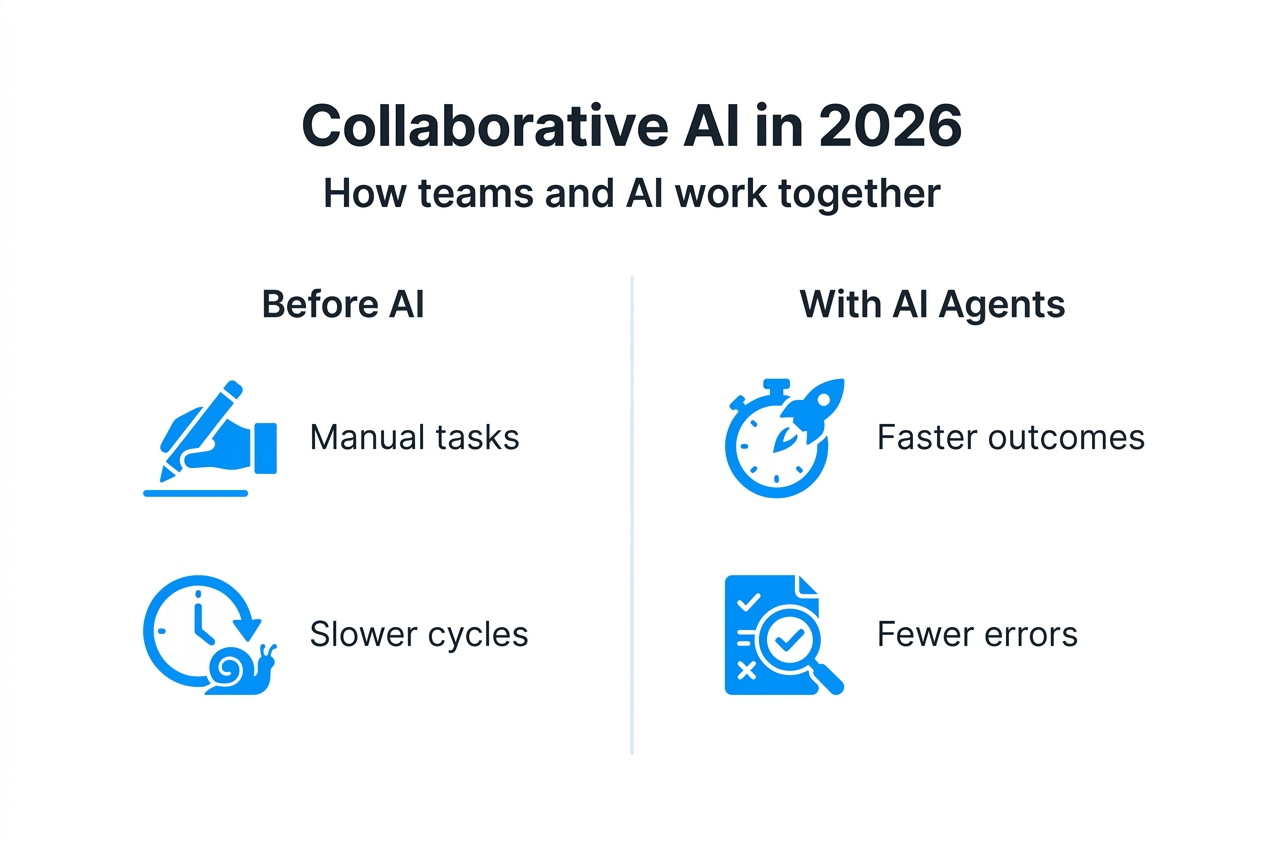
| Benefits include speed and accuracy gains | Faster cycle times, fewer errors, and consistent execution deliver measurable business value. |
| Implementation needs strategic planning | Focus on critical decisions, validate outputs, and maintain human oversight for optimal results. |
| Ethical considerations drive trust | Transparency and fairness in AI integration preserve team cohesion and user confidence. |
Understanding collaborative AI and its impact on business workflows
Collaborative AI involves multiple AI agents working alongside humans to enhance team output and business outcomes. This approach contrasts sharply with individual AI workflows that often fail to create broader organizational impact.
The difference matters more than most realize. When AI clarifies team goals and resolves conflicting motives, it enhances collective reasoning in ways individual tools cannot match. Teams coordinate better, share knowledge more effectively, and mitigate biases that derail decision quality.
Think of collaborative AI as your team's intelligent coordinator. It manages information flow, optimizes collective attention, and helps everyone focus on what truly drives results. Rather than each person using AI in isolation, the entire team benefits from interconnected agents that understand context and priorities.
AI multi agent teams enable this transformation through specialized agents handling different workflow aspects. One agent might gather market data while another analyzes customer feedback and a third synthesizes insights for strategic planning. They work in concert, not competition.
The impact shows up in practical ways:
- Faster information sharing across departments without manual handoffs
- Reduced communication gaps between team members working asynchronously
- Better alignment on goals through AI-facilitated consensus building
- More balanced participation in discussions and decision processes
- Enhanced ability to spot patterns and opportunities collectively
Personalized knowledge sharing becomes possible at scale. Each team member receives relevant information tailored to their role, eliminating information overload while ensuring nothing critical gets missed. The AI learns team dynamics and adapts its collaboration style accordingly.
"Generative AI augments collective intelligence by clarifying shared objectives, resolving conflicting motivations, and supporting more effective collective reasoning processes."
This shift transforms how teams operate. Instead of struggling with coordination overhead, they focus energy on creative problem solving and strategic thinking. The AI handles routine coordination, tracks commitments, and flags potential conflicts before they escalate.
Redesigning workflows: from individual tasks to collective decision systems
The biggest mistake organizations make is layering AI onto unchanged workflows. Real value emerges when work itself gets redesigned around collaborative decision systems.
The unit of work shifts from isolated tasks to complete decision systems. This means examining how information gets gathered, choices get made, actions get taken, and exceptions get handled. Each element needs intentional design for human-AI collaboration.

Pro Tip: Map your three most expensive decisions by time and resources. These are your prime candidates for collaborative AI redesign, not your easiest tasks.
Prioritize decisions that dominate outcomes and costs. A single strategic choice often impacts results more than dozens of routine tasks. When you redesign workflows around these high-leverage decisions, productivity gains multiply.
Consider this transformation pattern:
- Identify decision points where delays, errors, or inconsistency hurt business outcomes most
- Map current information flows and bottlenecks in those decision processes
- Design AI agent roles to gather, synthesize, and present decision-relevant data
- Establish clear human approval gates and exception handling protocols
- Monitor decision quality and cycle time improvements systematically
The work composition changes dramatically. Strategic tasks increase while pure implementation decreases as AI handles more execution work. Real data from organizations implementing collaborative AI shows strategic work rising to 73% of team time while implementation activities drop significantly.
| Work Type | Before Collaborative AI | After Collaborative AI | Change |
|---|---|---|---|
| Strategic planning | 28% | 73% | +45% |
| Implementation | 52% | 18% | -34% |
| Coordination | 20% | 9% | -11% |
This shift creates space for higher-value activities. Your team spends more time on judgment calls, relationship building, and innovation. Less time goes to data gathering, report formatting, and status updates.
Managing AI at scale requires treating it as an operating design challenge. You're not adding intelligence to static processes. You're fundamentally changing how work flows through your organization.
The redesign process reveals hidden inefficiencies. Questions like "Why do we need three approvals for this?" or "Could AI handle exception routing better than our current system?" surface naturally. Many legacy processes exist because manual coordination was difficult, not because they add value.
Successful redesign focuses on decision quality metrics. Track how often AI recommendations get accepted, how quickly decisions move through the system, and whether outcomes improve over time. These indicators matter more than simple automation rates.
Practical benefits and challenges of implementing collaborative AI
The measurable benefits of collaborative AI extend across multiple business dimensions. Organizations report faster cycle times, fewer errors, better experiences, and more consistent execution when collaborative AI gets implemented effectively.
Speed improvements show up first. Decision cycles that previously took days compress to hours as AI agents gather information, identify patterns, and present options. Teams move from reactive to proactive positions because they spot opportunities and risks earlier.
Error reduction follows close behind. Collaborative AI catches inconsistencies humans miss when tired or distracted. It applies rules uniformly, flags anomalies, and ensures nothing falls through workflow cracks. Quality becomes more predictable.
User experience gains matter internally and externally. Employees spend less time on frustrating coordination tasks. Customers get faster, more accurate responses. Everyone benefits from the consistency collaborative AI provides.
Key benefits include:
- Accelerated information processing across distributed teams
- Reduced decision-making delays through automated data synthesis
- Improved accuracy in complex multi-step processes
- Enhanced consistency in policy application and rule enforcement
- Lower operational risk from human oversight gaps
AI workforce management enables these outcomes by coordinating multiple agents toward common objectives. Each agent contributes specialized capabilities while the system ensures coherent results.
Challenges require attention too. Trust and cohesion face pressure when AI enters collaborative dynamics. Team members may question whether AI recommendations favor certain perspectives or whether their contributions still matter.
"Integrating AI into collaboration presents challenges including potential impacts on trust, cohesion, and ethical concerns that must be addressed through transparent design and clear governance."
Ethical considerations prove critical. Transparency about how AI makes recommendations, what data it uses, and where humans retain final authority preserves team confidence. Fairness in how AI distributes work and attention prevents resentment.
Attention management becomes crucial. In asynchronous workflows, AI must route information to the right people at the right time without overwhelming anyone. In synchronous collaboration, AI should enhance discussion without dominating it.
Balancing AI assistance with human oversight delivers optimal results. Full automation risks costly errors when situations exceed AI training. Pure manual processes waste AI capabilities. The sweet spot involves AI handling routine elements while humans focus on judgment and exceptions.
Building trust requires demonstrating AI reliability over time. Start with lower-stakes decisions, show consistent performance, and gradually expand AI authority as confidence grows. Transparency about limitations matters as much as showcasing successes.
How to start applying collaborative AI in your business workflows
Implementing collaborative AI successfully requires methodical planning and execution. Follow these steps to integrate AI agents effectively into your workflows.
- Map decision points that most influence business outcomes and operational costs in your workflows
- Document current information flows, approval chains, and bottlenecks for those critical decisions
- Design AI agent roles with clear responsibilities, data sources, and escalation triggers
- Establish validation protocols where humans review AI outputs before implementation
- Launch pilot projects targeting strategic tasks with measurable success criteria
- Gather performance data and team feedback to refine workflows continuously
Focus on decisions that dominate outcomes and cost rather than trying to automate everything at once. A single well-designed collaborative AI workflow delivers more value than dozens of shallow automations.
Design agents to follow your lead as collaborative partners. They should understand context, adapt to your preferences, and escalate appropriately. Configure AI brains to match your business logic and decision criteria rather than using generic models.
Validation prevents expensive mistakes. Every AI recommendation needs human review initially. As patterns prove reliable, you can reduce oversight selectively. Never eliminate validation entirely for high-stakes decisions.
Pro Tip: Start pilots with decisions you make frequently but that aren't mission-critical. This builds team confidence and reveals integration challenges before expanding to strategic areas.
Pilot projects prove value and build organizational confidence. Choose workflows where success metrics are clear and stakeholders are open to innovation. Document improvements carefully to build the case for broader adoption.
Understanding what AI agents do and how they work helps teams collaborate effectively. When everyone knows agent capabilities and limitations, they use AI more appropriately and trust grows naturally.
Continuous refinement separates successful implementations from abandoned experiments. Review performance weekly during pilots and monthly after deployment. Adjust agent instructions, data sources, and human touchpoints based on what you learn.
Common refinement areas include:
- Information presentation formats that match team decision styles
- Escalation triggers that balance autonomy with appropriate oversight
- Integration touchpoints with existing tools and systems
- Agent collaboration protocols when multiple agents interact
- Feedback mechanisms that improve AI recommendations over time
Team training matters as much as technical setup. Everyone needs to understand how to work with AI agents, what to expect, and how to provide useful feedback. Collaborative AI succeeds when humans and AI both improve together.
Explore collaborative AI solutions with AgentsBooks
Ready to transform your business workflows with collaborative AI? AgentsBooks provides everything you need to build, deploy, and manage AI agent teams that enhance productivity and automate complex processes.
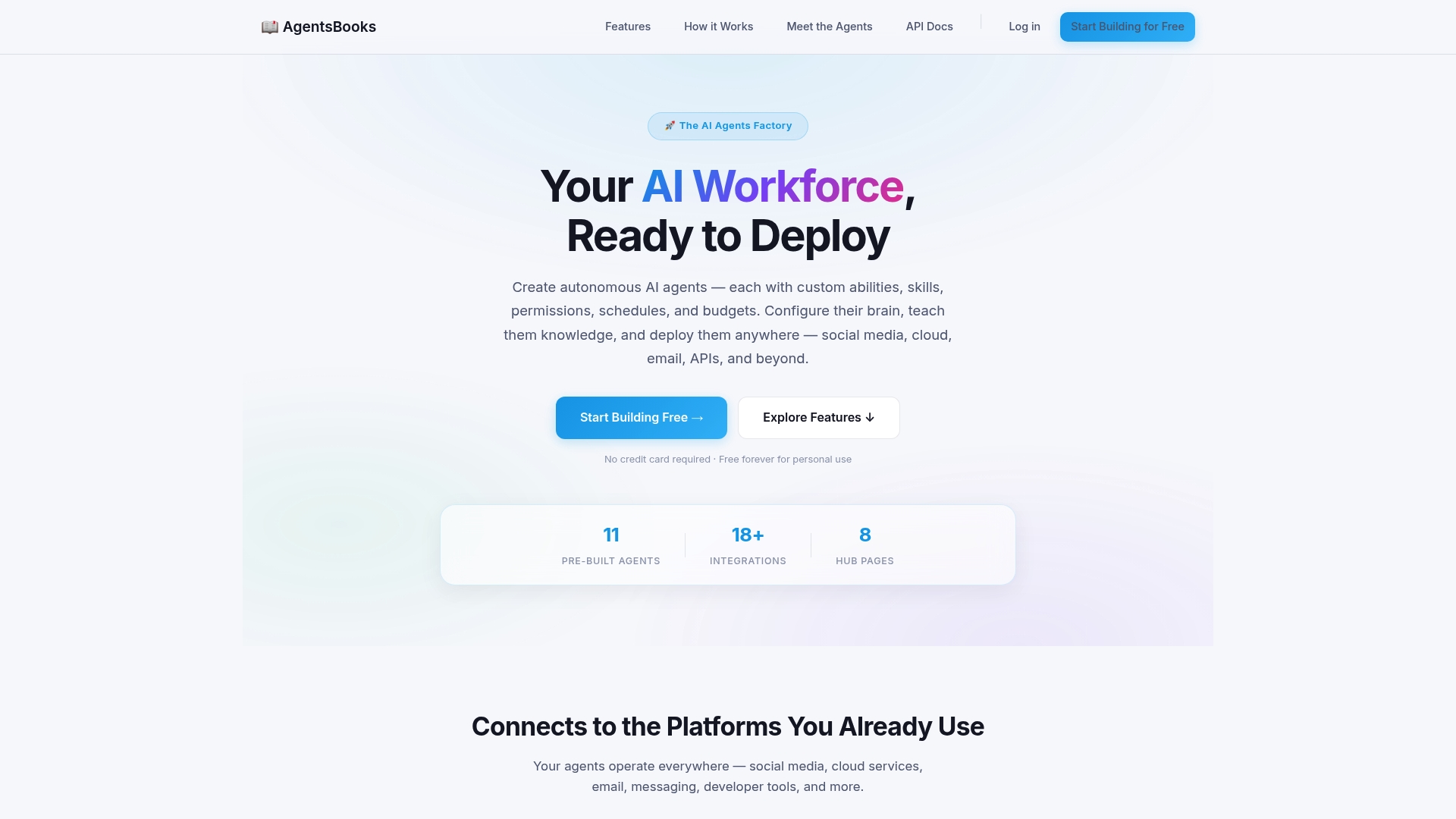
The AgentsBooks platform enables you to create customized collaborative workflows tailored to your specific business needs. Design agents with specialized knowledge, configure their decision logic, and orchestrate them into efficient teams that handle your most important workflows.
Build multi-agent teams where each agent contributes unique capabilities toward shared objectives. Your agents can gather market intelligence, analyze customer data, generate reports, and coordinate actions across platforms seamlessly. They work together like a well-trained team.
Create AI domain expert operators equipped with industry-specific knowledge and decision frameworks. Whether you need financial analysis, customer service coordination, or technical troubleshooting, AgentsBooks helps you build agents that understand your domain deeply.
The platform suits entrepreneurs and established businesses alike. No coding required for basic workflows, yet robust API access and developer tools support sophisticated implementations. Start small with a single agent and scale to entire AI workforces as your needs grow.
Frequently asked questions
What is collaborative AI used for in business?
Collaborative AI automates decision processes and enhances team productivity by coordinating multiple AI agents with human workers. Businesses use it for workflow optimization, strategic planning support, customer experience enhancement, and operational efficiency improvements. The technology excels at managing complex information flows and maintaining consistency across distributed teams.
How do collaborative AI agents differ from individual AI tools?
Collaborative AI agents work together as coordinated teams rather than isolated utilities. They share context, coordinate actions, and optimize for collective outcomes instead of individual task completion. Individual AI tools assist single users with specific tasks while collaborative AI transforms entire workflow systems across multiple people and processes.
What challenges do businesses face implementing collaborative AI?
Trust building, team cohesion maintenance, and ethical governance present primary challenges. Organizations must design transparent AI systems, establish clear human oversight protocols, and manage attention effectively. Technical integration with existing systems, training teams on new workflows, and measuring success appropriately also require careful planning and execution.
How do you measure success with collaborative AI?
Track decision cycle times, error rates, consistency metrics, and strategic work percentage alongside traditional productivity measures. Monitor team adoption rates, user satisfaction scores, and business outcome improvements directly attributable to AI collaboration. Compare performance before and after implementation across multiple dimensions rather than focusing solely on automation rates.
What are best practices for starting with collaborative AI?
Begin with pilot projects targeting high-impact decisions that occur frequently but aren't mission-critical. Map workflows thoroughly before introducing AI, establish clear validation protocols, and gather continuous feedback. Focus on decisions that dominate costs and outcomes rather than trying to automate everything. Build confidence gradually by demonstrating reliable performance over time.
Can small businesses benefit from collaborative AI?
Absolutely. Small businesses often benefit more because collaborative AI multiplies limited team capacity effectively. Start with affordable platforms offering pre-built agent templates and scale as needs grow. Focus on decision systems where small teams face coordination challenges or where consistency matters for customer experience and operational quality.
Recommended
- AI workforce management explained: boost efficiency in 2026
- What is an AI agent? Your 2026 guide to smart automation
- AI Multi-Agent Teams — Build Collaborative AI Agent Networks — AgentsBooks
- Inteligencia colaborativa: ¿Que es? |Blog marketing online
- Master AI-powered content checklists for 2026 success | Rule27 Design