
Technology leaders face mounting pressure to transform their workforce strategies as AI adoption accelerates. With 80% of employees now using AI tools, understanding which trends deliver measurable productivity gains versus those that create workforce disruption is critical. This guide examines six data-backed AI workforce trends reshaping technology companies in 2026, providing clear criteria and benchmarks to inform your strategic planning. You'll discover optimal AI usage levels, phased integration approaches, and proven frameworks to balance innovation with workforce stability while capitalizing on productivity improvements.
Table of Contents
- Key Takeaways
- 1. Criteria for evaluating AI workforce trends
- 2. Six AI workforce trends reshaping organizations
- 3. Comparative productivity and talent impact of AI workforce trends
- 4. Strategic roadmap for successful AI workforce integration
- Explore AI agent solutions to accelerate your AI workforce strategy
- Frequently asked questions about AI workforce trends in 2026
Key Takeaways
| Point | Details |
|---|---|
| Optimal AI usage | Productivity gains peak when AI tools account for about 7 to 10 percent of work time. |
| Phased transformation roadmaps | A four stage maturity model guides gradual AI integration from foundation through autonomous deployment. |
| Human in the loop | Workflows mix AI processing with human context and oversight to sustain quality and capture productivity gains. |
| AI driven recruiting | AI driven recruiting reduces time to hire and lowers recruiting costs. |
| Governance and ethics | Strategy emphasizes governance measurement and ethics to guide responsible deployment. |
1. Criteria for evaluating AI workforce trends
Before adopting any AI workforce strategy, you need clear evaluation criteria. The 2026 state of the workplace reveals that AI adoption reaches 80% among employees, but the sweet spot for productivity sits at 7-10% of work time dedicated to AI tools. This benchmark provides your first criterion: optimal usage percentage.
Effective evaluation starts with understanding AI workforce management maturity stages. Consider these essential criteria when assessing trends:
- Measurable productivity gains with specific percentage improvements
- Clear adoption rate benchmarks and usage thresholds
- Workforce impact metrics including churn and displacement rates
- ROI indicators like time-to-hire reductions and cost savings
- Human-AI collaboration models with defined oversight roles
- Governance structures and ethical compliance frameworks
Apply a staged maturity model to your evaluation. Foundation stage focuses on tool selection and pilot programs. Capabilities stage builds AI fluency across teams. Enhancement stage optimizes workflows for human-AI collaboration. Autonomous stage deploys self-managing AI systems with human oversight.
Pro Tip: Prioritize trends showing 60% or higher productivity improvements with human-in-the-loop design, as these deliver measurable gains while maintaining quality control.
Your criteria should balance opportunity with risk. While productivity lifts of 60% with human-AI teams sound compelling, you must also evaluate workforce displacement risks and talent transition costs. The most successful technology companies weight both productivity metrics and employee impact equally when selecting AI workforce strategies.
Measurement matters. Establish dashboards tracking AI usage percentages, productivity gains per team, time-to-hire reductions, and employee sentiment scores. These metrics transform subjective trend evaluation into data-driven decision-making, enabling you to course-correct quickly when adoption patterns deviate from benchmarks.
2. Six AI workforce trends reshaping organizations
Six distinct trends are transforming how technology companies structure and manage their workforce. Each offers unique benefits but requires careful implementation to maximize value.
Widespread adoption with defined usage sweet spots represents the first major trend. While 80% employee adoption sounds impressive, the data shows diminishing returns beyond 10% of work time spent with AI tools. Companies achieving optimal results maintain strict usage guidelines, ensuring AI augments rather than replaces human judgment.

Phased transformation roadmaps provide systematic integration paths. The AI workforce transformation roadmap outlines four distinct stages: foundation, capabilities, enhancement, and autonomous. This structured approach prevents the chaos of ad hoc AI tool proliferation while building organizational capability progressively.
Human-in-the-loop collaboration models dominate successful implementations. Rather than full automation, leading technology companies design workflows where AI handles data processing and pattern recognition while humans provide context, judgment, and ethical oversight. This trend addresses quality concerns while capturing productivity gains.
AI-powered recruiting and HR automation delivers immediate ROI. Organizations report 33% reductions in time-to-hire and significant cost savings when deploying AI for candidate screening, interview scheduling, and initial query responses. This trend offers a low-risk entry point for AI workforce initiatives.
Talent churn and workforce displacement creates the biggest challenge. Entry-level hiring dropped 13% as AI tools absorbed routine tasks, while 22% of workers experienced transition-related churn. Forward-thinking companies address this through proactive reskilling programs focused on AI fluency and complementary human skills.
Pro Tip: Start with HR and recruiting pilots to build organizational confidence and demonstrate ROI before expanding AI workforce initiatives to core business functions.
Governance, measurement, and ethics frameworks separate successful adopters from struggling organizations. Companies deploying comprehensive dashboards, usage policies, and ethical guidelines achieve higher productivity gains with lower workforce disruption compared to those lacking formal governance structures.
3. Comparative productivity and talent impact of AI workforce trends
Quantifying the tradeoffs between productivity gains and workforce challenges helps you make informed decisions. The data reveals striking contrasts across different adoption approaches.
| Metric | AI-Powered Recruiting | Human-AI Collaboration | Full Automation Attempts |
|---|---|---|---|
| Time-to-hire reduction | 33% decrease | Not applicable | Not applicable |
| Productivity gain | 15-20% in HR functions | 60% with optimal design | 40% with quality issues |
| Workforce churn | Minimal (5-8%) | Low (10-12%) | High (22%+) |
| Implementation time | 3-6 months | 6-12 months | 12-18 months |
| Skill requirements | Moderate AI fluency | High AI fluency + judgment | Technical expertise |
The AI for HR benchmarks demonstrate impressive gains: 33% time-to-hire reduction, IBM's $4.5B productivity gain, and Repsol saving 121 minutes per employee weekly. These numbers represent best-case scenarios with mature implementations and strong governance.
Contrast these wins with workforce challenges. Stanford research shows entry-level white-collar hiring collapsed by 13% with 22% churn among displaced workers. Young professionals entering the workforce face particular challenges as AI tools absorb traditional entry-level tasks.
Pro Tip: Calculate your workforce transition costs before projecting net ROI from AI adoption, including reskilling programs, potential severance, and productivity dips during implementation.
The productivity versus churn tradeoff demands careful navigation. Organizations achieving 60% productivity lifts invest heavily in change management and reskilling. Those rushing implementation without talent transition plans experience higher churn rates that erode productivity gains.
"The companies winning with AI workforce strategies balance aggressive productivity targets with equally ambitious talent development programs, ensuring humans evolve alongside AI capabilities rather than compete against them."
Your comparative analysis should examine implementation velocity versus workforce stability. Faster adoption timelines correlate with higher churn but quicker ROI realization. Measured approaches reduce disruption but delay productivity gains. Most successful technology companies choose a middle path, moving quickly in low-risk functions like recruiting while taking measured approaches in core operations.
Dashboard-driven measurement enables real-time comparison of different AI workforce initiatives. Track productivity gains, usage patterns, employee sentiment, and churn rates across pilots to identify which trends deliver the best risk-adjusted returns for your specific organizational context.
4. Strategic roadmap for successful AI workforce integration
Transforming insights into action requires a structured implementation roadmap. Follow these proven steps to capitalize on AI workforce trends while managing risks.
-
Launch targeted pilots in HR and recruiting functions. Start with recruiting and HR query automation where AI delivers quick wins with minimal disruption. These pilots build organizational confidence and demonstrate ROI to secure broader support.
-
Establish governance frameworks before scaling. Deploy usage policies, ethical guidelines, and oversight committees. Define clear human-in-the-loop protocols for quality control and decision authority.
-
Implement measurement dashboards linked to strategic KPIs. Track AI usage percentages, productivity gains per team, time savings, cost reductions, and employee sentiment. Use this data to optimize deployment and identify issues early.
-
Design reskilling programs focused on AI fluency and complementary skills. Invest in training that builds technical AI literacy alongside uniquely human capabilities like judgment, creativity, and ethical reasoning. Use AI-powered skill assessments to personalize learning paths.
-
Scale systematically using the four-stage transformation model. Progress from foundation (tool selection, pilots) through capabilities (team training, workflow design) to enhancement (optimization, integration) and finally autonomous operations (self-managing systems with oversight).
Pro Tip: Redesign workflows before deploying AI tools rather than simply automating existing processes, as this prevents embedding inefficiencies and maximizes productivity gains.
Your step-by-step implementation should prioritize human-centered design. Involve employees in workflow redesign, gather feedback continuously, and adjust based on real-world usage patterns. This participatory approach reduces resistance and surfaces practical insights that improve outcomes.
Focus skill development on three areas:
- AI fluency: Understanding tool capabilities, limitations, and optimal use cases
- Prompt engineering: Crafting effective instructions for AI systems
- Critical judgment: Evaluating AI outputs for accuracy, bias, and appropriateness
- Ethical reasoning: Identifying and addressing fairness, privacy, and transparency concerns
Managing AI at scale requires continuous optimization. Review dashboard metrics monthly, conduct quarterly workforce impact assessments, and adjust governance policies based on emerging challenges. Successful organizations treat AI workforce integration as an ongoing transformation rather than a one-time project.
Measure success through both quantitative and qualitative indicators. Quantitative metrics include productivity gains, time savings, and cost reductions. Qualitative indicators encompass employee satisfaction, innovation rates, and customer feedback quality. Balanced scorecards capturing both dimensions provide the clearest picture of AI workforce initiative performance.
Explore AI agent solutions to accelerate your AI workforce strategy
Transforming AI workforce strategy from concept to reality requires robust tools for building and managing autonomous agents. AgentsBooks provides a comprehensive platform enabling technology companies to create, customize, and deploy AI agents across multiple functions and platforms.
The platform supports collaborative multi-agent networks where specialized agents work together, mirroring the human-AI collaboration models proven to deliver 60% productivity gains. You can deploy domain expert operators tailored to specific business functions, ensuring AI agents possess the knowledge and capabilities your teams need.
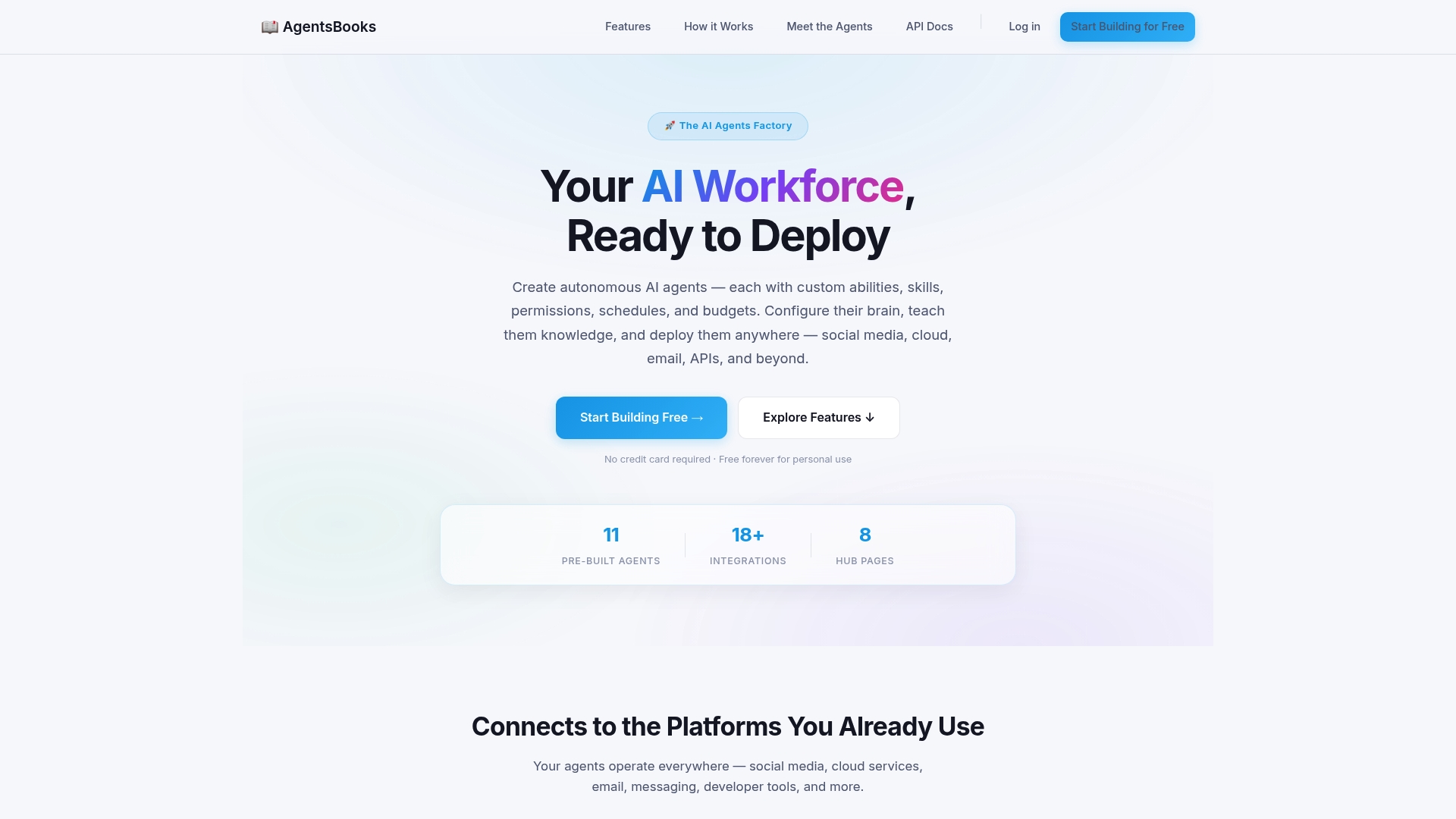
Whether you're piloting AI-powered recruiting, scaling customer service automation, or building complex multi-agent workflows, AgentsBooks offers the developer-friendly tools and intuitive interfaces to accelerate your initiatives. The platform's three-step process handles creation, configuration, and deployment, making sophisticated AI workforce solutions accessible even for teams with limited technical resources.
Frequently asked questions about AI workforce trends in 2026
What is the ideal AI usage percentage for productivity gains?
Research shows 7-10% of work time dedicated to AI tools delivers optimal productivity gains of up to 60% when combined with human oversight. Usage below 7% underutilizes AI capabilities, while exceeding 10% often introduces quality issues and diminishing returns.
How can companies manage workforce churn during AI adoption?
Invest in comprehensive reskilling programs focused on AI fluency and complementary human skills before deploying automation. Transparent communication about role evolution, participatory workflow redesign, and career path clarity reduce anxiety and retention risks. Companies with proactive talent transition programs experience 50% lower churn compared to those implementing AI without workforce support.
What skills should businesses prioritize for AI readiness?
Prioritize three skill categories: technical AI fluency including prompt engineering and tool proficiency, critical judgment for evaluating AI outputs and making contextual decisions, and ethical reasoning to identify bias and fairness concerns. Complement these with uniquely human capabilities like creativity, emotional intelligence, and complex problem-solving that AI cannot replicate.
How does AI reduce recruiting time and cost?
AI-powered recruiting automates candidate screening, interview scheduling, and initial query responses, delivering 33% reductions in time-to-hire. Cost savings come from reduced recruiter workload, faster position fills that minimize productivity gaps, and improved candidate quality through data-driven matching algorithms. Organizations report $500-$2,000 savings per hire depending on role complexity.
What governance measures ensure ethical AI deployment?
Establish clear usage policies defining acceptable AI applications and human oversight requirements. Deploy AI workforce management dashboards tracking usage patterns, bias indicators, and outcome quality. Create ethics committees reviewing high-stakes AI decisions and maintaining transparency about AI involvement in customer and employee interactions. Regular audits identify emerging risks before they escalate into serious issues.