
TL;DR:
- SaaS AI offers faster deployment, continuous updates, and scalable automation compared to self-hosted solutions.
- For most businesses, SaaS is more cost-effective and reduces operational complexity at moderate request volumes.
- While self-hosted AI suits high-volume, regulated, or proprietary needs, SaaS enables rapid experimentation and growth.
Nearly half of all companies now capture financial impact from AI delivered through SaaS platforms, yet many business owners still hesitate. The confusion is understandable. Self-hosted AI sounds like it gives you more control, and on paper, that feels safer. But the operational reality tells a different story. SaaS-delivered AI removes infrastructure friction, accelerates deployment, and scales with your business in ways that on-premise setups simply cannot match at the same speed. This guide walks through the evidence, the mechanics, and the strategic considerations so you can make a confident, informed decision.
Table of Contents
- Core benefits of SaaS for AI automation
- SaaS vs. self-hosted AI: Comparison of scalability and management
- Financial impact and business value: Pricing models that align incentives
- Nuance and edge cases: When SaaS for AI shines and where alternatives matter
- Why most managers underestimate SaaS for AI and what really matters
- Explore scalable AI SaaS solutions for your business
- Frequently asked questions
Key Takeaways
| Point | Details |
|---|---|
| Faster impact | SaaS-based AI enables rapid automation and immediate business benefits with no infrastructure setup. |
| Scalable solutions | Cloud AI SaaS platforms auto-scale to meet unpredictable workloads and streamline operations. |
| Aligned pricing | Usage-based pricing ensures costs scale with impact, supporting agile adoption and ongoing innovation. |
| Strategic flexibility | Hybrid SaaS models allow businesses to combine standard automation with custom AI for differentiation. |
| Expert perspectives | Most managers underappreciate SaaS’s ongoing compounding effects and operational advantages. |
Core benefits of SaaS for AI automation
The single biggest advantage SaaS brings to AI is speed. You skip months of hardware procurement, environment configuration, and model integration. Instead, you connect to a platform, configure your workflows, and start generating value within days. That compressed timeline is not a minor convenience. It is a fundamental competitive edge.
AI SaaS enables faster time-to-value, proactive automation, and personalization at scale. Those three outcomes map directly to what most businesses are trying to achieve. Faster time-to-value means your investment starts paying off before a self-hosted team has even finished provisioning servers.
Here is what SaaS-delivered AI automation actually enables in practice:
- Immediate model access: Connect to GPT, Claude, or other large language models without managing API infrastructure yourself.
- Workflow automation: Trigger AI actions based on events, schedules, or data changes across your existing tools.
- Personalization at scale: Use real-time customer data to customize outputs, recommendations, and responses without rebuilding models.
- Continuous updates: Benefit from model improvements and new features automatically, without manual upgrade cycles.
- Cross-platform integration: Deploy agents across email, social media, messaging apps, and APIs from a single control layer.
Pro Tip: Start with one high-friction workflow, such as customer inquiry routing or content drafting, and automate it fully before expanding. Narrow wins build organizational confidence faster than broad rollouts.
For teams exploring scalable AI deployment, SaaS removes the biggest barrier: infrastructure complexity. You focus on what the AI does, not on keeping it running.
"The real power of SaaS for AI is not just automation. It is the compounding effect of continuous improvement delivered without operational overhead."
Managers who have tracked AI agent productivity across teams consistently report that SaaS-based agents outperform manual processes within weeks, not quarters. The feedback loop is tighter, the iteration cycle is faster, and the results compound over time. When you pair that with strong AI task management practices, the operational gains become measurable and defensible.
SaaS vs. self-hosted AI: Comparison of scalability and management
To understand the real difference, you need to look beyond the initial setup and examine what happens when demand spikes, models need updating, or your team grows.
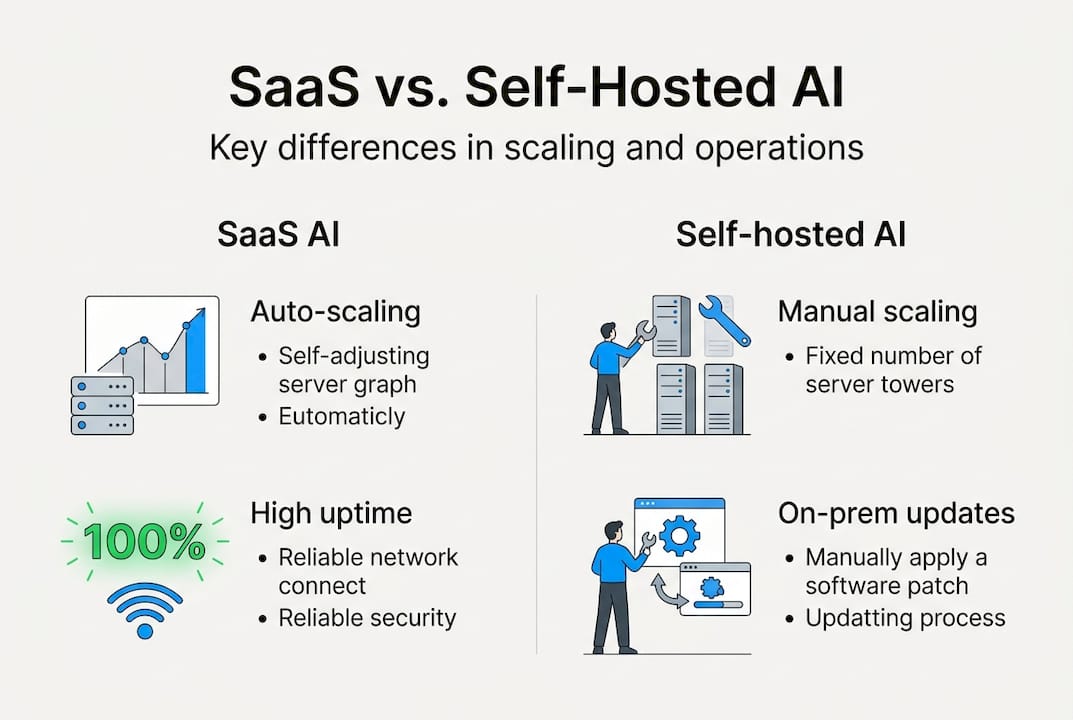
Cloud AI SaaS offers auto-scaling, managed updates, and high uptime at 99.9% or above, while self-hosted solutions require manual management and face hardware limits. That uptime gap alone has significant business implications. Downtime during peak demand is not just an inconvenience. It is lost revenue and eroded customer trust.

| Factor | SaaS AI | Self-hosted AI |
|---|---|---|
| Scaling | Automatic, near-instant | Manual, hardware-bound |
| Uptime | 99.9%+ guaranteed | Dependent on your team |
| Updates | Automated, continuous | Manual, scheduled downtime |
| Infrastructure cost | Subscription-based | Capital expenditure upfront |
| Time to deploy | Days | Weeks to months |
| Compliance flexibility | Vendor-dependent | Full control |
When you are managing AI at scale, the operational burden of self-hosted systems grows nonlinearly. One model is manageable. Five models across three departments with different update cycles becomes a full-time infrastructure job.
Here is how to think about the decision:
- Assess your workload predictability. If demand is variable or growing, SaaS scales without friction. If demand is perfectly stable and high-volume, self-hosted may eventually break even on cost.
- Evaluate your internal expertise. SaaS requires minimal DevOps knowledge. Self-hosted requires ML engineers, infrastructure specialists, and security teams.
- Map your compliance requirements. Regulated industries like healthcare or finance may need data residency controls that some SaaS vendors support natively now.
- Calculate total cost of ownership. Include engineering time, hardware depreciation, and opportunity cost, not just licensing fees.
For most growing businesses, the math favors SaaS until you reach very high, predictable request volumes, typically above 100,000 to 300,000 requests per month. Below that threshold, AI workforce management through SaaS is almost always more cost-effective when you factor in full operational costs.
Key insight: The hidden cost of self-hosted AI is not the hardware. It is the engineering attention diverted from building your actual product.
Financial impact and business value: Pricing models that align incentives
Pricing structure shapes behavior. SaaS pricing for AI is designed around a simple principle: you pay as you grow, and the vendor succeeds when you succeed.
The recurring revenue model in SaaS aligns with ongoing AI compute needs, creating virtuous cycles where vendor investment in model quality directly benefits customers. When your vendor improves the underlying model, your outputs improve without renegotiating a contract.
Usage-based pricing in AI SaaS aligns costs with value, enabling scalable adoption across teams of any size. You are not paying for seats that sit idle. You pay for actual work performed.
| Pricing model | Best for | Risk profile |
|---|---|---|
| Usage-based | Variable workloads, growth-stage | Low upfront, scales with demand |
| Flat subscription | Predictable, consistent usage | Predictable budget, potential waste |
| Hybrid tier | Mixed workflows | Balanced, requires monitoring |
The financial results back this up. Consider the 46% of companies that now report measurable financial impact from AI SaaS. That is not a marginal effect. Companies like Reckitt have reported substantial revenue increases tied directly to AI-driven SaaS workflows.
The AI agent benefits extend beyond cost savings. Faster customer response times, higher content output, and reduced error rates all contribute to revenue growth that compounds over time. A solid task management guide helps teams capture these gains systematically.
"Usage-based pricing removes the psychological barrier of large upfront commitments, letting teams experiment, prove value, and expand with confidence."
For business owners watching margins carefully, this pricing structure is genuinely different from traditional software licensing. You are not buying a tool. You are buying outcomes, and the cost scales with the impact you generate.
Nuance and edge cases: When SaaS for AI shines and where alternatives matter
SaaS is not the right answer for every situation. Knowing where it excels and where it falls short is what separates strategic operators from reactive ones.
Hybrid models are common, with SaaS handling commodity workflows and custom models reserved for strategic differentiation. SaaS also enhances incumbents through data moats, meaning the more you use a platform, the better it learns your patterns. That is a genuine competitive advantage, but it also creates dependency.
SaaS excels when:
- Workloads are variable or unpredictable. Auto-scaling handles traffic spikes without over-provisioning.
- Speed of experimentation matters. Test new AI workflows in hours, not months.
- Cross-platform automation is required. Connect agents across tools without custom integrations.
- Team AI expertise is limited. Managed infrastructure removes the need for dedicated ML ops.
Self-hosted or hybrid approaches make more sense when:
- Data sovereignty is non-negotiable. Certain regulated industries require data to stay on-premise.
- Workloads are extremely high and predictable. At massive scale, fixed infrastructure costs can undercut SaaS pricing.
- Proprietary model training is core to your product. If your AI is your product, you need full control.
Critics note vendor lock-in, data privacy risks, and rising usage costs as real concerns with SaaS. These are legitimate. Vendor lock-in is manageable if you use platforms with open APIs and portable data formats. Privacy risks depend heavily on vendor certifications and your data handling practices.
Pro Tip: Before committing to any SaaS AI platform, audit their data processing agreements, uptime SLAs, and export capabilities. The ability to migrate your data and configurations is as important as the features themselves.
For teams building differentiated workflows, configuring AI brains with custom knowledge and behavioral rules is how you extract unique value from SaaS platforms. And for businesses ready to scale agent-based operations, exploring an AI agent workforce model shows how far SaaS-powered automation can extend.
Why most managers underestimate SaaS for AI and what really matters
Here is the uncomfortable truth: most managers who hesitate on SaaS for AI are optimizing for the wrong variable. They focus on per-unit cost or data privacy edge cases, and in doing so, they miss the compounding automation gains that their competitors are already capturing.
The businesses winning with AI right now are not the ones with the most sophisticated infrastructure. They are the ones that deployed faster, iterated quickly, and let real-world usage data guide their next move. SaaS makes that cycle possible. Self-hosted makes it slow.
The obsession with theoretical control often masks a simpler fear: committing to a platform before fully understanding it. But waiting for perfect information is itself a strategic choice, and it usually favors whoever moved first.
For enterprise automation at any meaningful scale, the compounding effect of continuous SaaS improvements outweighs the marginal control benefits of self-hosting for the vast majority of use cases. The managers who recognize this early and build their AI clone your business strategy around SaaS-first principles tend to scale faster and spend less time managing infrastructure that does not differentiate them.
Focus on application speed. Adapt as your needs evolve. The edge cases will sort themselves out.
Explore scalable AI SaaS solutions for your business
If the case for SaaS-powered AI resonates, the next step is finding a platform built for real operational scale, not just demos.
AgentsBooks gives you a SaaS-native environment to build, configure, and deploy autonomous AI agents across every major digital platform. Whether you need AI domain operators for specialized tasks, AI multi-agent teams for coordinated workflows, or deep customization through agent brain features, the platform is designed to scale with your business from day one. No hardware. No long deployment cycles. Just agents working across your stack, delivering measurable results from the moment you deploy.
Frequently asked questions
How does SaaS-based AI enable faster business automation?
SaaS-based AI delivers instant access to scalable automation tools without hardware setup, accelerating workflow improvements and time-to-value significantly compared to self-hosted alternatives.
Is self-hosted AI ever preferable to SaaS?
Self-hosted AI is best for highly predictable, high-volume workloads above roughly 100,000 to 300,000 requests per month, or for strict compliance needs that require full data residency control.
How do SaaS pricing models align costs and business value?
Usage-based pricing in AI SaaS lets businesses pay only for what they use, scaling costs with actual impact and avoiding the waste of fixed seat commitments that go underutilized.
What are common concerns with SaaS for AI?
Vendor lock-in, data privacy risks, and rising usage costs are the most cited concerns, though most leading vendors now offer open APIs, strong compliance certifications, and transparent cost controls to address them.