
TL;DR:
- Scalable AI workforce solutions enable businesses to grow operations without proportional cost increases.
- They offer benefits like cost savings, 24/7 reliability, increased productivity, and enhanced innovation.
- Businesses should evaluate AI solutions based on scalability, integration, reliability, and flexibility to maximize ROI.
Scaling a business without scaling your costs is one of the hardest problems in modern operations. Most teams hit a wall where adding more work means adding more headcount, more tools, and more complexity. Scalable AI workforces break that equation. Instead of linear growth, you get operational leverage, where your systems handle more volume without proportional cost increases. This article walks through how to evaluate AI workforce solutions, the five biggest benefits you can expect, real industry examples, and a direct comparison of leading options so you can make a confident, data-backed decision.
Table of Contents
- How to evaluate scalable AI solutions
- Five major benefits of a scalable AI workforce
- Common use cases and industry examples
- Comparing scalable AI solutions: which delivers the best ROI?
- Our perspective: why most businesses underestimate scalable AI's potential
- Accelerate results with expert AI workforce solutions
- Frequently asked questions
Key Takeaways
| Point | Details |
|---|---|
| Dramatic productivity gains | Scalable AI workforces can deliver 15–50% efficiency improvements for many businesses. |
| Flexible, future-proof operations | AI solutions scale to meet growing demands, making operations more adaptive and cost-effective. |
| Enhances human value | AI automates routine tasks, allowing teams to focus on strategic decision-making and innovation. |
| Industry-proven results | Empirical studies confirm strong ROI from scalable AI in customer support, tech, and other sectors. |
How to evaluate scalable AI solutions
Not every AI solution is built for scale. Some tools work well for a single use case but fall apart when you try to expand them across departments or integrate them into complex workflows. Before you commit to any platform, you need a clear set of criteria to guide your evaluation.
Here are the core factors to assess:
- Scalability: Can the platform handle a 10x increase in workload without degrading performance or requiring a full rebuild?
- Integration capability: Does it connect natively with your existing stack, including CRMs, APIs, messaging tools, and cloud services?
- Reliability: What are the uptime guarantees, and how does the system handle errors or edge cases in automated workflows?
- Cost-effectiveness: Is the pricing model aligned with usage, so you pay for what you use rather than a flat fee for capacity you may not need?
- Ease of management: Can non-technical team members configure, monitor, and adjust agents without engineering support?
Matching the scale of your AI solution to the complexity of your workflows is critical. A lightweight chatbot may solve a narrow problem, but a platform designed for AI scale in SaaS environments will grow with you as your needs evolve.
The data backs this up. Research shows 15-50% productivity gains in tasks like customer support and coding, with the largest improvements seen among junior workers through what researchers call skill compression. That means your newest team members can perform closer to senior level when supported by the right AI tools.
If you want a structured approach to rollout, a solid AI deployment guide can help you map criteria to your specific operational context.
Pro Tip: Prioritize platforms that offer robust automation triggers, multi-platform integration, and configurable agent behaviors. These features are the difference between a tool you outgrow in six months and one that scales with your business for years.
Five major benefits of a scalable AI workforce
With a clear evaluation framework in place, here are the five real-world payoffs that businesses consistently report after moving to a scalable AI workforce.
- Cost savings through automation: Repetitive, rule-based tasks like data entry, ticket routing, and report generation can be fully automated. This reduces labor costs and frees budget for higher-value work.
- Productivity boosts across skill levels: The 15-50% productivity gains documented in empirical research are especially pronounced for junior employees, who benefit most from AI-assisted skill compression in technical and support roles.
- 24/7 operational reliability: AI agents do not take sick days, go on vacation, or experience burnout. Your workflows run continuously, which is critical for global teams and customer-facing operations.
- Agility to scale up or down: Demand spikes during product launches or seasonal peaks no longer require emergency hiring. You adjust agent capacity in real time to match workload.
- Innovation through focus: When people are freed from mundane tasks, they redirect energy toward strategy, creativity, and customer relationships. This is where human judgment genuinely adds value.
"The most significant benefit of scalable AI is not the cost reduction. It is the strategic capacity it creates when your team stops firefighting and starts building."
For a deeper look at how these benefits translate into day-to-day operations, AI workforce management practices are evolving rapidly in 2026. Staying current on AI workforce trends will help you anticipate where the biggest gains are emerging across industries.

Common use cases and industry examples
Knowing the benefits is useful. Seeing them applied in specific contexts makes the decision real. Here is where scalable AI workforces are delivering measurable results right now.
Industry use cases:
- Customer support: AI agents handle tier-1 inquiries, route complex issues to humans, and provide 24/7 response coverage. Resolution times drop, and customer satisfaction scores improve.
- Software development: AI assists with code review, documentation, bug triage, and test generation. Junior developers see the largest productivity lifts.
- Marketing: Agents automate content scheduling, audience segmentation, A/B test monitoring, and campaign reporting across multiple platforms simultaneously.
- Operations: Workflow automation handles invoice processing, inventory alerts, compliance checks, and internal notifications without manual intervention.
Empirical studies show 15-50% efficiency gains across these real-world tasks, making the ROI case straightforward for most business functions.
| Metric | AI-augmented team | Human-only team |
|---|---|---|
| Cost per task | Lower by 30-60% | Baseline |
| Throughput | 3-5x higher | Baseline |
| Error rate | Reduced by up to 40% | Baseline |
| Availability | 24/7 | Business hours only |
| Scalability | On-demand | Hiring dependent |
For businesses just beginning to explore this space, the AI workforce guide is a strong starting point. And if you want to understand why managing AI at scale matters beyond individual task automation, the case for AI automation success at the organizational level is well documented.
Comparing scalable AI solutions: which delivers the best ROI?
With actual examples in mind, the next question is how to compare solutions and maximize your investment. Not all platforms are equal, and the differences in ROI often come down to a few key dimensions.
| Factor | Basic automation tools | Mid-tier AI platforms | Enterprise AI workforce platforms |
|---|---|---|---|
| Scalability | Limited | Moderate | High |
| Integration flexibility | Low | Medium | Extensive |
| Agent customization | None | Limited | Full behavioral config |
| Cost model | Flat fee | Per-seat | Usage-based |
| Support quality | Self-serve | Email/chat | Dedicated + developer resources |
| ROI timeline | 6-12 months | 3-6 months | 1-3 months |
AI workforces show higher ROI than static automation because they adapt to changing workflows rather than breaking when conditions shift. Static tools automate a fixed process. AI workforce platforms handle variation, exception cases, and multi-step reasoning.
When matching a solution to your business goals, ask three questions. First, what is the complexity of the workflows you need to automate? Second, how frequently do those workflows change? Third, do you need agents to collaborate across departments or operate independently?
The answers will point you toward the right tier. For most growing businesses, the sweet spot is a platform with strong integration flexibility and configurable agent behaviors. Exploring AI agent productivity benefits in detail will help you build a business case with specific metrics tied to your industry.
Pro Tip: Do not optimize for the cheapest option at launch. Optimize for the solution that will still fit your needs when your workflow volume doubles. Switching platforms mid-growth is far more expensive than choosing the right one upfront.
Our perspective: why most businesses underestimate scalable AI's potential
Most leaders evaluate scalable AI through a single lens: cost reduction. They run the numbers on how many hours of manual work can be replaced, calculate a rough payback period, and make a decision based on that alone. This framing misses the bigger opportunity entirely.
The businesses seeing the most transformative results are not using AI to do the same work cheaper. They are using it to reinvent how their business operates at a structural level. They are building workflows that were never possible with human teams alone, because the speed, consistency, and 24/7 availability of AI agents open up entirely new service models.
There is also the employee development angle that almost nobody talks about. When junior staff are supported by AI that compresses skill gaps, your team develops faster. You are not just automating tasks. You are accelerating the learning curve of your entire workforce.
The businesses that will win with scalable AI are the ones that treat it as a strategic capability, not a cost-cutting exercise. Iterative adoption matters here. Start with one high-impact workflow, measure results, and expand deliberately. That approach builds organizational confidence and compounds returns over time.
Accelerate results with expert AI workforce solutions
Ready to put these benefits to work? AgentsBooks gives your business the infrastructure to build, configure, and deploy autonomous AI agents across every major digital platform, without needing a technical team to manage it.
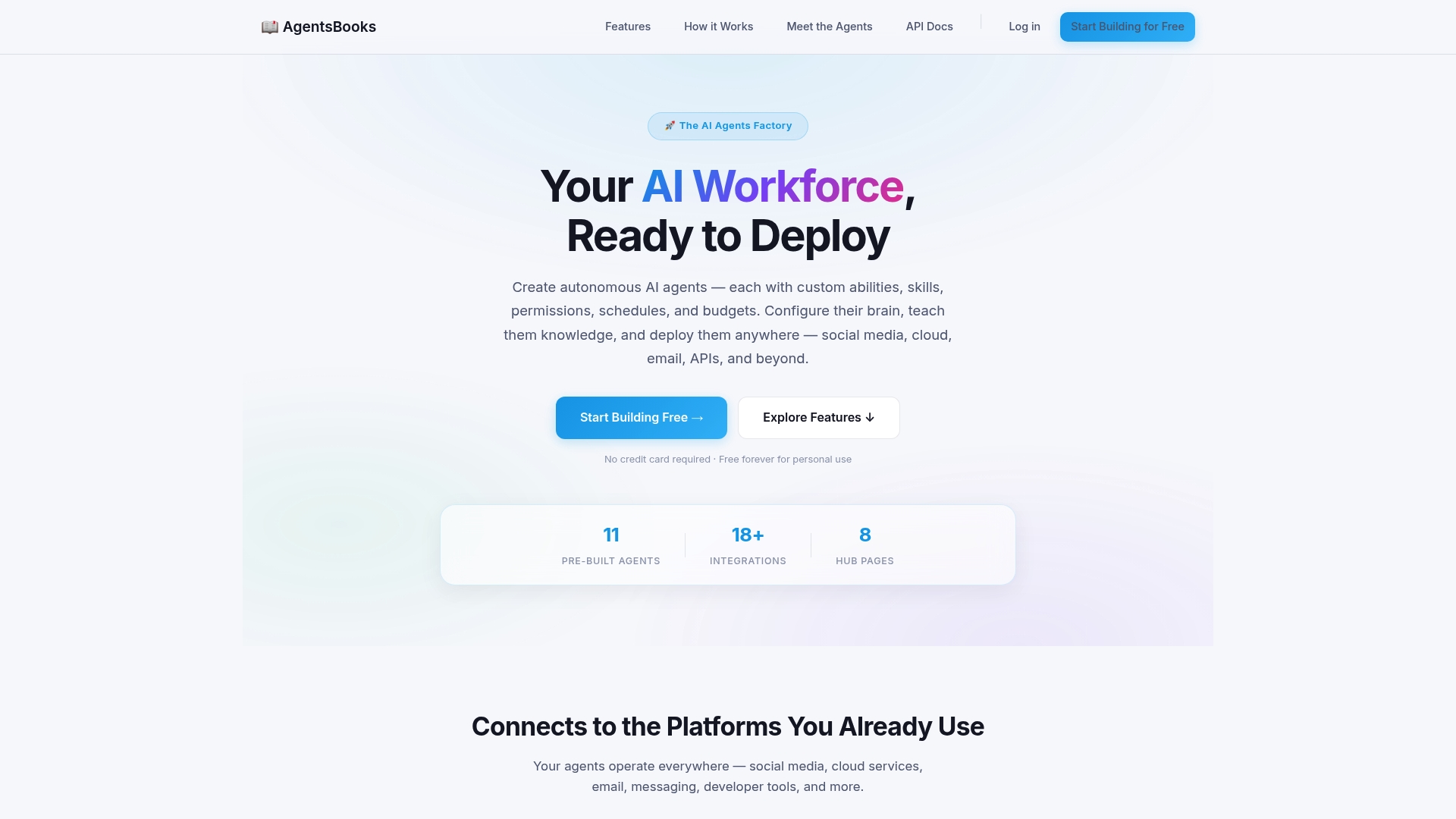
Whether you need AI domain expert operators that specialize in specific business functions or fully coordinated AI multi-agent teams that collaborate across departments, AgentsBooks has the tools to match your scale. The platform's three-step creation process means you can go from idea to deployed agent in hours, not months. Explore what is possible for your operations at the AgentsBooks platform and start building your scalable AI workforce today.
Frequently asked questions
What is a scalable AI workforce?
A scalable AI workforce refers to AI systems and agents that can be expanded or adjusted on demand to handle varied workloads, helping businesses scale operational capacity and drive efficiency gains without proportional increases in cost or headcount.
How much productivity improvement can I expect from scalable AI?
Empirical studies show businesses can achieve 15% to 50% productivity gains by deploying scalable AI workforces, especially in customer support and technical roles where skill compression benefits junior workers most.
Can scalable AI workforces replace human employees?
AI is designed to augment and automate repetitive tasks, but it works best when automating routine tasks and supporting human teams, freeing people to focus on strategic, creative, and relationship-driven work.
Which business functions benefit most from scalable AI?
Customer support, software development, marketing, and operations see some of the biggest gains, with customer support and coding showing the largest documented productivity improvements across industries.