
Custom AI agents deliver 132-671% ROI in Year 1 and accuracy rates up to 82.7%, numbers that generic AI tools simply cannot match. Yet most businesses still default to off-the-shelf models and wonder why results fall flat. This guide breaks down exactly what custom AI is, how it works, the methodologies behind it, and how you can start building agents that actually fit your organization. Whether you run a growing business or manage your own digital brand, the difference between generic and custom AI is the difference between a tool that almost works and one that genuinely performs.
Table of Contents
- What is custom AI?
- Core methodologies for custom AI
- Custom AI development process: step-by-step
- Performance benchmarks: custom AI vs generic AI
- Challenges, edge cases, and management strategies
- Custom AI for productivity and engagement: practical use cases
- Take the next step: building custom AI agents with AgentsBooks
- Frequently asked questions
Key Takeaways
| Point | Details |
|---|---|
| Custom AI boosts ROI | Custom AI agents deliver higher accuracy and ROI than generic models, often with rapid payback periods. |
| Tailored solutions drive engagement | Custom AI is uniquely suited for business automation and digital engagement through organizational alignment. |
| Production challenges require strategy | Reliability, complexity, and attack risks are real and demand rigorous agent design and hybrid architectures. |
| Hybrid and human-in-loop approaches | Mixing data-driven models with human evaluation and deterministic code enhances success and control. |
What is custom AI?
Custom AI refers to artificial intelligence systems built for a single organization, trained on proprietary data, and designed around specific workflows and objectives. It is not a general-purpose chatbot you plug in and hope for the best. It is an end-to-end solution shaped by your data, your goals, and your operational context.
Generic AI, by contrast, is trained on broad public datasets and optimized for wide applicability. It deploys fast and works reasonably well across many tasks. The trade-off is precision: generic models do not know your customers, your terminology, your compliance requirements, or your brand voice.
Here is what custom AI brings to the table that generic AI cannot:
- Proprietary data training: Your agent learns from your documents, CRM records, support tickets, and internal knowledge bases
- Workflow specificity: The agent is built around your actual processes, not a generalized approximation of them
- Compliance alignment: You control what the model knows and how it behaves, which matters enormously in regulated industries
- Brand consistency: Tone, terminology, and decision logic reflect your organization, not a generic average
- Scalable accuracy: Performance improves as you feed more of your own data over time
"The most valuable AI systems are not the most powerful ones. They are the ones most aligned with how your organization actually thinks and operates." This business DNA alignment principle is what separates transformative AI deployments from expensive experiments.
When you configure AI brains for specific business functions, you are not just adjusting settings. You are building a system that understands context the way a trained employee would.
Core methodologies for custom AI
Building a custom AI agent is not a single technique. It is a combination of approaches chosen based on your data, budget, and performance requirements. Understanding the options helps you make smarter decisions from day one.
The most common methods include LoRA, RAG, supervised fine-tuning, model distillation, and agentic architectures. Each serves a different purpose. RAG (Retrieval-Augmented Generation) lets your agent pull from a live knowledge base at inference time, which is ideal for frequently updated information. Fine-tuning with LoRA (Low-Rank Adaptation) adjusts a foundation model's weights using your data without retraining the entire model, which saves significant compute cost.
Agentic architectures add another layer entirely. They include five core components:
- Perception layer: Ingests inputs from text, APIs, documents, and real-time data streams
- Reasoning layer: Processes context and determines the best course of action
- Memory layer: Retains short-term and long-term context across interactions
- Action layer: Executes tasks like sending emails, calling APIs, or updating records
- Orchestration layer: Coordinates multi-step workflows and inter-agent communication
Hybrid approaches combine multiple methods for greater reliability. You might use RAG for knowledge retrieval, fine-tuning for tone and terminology, and deterministic code for high-stakes decision logic. This layered approach is what production-grade agents typically use.
The enterprise AI guide from Prem AI recommends starting with the simplest architecture that meets your accuracy threshold, then adding complexity only when benchmarks demand it. This is smart advice that saves months of over-engineering.
Pro Tip: Start with a no-code or low-code agent to validate your use case and data quality. Once you confirm the concept works, layer in custom fine-tuning. Skipping validation is the most expensive mistake in custom AI development. The developer resources for custom AI at AgentsBooks walk you through this progression step by step.
Custom AI development process: step-by-step
Deploying a custom AI agent follows a repeatable process. Skipping steps does not save time. It creates technical debt that compounds fast.
The full development workflow moves through these stages:
- Define the objective: Identify the specific task, the success metric, and the data sources available
- Prepare your data: Clean, label, and structure your proprietary datasets for training or retrieval
- Select your model: Choose a foundation model (GPT, Claude, Llama) based on task type and cost constraints
- Train or fine-tune: Apply LoRA, RAG, or supervised fine-tuning depending on your methodology
- Integrate with systems: Connect the agent to your CRM, APIs, messaging platforms, or cloud services
- Test rigorously: Run adversarial tests, edge case scenarios, and human-in-the-loop evaluations
- Deploy and monitor: Push to production with logging, alerting, and performance dashboards active
- Retrain continuously: Feed new data regularly and update benchmarks as your business evolves
| Factor | Custom AI development | Generic AI deployment |
|---|---|---|
| Setup time | Weeks to months | Hours to days |
| Accuracy on domain tasks | 75-82.7% | 59-63% |
| Data privacy | Full control | Shared infrastructure |
| Long-term ROI | 132-671% Year 1 | Variable, often lower |
| Compliance fit | Configurable | Limited |
| Ongoing cost | Decreases as model matures | Flat or rising |
The custom AI development process at Omdena emphasizes that the testing phase is where most projects either succeed or stall. Allocate at least 20% of your project timeline to evaluation before deployment.

Pro Tip: Build custom benchmarks specific to your use case before you start training. Human-in-the-loop evaluation, used by 74% of production teams, consistently outperforms automated-only testing for catching real-world failure modes. The AI deployment guide covers how to structure this phase effectively.
Performance benchmarks: custom AI vs generic AI
The performance gap between custom and generic AI is not marginal. It is decisive. Here is what the data shows.
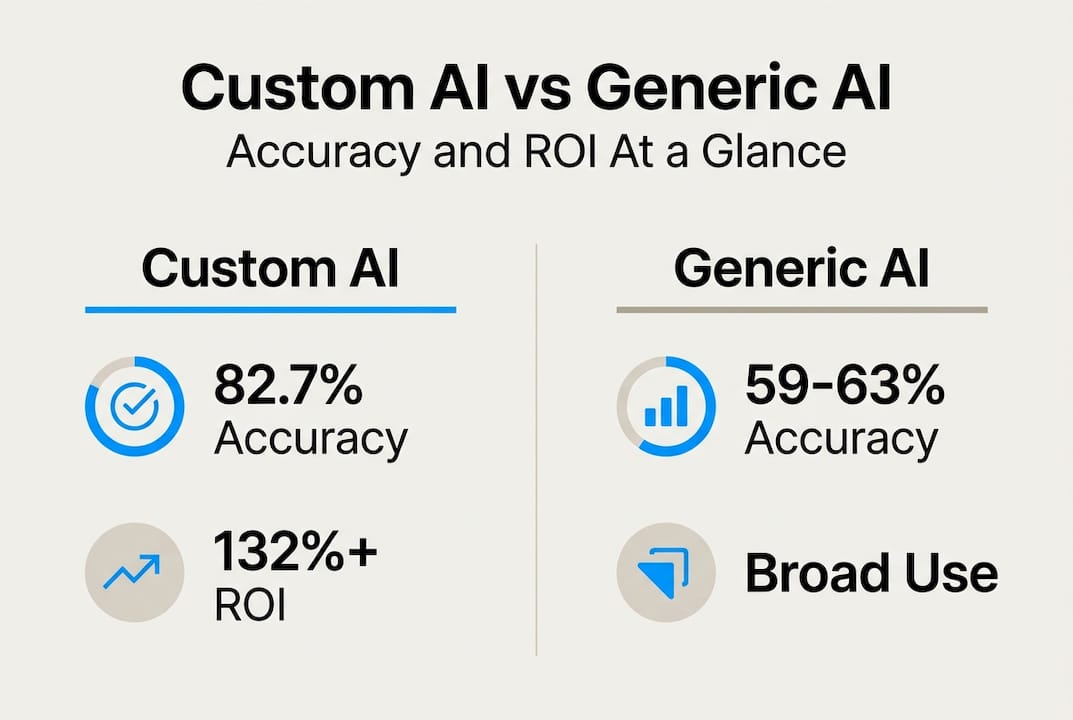
Domain-specific agents achieve 82.7% accuracy compared to 59-63% for general large language models. Average payback period is 4.3 months. Year 1 ROI ranges from 132% to 671% depending on the use case and deployment scale.
| Agent type | Accuracy | Year 1 ROI | Avg payback |
|---|---|---|---|
| Custom domain-specific agent | 82.7% | 132-671% | 4.3 months |
| General LLM (generic) | 59-63% | Variable | 12+ months |
| Hybrid (custom + generic) | 70-78% | 100-300% | 6-8 months |
The AI agents benchmarks research from arXiv confirms that accuracy alone does not tell the full story. Efficiency gains, error reduction rates, and cost per task completed are equally important metrics.
Key performance advantages of custom AI include:
- Higher task completion rates: Custom agents complete domain-specific tasks at rates 20-30% above generic models
- Lower hallucination rates: Proprietary data grounding reduces factual errors significantly
- Faster response relevance: Agents trained on your context skip the disambiguation step that slows generic models
- Compounding improvement: Each retraining cycle improves performance, unlike static generic deployments
Generic AI suits rapid experimentation and broad tasks well. But for proprietary data, compliance requirements, high accuracy thresholds, and long-term ROI, custom AI wins decisively. The AI agent benefits extend well beyond accuracy into operational efficiency and competitive advantage.
Challenges, edge cases, and management strategies
Custom AI is powerful, but it is not without real production risks. Understanding these before you build saves you from expensive surprises after deployment.
The most critical issues teams face include:
- Reliability degradation at scale: Reliability drops from 60% on single runs to 25% at 8-step task chains. Longer workflows compound errors fast
- Prompt injection vulnerabilities: Near-100% success rates for prompt injection attacks have been documented in production agents. This is not a theoretical risk
- Complexity creep: Most successful production agents are simpler than their designers initially planned. Over-engineering is a common failure mode
- Data quality bottlenecks: Garbage in, garbage out applies more severely to custom AI than to generic models
- Integration fragility: Agents connected to multiple APIs fail when any single dependency changes
The production agent benchmarks research highlights that teams who decompose complex tasks into smaller, single-purpose agents consistently outperform those who build monolithic agents.
Pro Tip: Decompose complex workflows into chains of simple agents rather than one agent trying to do everything. Enforce structured outputs (JSON schemas, typed responses) at every step. Combine LLM reasoning with deterministic code for any logic that must be 100% reliable. Multi-agent teams and domain expert operators on AgentsBooks are designed specifically for this kind of modular architecture.
Custom AI for productivity and engagement: practical use cases
Knowing the theory is useful. Seeing where custom AI actually delivers results is what drives action.
Organizations are deploying custom agents across a wide range of functions:
- Customer support automation: Agents trained on product documentation and past tickets resolve 60-80% of inquiries without human escalation
- Sales enablement: Custom agents qualify leads, draft personalized outreach, and update CRM records in real time
- Content and social media: Agents trained on brand voice generate, schedule, and publish content across platforms consistently
- Internal knowledge management: Employees query a custom agent instead of digging through wikis, cutting research time by hours per week
- Compliance monitoring: Agents scan documents and flag regulatory issues using organization-specific rule sets
- Personal brand building: Individual creators use custom agents to maintain consistent output across newsletters, social posts, and community engagement
"Custom AI enables businesses and individuals to deploy autonomous agents using proprietary data for superior alignment. The result is not just automation. It is a digital extension of your organization's expertise and judgment."
The enterprise AI use cases from Modern Tech show that the highest-ROI deployments share one trait: they replace a specific, high-frequency human task rather than trying to automate everything at once. Start narrow, prove value, then expand.
For individuals, the opportunity is equally real. You can clone your business with AI to scale your expertise, or use an AI personal brand builder to maintain a consistent digital presence without burning out.
Take the next step: building custom AI agents with AgentsBooks
Everything covered in this guide, from methodology selection to deployment and monitoring, is exactly what the AI Agents Factory at AgentsBooks is built to support. The platform gives you a three-step creation process: describe your agent, configure its knowledge and behavior, and deploy it across the platforms you already use.
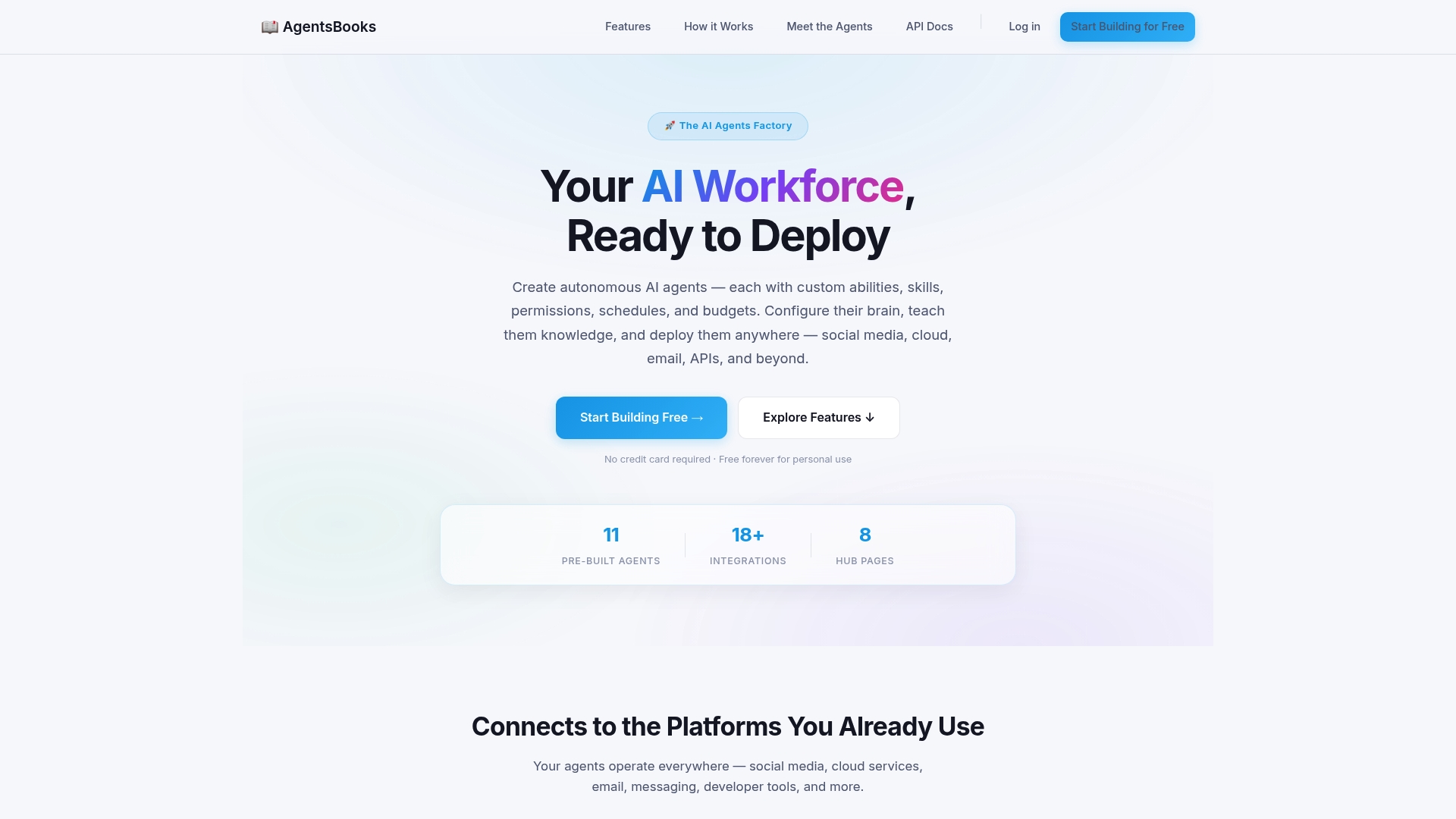
You do not need a machine learning team to get started. AgentsBooks lets you ingest knowledge from multiple sources, configure AI brains using GPT or Claude, set triggers and schedules, and connect agents to social media, email, APIs, and messaging platforms. For teams that need more, domain expert operators and multi-agent teams enable the kind of modular, collaborative agent architecture that production-grade deployments require. Whether you are automating business workflows or building a personal brand, AgentsBooks gives you the infrastructure to do it right.
Frequently asked questions
What makes custom AI different from generic AI?
Custom AI is built for specific organizational goals and trained on proprietary data, while generic AI relies on broad public datasets and is not tailored to your workflows, terminology, or compliance requirements.
How much does custom AI improve performance versus generic tools?
Domain-specific agents achieve 82.7% accuracy versus 59-63% for general models, with Year 1 ROI ranging from 132% to 671% and an average payback period of just 4.3 months.
What are the main risks or challenges in deploying custom AI?
Reliability drops sharply in multi-step workflows, prompt injection vulnerabilities are near-universal in production, and complexity creep is common. Decomposing tasks and combining LLM reasoning with deterministic code are the most effective mitigations.
Can individuals use custom AI agents, or is it only for enterprises?
Both businesses and individuals can deploy custom agents. Proprietary data alignment benefits anyone with domain-specific knowledge to encode, and no-code tools make entry accessible without technical expertise.
How do you measure success for custom AI agents?
Success goes beyond accuracy. Production teams prioritize human-in-the-loop evaluation, custom benchmarks, cost per task, and reliability metrics alongside accuracy to get a complete picture of agent performance.