
Building AI agents shouldn't feel like decoding alien technology. Many developers assume AI development demands complex infrastructure, expensive tools, and months of learning obscure frameworks. AgentsBooks flips that script by offering accessible, comprehensive developer resources that let you create, customize, and deploy autonomous AI agents without the traditional barriers. This guide walks you through the platform's SDKs, APIs, multi-agent capabilities, cloud integration tools, and learning resources so you can start building sophisticated AI solutions today.
Table of Contents
- Key takeaways
- Understanding core developer resources on AgentsBooks
- Leveraging multi-agent teams and expert operators for complex AI solutions
- Deploying and scaling AI agents with cloud and automation tools
- Learning and support resources for developers on AgentsBooks
- Explore AgentsBooks developer solutions today
- Frequently asked questions
Key Takeaways
| Point | Details |
|---|---|
| Agent development tools | AgentsBooks provides SDKs and APIs to build, customize, and deploy autonomous AI agents. |
| Multi agent collaboration | The platform enables coordinated networks of specialized agents to tackle complex tasks. |
| Learning resources | Comprehensive tutorials and documentation help developers onboard quickly and grow their AI skills. |
| Cloud integration | Seamless integration with cloud platforms simplifies deployment and scaling of AI agents. |
| Developer empowerment | Resources focus on enabling developers to build, customize, and manage AI efficiently. |
Understanding core developer resources on AgentsBooks
The foundation of any AI development project starts with the right tools. AgentsBooks offers software development kits and APIs for integrating AI capabilities directly into your applications, giving you programmatic control over agent creation, configuration, and deployment. Think of SDKs as your toolkit for building agents from scratch, while APIs act as communication channels between your code and the platform's AI infrastructure.
The platform provides comprehensive documentation that covers everything from basic agent setup to advanced customization. Code libraries include pre-built functions for common tasks like knowledge ingestion, behavior configuration, and platform integration. You can spin up a basic agent in under 10 minutes or spend days fine-tuning complex multi-agent systems, depending on your project requirements.
What sets AgentsBooks apart is the focus on developer experience. The SDK handles authentication, rate limiting, and error handling automatically, so you can focus on building unique agent behaviors rather than wrestling with infrastructure. The REST API follows standard conventions, making it intuitive for anyone familiar with modern web development practices.
Pro Tip: Start with the SDK's template agents when prototyping. These pre-configured examples demonstrate best practices for common use cases like customer support, content generation, and data analysis. Clone a template, modify the behavior parameters, and you'll have a working prototype in minutes instead of hours.
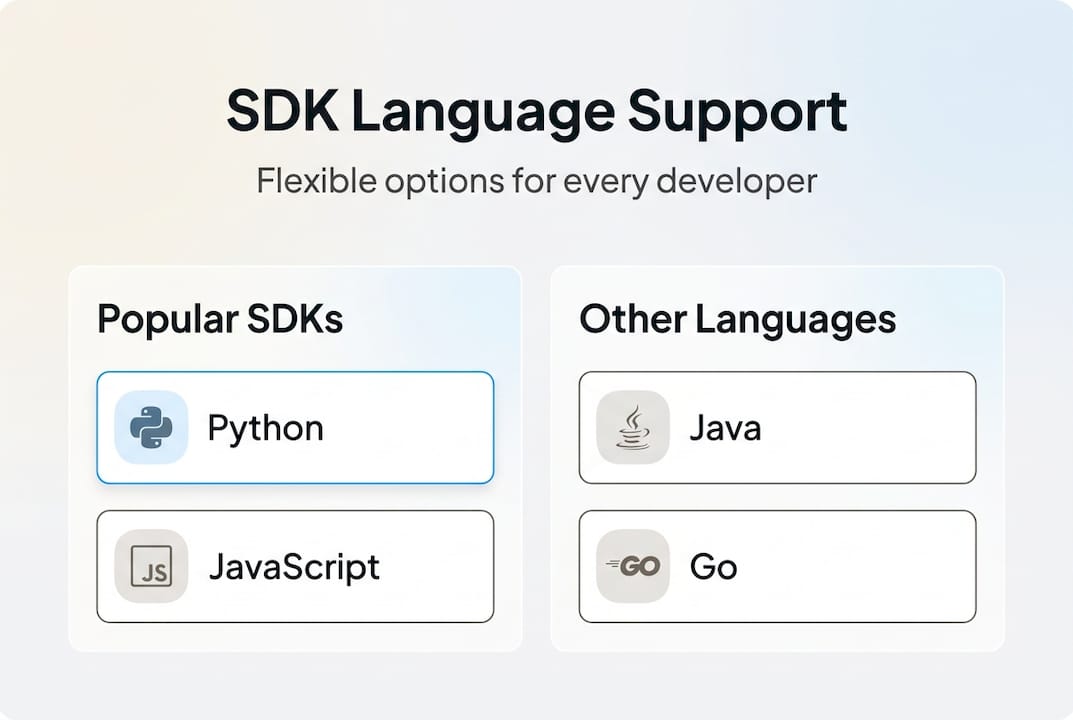
Developers appreciate the flexibility to choose their preferred programming language. The platform supports multiple SDK implementations, and the REST API works with any language that can make HTTP requests. This language-agnostic approach means you can integrate AI agents into existing codebases without rewriting your entire stack.
Leveraging multi-agent teams and expert operators for complex AI solutions
Single agents handle straightforward tasks well, but real-world problems often require specialized expertise working in concert. AgentsBooks enables building collaborative AI agent networks and domain expert operators that run real platforms, allowing you to architect sophisticated systems where multiple agents contribute their unique capabilities to solve complex challenges.
Multi-agent teams function like human work groups. Each agent brings specific skills, and they communicate through structured protocols to coordinate their efforts. A content marketing team might include a research agent gathering data, a writing agent drafting articles, an editor agent refining output, and a distribution agent publishing to multiple channels. This division of labor produces better results than asking one generalist agent to handle everything.
Domain expert operators take specialization further by managing entire platforms or business functions. These agents don't just perform tasks; they make decisions, optimize processes, and adapt to changing conditions within their domain. A sales expert operator might qualify leads, schedule meetings, update CRM records, and analyze conversion patterns, all while learning from each interaction to improve performance.
| Agent Type | Capabilities | Ideal Use Cases | Coordination Complexity |
|---|---|---|---|
| Single Agent | Focused task execution | Simple automation, basic queries | None |
| Multi-Agent Team | Collaborative problem solving | Content creation, research projects | Medium |
| Expert Operator | Autonomous platform management | Sales, customer service, analytics | High |
The advantages of multi-agent teams on AgentsBooks become obvious when tackling projects that require diverse skill sets. Market research projects benefit from agents specialized in data collection, analysis, visualization, and reporting. Software development teams use agents for code review, testing, documentation, and deployment monitoring. Customer service operations deploy agents handling initial triage, technical support, escalation management, and follow-up.
Pro Tip: Design your agent communication protocols before building the team. Define clear message formats, shared data structures, and handoff procedures. Agents that understand when to pass tasks to teammates and what context to include prevent bottlenecks and reduce errors. The AgentsBooks platform supports custom communication channels, so you can implement sophisticated coordination patterns like auction-based task allocation or consensus-driven decision making.
Building AI domain expert operators requires deeper integration with your business systems. These agents need access to relevant data sources, permission to take actions, and feedback loops to measure their performance. The investment pays off through autonomous operation that scales beyond human capacity while maintaining consistency and learning from every interaction.
Deploying and scaling AI agents with cloud and automation tools
Creating agents is one thing; running them reliably at scale is another challenge entirely. Cloud platforms and managed services help developers deploy and scale AI applications, and AgentsBooks integrates seamlessly with major cloud providers to give you enterprise-grade infrastructure without the complexity.

Cloud infrastructure solves the scalability problem that plagues self-hosted AI systems. Your agents can handle 10 requests per day or 10,000 requests per second, and the underlying infrastructure adjusts automatically. This elasticity means you pay only for what you use while maintaining consistent performance during traffic spikes.
Deploying agents through cloud services for AI deployment follows a straightforward process:
- Configure your agent's behavior, knowledge sources, and permissions in the AgentsBooks dashboard or via API
- Select your deployment targets (web APIs, messaging platforms, email, social media)
- Set up triggers and schedules that determine when your agent activates
- Connect to cloud services for storage, compute, and specialized AI capabilities
- Enable monitoring and logging to track performance and identify issues
- Implement continuous integration pipelines that test and deploy agent updates automatically
"Cloud-based AI deployment reduces operational costs by 60% compared to on-premises solutions while improving reliability and enabling global distribution. The combination of managed services and automation tools lets small teams achieve what previously required entire operations departments."
Automation tools transform agent management from a manual chore into a streamlined workflow. Continuous integration pipelines test agent behavior changes before deployment, catching bugs that could disrupt production systems. Automated rollback capabilities revert problematic updates instantly, minimizing downtime. Scheduled tasks trigger agents at optimal times without human intervention.
Monitoring becomes critical as your agent ecosystem grows. Track response times, error rates, resource consumption, and business metrics to understand how your agents perform in real conditions. Set up alerts for anomalies like sudden traffic spikes, elevated error rates, or unusual behavior patterns. The data you collect informs optimization decisions and helps you spot opportunities for improvement.
Best practices for reliable agent operation include implementing graceful degradation when dependencies fail, caching frequently accessed data to reduce latency, rate limiting to prevent resource exhaustion, and maintaining separate development, staging, and production environments. These patterns prevent small issues from cascading into major outages.
Learning and support resources for developers on AgentsBooks
Even the best tools require learning time, and AgentsBooks recognizes that developer success depends on accessible education. AgentsBooks provides courses, tutorials, and training resources for developers to learn AI agent building through multiple formats designed for different learning styles and experience levels.
Video tutorials walk through common scenarios step by step, showing exactly how to accomplish specific tasks. Written guides provide detailed explanations with code examples you can copy and modify. Interactive lessons let you experiment with agent configurations in a sandbox environment, seeing immediate results from your changes. This variety ensures you can learn in whatever format works best for your schedule and preferences.
The AI education and tutorials on AgentsBooks include a personalized AI Tutor Agent that tracks your progress and adapts lessons to your skill level. Struggling with a concept? The tutor provides additional examples and breaks down complex ideas into digestible pieces. Mastering topics quickly? It accelerates through basics and introduces advanced techniques. This personalized approach reduces frustration and accelerates skill development.
Community resources extend beyond official documentation. Developer forums connect you with other builders solving similar problems, sharing code snippets, and discussing best practices. The open-source code repositories on GitHub let you examine real implementations, contribute improvements, and learn from production-tested patterns. Support channels provide direct access to the AgentsBooks team when you encounter issues that community resources can't resolve.
Leveraging these resources strategically shortens development cycles and improves code quality. Start new projects by reviewing similar examples in the code repository. When stuck on a problem, search the forums before spending hours debugging. Schedule regular learning sessions to stay current with new features and capabilities. The investment in continuous learning pays dividends through faster development and more robust solutions.
Developers report that combining multiple resource types accelerates learning. Watch a video tutorial for overview understanding, read the written guide for implementation details, and experiment in the interactive sandbox to solidify concepts. This multi-modal approach builds deeper comprehension than any single method alone.
Explore AgentsBooks developer solutions today
Ready to transform how you build and deploy AI solutions? The AgentsBooks platform gives you everything needed to create sophisticated AI agents without the traditional complexity and cost barriers. Whether you're building a single assistant or orchestrating teams of specialized agents, the comprehensive developer tools, intuitive APIs, and extensive learning resources support your journey from prototype to production.
Explore AI domain expert operators to see how autonomous agents can manage entire business functions. Discover how multi-agent teams tackle complex projects through collaboration. The platform's three-step process (creation, configuration, deployment) means you can launch your first agent today and scale to enterprise solutions as your needs grow. Join thousands of developers already building the future of autonomous AI systems.
Frequently asked questions
What SDKs and APIs does AgentsBooks provide for AI development?
AgentsBooks offers software development kits and APIs for integrating AI capabilities into your applications with minimal friction. The REST API provides endpoints for agent creation, configuration, knowledge management, and deployment control. SDKs are available for popular programming languages, handling authentication and request formatting automatically. Comprehensive documentation includes code examples, parameter references, and integration guides to get you building quickly.
How can I build collaborative AI agent networks on AgentsBooks?
AgentsBooks enables building collaborative AI agent networks and domain expert operators that run real platforms through structured communication protocols and shared knowledge bases. Create specialized agents for different aspects of your project, define how they exchange information, and let them coordinate automatically. The platform handles message routing, state synchronization, and conflict resolution, so you can focus on designing effective team structures rather than managing infrastructure.
What learning resources are available for developers new to AI agents?
AgentsBooks provides courses, tutorials, and training resources for developers to learn AI agent building through video tutorials, written guides, and interactive lessons. The AI Tutor Agent personalizes your learning path based on progress and skill level, ensuring you master fundamentals before advancing to complex topics. Community forums and code repositories provide real-world examples and peer support throughout your learning journey.
How does cloud integration improve AI agent deployment?
Cloud integration provides automatic scaling, global distribution, and managed infrastructure that adapts to your agent's workload. Deploy once and let cloud services handle traffic spikes, geographic distribution, and resource optimization. This approach reduces operational costs while improving reliability and performance compared to self-hosted solutions.
Can I use AgentsBooks with my existing development workflow?
Yes, the platform integrates seamlessly with standard development tools and practices. The REST API works with any programming language, and SDKs support popular frameworks. Implement continuous integration pipelines, version control your agent configurations, and maintain separate environments for development, testing, and production just like traditional software projects.