
TL;DR:
- Modern AI messaging systems understand context, learn from interactions, and take real actions across channels.
- They outperform traditional chatbots by interpreting intent, maintaining conversation memory, and integrating with data tools.
- Hybrid human-AI approaches deliver the best results, with careful implementation and ongoing management.
Most businesses assume AI-powered messaging is just a fancier chatbot. It is not. Where traditional bots follow rigid scripts and break the moment a customer goes off-script, modern AI messaging systems understand context, learn from interactions, and take real action across channels. Businesses using AI messaging report measurable gains in customer satisfaction and resolution speed. This guide breaks down exactly what AI-powered messaging is, how it works under the hood, where it still falls short, and the best practices that separate high-performing deployments from expensive experiments.
Table of Contents
- Defining AI-powered messaging: Beyond chatbots
- How AI-powered messaging works: Key mechanics and processes
- Strengths and limitations: What AI-powered messaging gets right and wrong
- Best practices for businesses adopting AI-powered messaging
- Why 'just chatbots' thinking holds businesses back
- Accelerate your AI messaging journey with AgentsBooks
- Frequently asked questions
Key Takeaways
| Point | Details |
|---|---|
| More than chatbots | True AI-powered messaging agents go far beyond rule-based scripts to personalize and automate interactions. |
| Best as hybrid | Combining AI agents with human oversight delivers better outcomes than relying on AI alone. |
| Know the limits | AI messaging excels with FAQs but falters with complex, emotional, or multi-step conversations. |
| Integration matters | Agent effectiveness increases dramatically when integrated with business data and workflows. |
Defining AI-powered messaging: Beyond chatbots
Let's be precise. AI-powered messaging refers to AI-driven systems that automate and personalize customer interactions via channels like SMS, WhatsApp, email, and chat, using large language models (LLMs) for natural language understanding, generation, and action-taking. That last part matters. These systems do not just respond. They reason, retrieve information, and trigger workflows.
The gap between this and a traditional chatbot is enormous. A rule-based chatbot matches keywords to preset responses. Ask it something slightly unexpected and it fails. An AI messaging agent, by contrast, understands intent, holds context across a conversation, and can pull data from your CRM or order management system to give a genuinely useful answer.
Understanding the difference between AI agents and chatbots is the first step to making a smart adoption decision. The core distinction comes down to autonomy and tool use. AI agents can plan, decide, and act. Chatbots can only respond.
"AI-powered messaging is not about replacing humans with scripts. It is about deploying intelligent systems that understand what customers actually need and take meaningful action."
Here is what separates AI-powered messaging from legacy chatbot solutions:
- Natural language understanding (NLU): Interprets meaning, not just keywords, so conversations feel natural
- LLM-driven generation: Produces contextually appropriate, human-quality responses at scale
- Multichannel reach: Operates across SMS, WhatsApp, email, web chat, and more from a single system
- Tool and API integration: Connects to CRMs, order systems, and databases to act on real data
- Continuous learning: Improves over time based on interaction data and feedback
The business outcomes are tangible. Companies deploying AI messaging for customer support use cases consistently report faster resolution times, lower support costs, and higher customer satisfaction scores. When you move beyond scripted responses to genuine AI reasoning, the results follow.
Exploring AI texting platforms gives you a practical sense of how these systems are already being deployed across industries from retail to healthcare.
How AI-powered messaging works: Key mechanics and processes
Now that you know what AI-powered messaging is, let's explore how it actually works end-to-end. The process is more layered than most people expect, and understanding it helps you configure and manage these systems far more effectively.

Core mechanics include NLU for intent detection, context retention via memory and agent state, LLM generation for responses, tool integration through APIs for CRM and order data, multi-turn conversation handling, and escalation to human agents when needed. Each layer depends on the one before it.
Here is how a single customer interaction flows through an AI messaging system:
- Input received: Customer sends a message via SMS, WhatsApp, or web chat
- NLU processing: The system identifies intent (refund request, product question, complaint) and extracts key entities
- Context retrieval: Agent memory pulls prior conversation history and relevant customer data
- LLM response generation: The model drafts a response grounded in retrieved context and integrated data
- Tool execution: If action is needed (checking order status, updating a record), the agent calls the relevant API
- Delivery and monitoring: Response is sent, interaction is logged, and escalation triggers are checked
| Feature | AI-powered messaging | Rule-based chatbot |
|---|---|---|
| Intent understanding | Semantic, context-aware | Keyword matching only |
| Multi-turn memory | Retained across session | Resets each message |
| API/tool use | Native integration | Rarely supported |
| Escalation logic | Dynamic, context-driven | Fixed trigger words |
| Personalization | CRM-informed, adaptive | Template-based |
Pro Tip: Connecting your AI messaging system to your CRM from day one is the single highest-leverage move you can make. Personalization powered by real customer data, purchase history, and prior interactions dramatically improves resolution rates and customer satisfaction scores.
For teams building on top of existing infrastructure, understanding API integration is essential. The richness of your AI messaging output is directly proportional to the quality of data you feed it. Businesses seeing the strongest results from AI messaging in sales are those treating data integration as a foundational step, not an afterthought.
Strengths and limitations: What AI-powered messaging gets right and wrong
Having seen what is under the hood, it is critical to consider where AI messaging shines and where it stumbles. Honest evaluation here saves you from costly over-investment and unrealistic expectations.
Where AI-powered messaging excels:
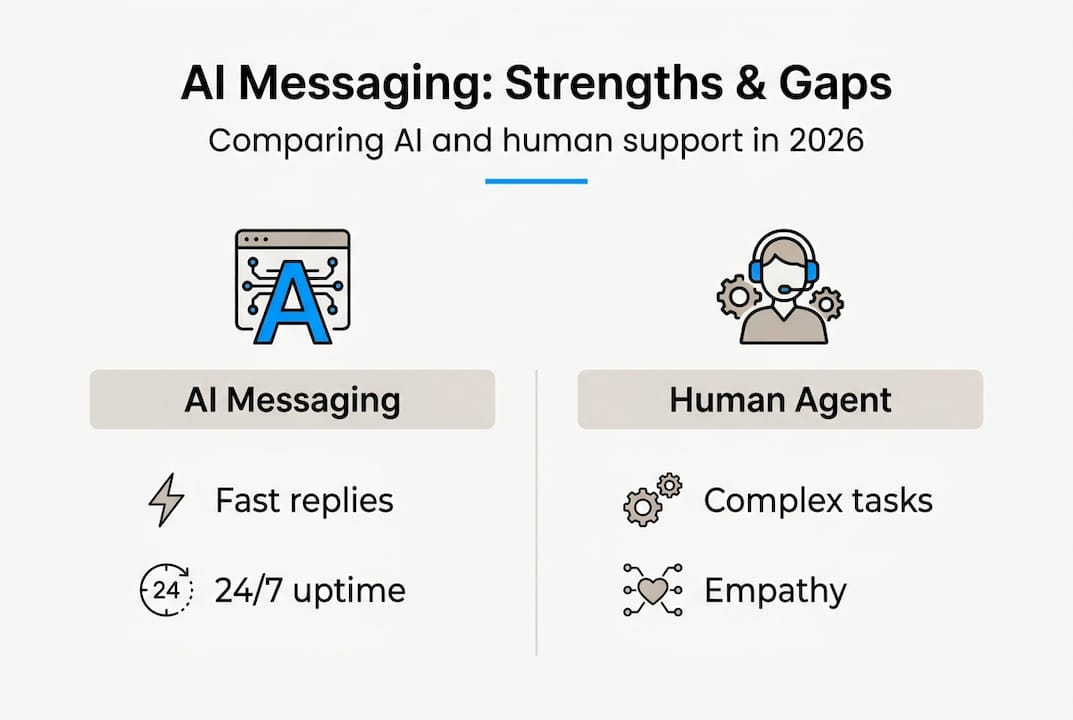
- 24/7 availability: No shift limits, no sick days. Customers get responses at 2 a.m. with no degradation in quality
- FAQ handling at scale: Routine questions about shipping, returns, and account status are resolved instantly
- Rapid response time: Average first-response times drop from minutes to seconds
- Consistent tone: No bad days, no mood-driven responses. Brand voice stays stable
- Scalability: Handle ten conversations or ten thousand without adding headcount
Where AI-powered messaging still struggles:
The performance data on LLM agents is sobering. Complex reasoning tasks see only 45 to 65% success rates. AI agents fail on multi-step planning without scaffolding, lose context accuracy beyond 40% of their memory window, and cannot reliably detect when they are uncertain. Hallucinations, where the model fabricates a confident but incorrect answer, remain a real risk in production environments.
| Capability | AI messaging | Human agent |
|---|---|---|
| Simple FAQ resolution | Excellent | Good |
| Complex multi-step issues | 45-65% success | 92% success |
| Emotional empathy | Limited | Strong |
| Factual accuracy | Risk of hallucination | Accountable |
| Availability | 24/7 | Shift-limited |
This is why hybrid human-AI systems consistently outperform pure AI deployments. The advantages of AI agents are real, but they are maximized when paired with human judgment for edge cases. A hybrid human-AI approach is not a compromise. It is the architecture that actually delivers.
Best practices for businesses adopting AI-powered messaging
So, how can your business actually get this right? Let's turn insight into action.
The most important thing to understand upfront is that Gartner predicts 33% of enterprise applications will be agentic by 2028, but also that 40% of AI agent projects will be canceled by 2027 due to costs and governance failures. The gap between those two numbers is where smart implementation strategy lives.
Here is a practical checklist for successful AI messaging adoption:
- Define scope clearly: Identify the top five to ten use cases where AI messaging adds the most value. Start narrow and expand.
- Train on your data: Generic models underperform. Feed your AI agent your product catalog, support history, and brand guidelines for real personalization.
- Build in human escalation: Set clear triggers for when conversations hand off to a human. Never leave a frustrated customer stuck with an AI that cannot help.
- Monitor for drift and hallucinations: Track response accuracy weekly. AI behavior can shift as models update or new edge cases emerge.
- Measure what matters: Resolution rate, escalation rate, CSAT, and first-contact resolution are your north stars.
- Iterate based on data: Review failed conversations monthly and use them to refine agent behavior and knowledge bases.
Pro Tip: Do not launch your AI messaging agent without a shadow mode period. Run it in parallel with human agents for two to four weeks, compare outputs, and fix gaps before going live. This single step prevents most early-stage failures.
Understanding the key benefits of AI agents in 2026 helps you build the business case internally. And once you are live, applying proven AI management strategies keeps performance from degrading over time. The teams winning with AI messaging are not the ones who deployed fastest. They are the ones who deployed most deliberately.
Why 'just chatbots' thinking holds businesses back
Stepping back from the tactics, here is where most organizations go wrong with AI messaging. They bring chatbot-era assumptions into agentic AI deployments and then wonder why results disappoint.
The mistake is not technical. It is conceptual. When a business treats an AI messaging agent like a smarter FAQ bot, they skip the data integration, skip the orchestration layer, and skip the human collaboration design. Then they blame the technology when it underdelivers.
The organizations seeing outsized results in 2026 are treating AI agents as collaborative teammates with specific roles, not as cost-cutting tools that replace human judgment wholesale. They invest in understanding AI workforce shifts and redesign workflows accordingly. The uncomfortable truth is that most AI messaging failures are leadership failures, not technology failures. The tech is ready. The question is whether your strategy is.
Accelerate your AI messaging journey with AgentsBooks
Ready to explore AI-powered messaging for your team? Here is how AgentsBooks can help.
The AgentsBooks platform is built for businesses that want to move beyond basic automation and deploy genuinely intelligent messaging agents. Whether you need a single support agent or a coordinated network of specialists, AgentsBooks gives you the tools to create, configure, and deploy without deep technical expertise.
Explore domain expert operators to deploy agents with deep knowledge in specific business areas, or scale customer engagement with multi-agent teams that collaborate to handle complex workflows. AgentsBooks connects to your existing channels and data sources, so your agents start informed and stay accurate. The path from concept to live deployment is shorter than you think.
Frequently asked questions
What is the main difference between AI-powered messaging and traditional chatbots?
AI-powered messaging uses advanced models to understand intent, retain context, and take action autonomously, while traditional chatbots follow preset scripts with no real adaptability. AI agents differ from chatbots by their autonomy, tool use, and planning capabilities.
How reliable is AI-powered messaging for handling customer service?
AI agents handle simple, high-volume issues well but show success rates of 45 to 65% on complex tasks, compared to around 92% for human agents on the same issues. Hybrid setups close that gap significantly.
Should businesses use AI-powered messaging alone or in combination with human agents?
Combining AI with human oversight consistently delivers the highest customer satisfaction. Hybrid human-AI systems show a 41-point NPS advantage over AI-only deployments, making collaboration the smarter architecture choice.
What channels can AI-powered messaging support?
AI-powered messaging works across SMS, WhatsApp, email, web chat, and additional platforms, adapting to wherever your customers prefer to engage without requiring separate systems for each channel.