
Businesses struggle to automate AI workflows when their software systems operate in silos, unable to share data or coordinate actions. API integration connects apps via RESTful, SOAP, WebSocket protocols using JSON/XML formats applying client-server model, enabling seamless communication between diverse platforms and AI tools. This guide clarifies what API integration is, how it works mechanically, and practical ways to harness it for reliable AI automation that drives measurable business outcomes.
Table of Contents
- Key takeaways
- Understanding API integration fundamentals
- Core mechanics and methodologies for AI automation
- Challenges and nuances in API integration for AI workflows
- Practical strategies to optimize and scale API integration for AI
- Explore AI agent platforms for advanced API integration
- Frequently asked questions
Key Takeaways
| Point | Details |
|---|---|
| API integration basics | API integration connects apps through RESTful, SOAP, and WebSocket protocols to exchange data in JSON or XML and enable coordinated actions across platforms. |
| Authentication methods | Use OAuth tokens, API keys, or JSON Web Tokens to securely authorize connections between systems. |
| Structured workflow steps | Follow a typical integration workflow by identifying required systems, selecting protocols, mapping data, configuring requests, testing, deploying, and monitoring. |
| Data mapping and transformation | Design data transformation logic to align formats between source and destination systems. |
| Error handling and reliability | Implement error catching, retries, validation, and logging to improve reliability and observability in AI automation. |
Understanding API integration fundamentals
API integration is the process of connecting software applications through application programming interfaces so they can exchange data and trigger actions across platforms. Process enables seamless data exchange and automation across platforms, forming the backbone of modern AI workflows where models need access to real-time information and external services. At its core, API integration relies on client-server architecture where one application sends requests and another responds with data or confirmation.
Most integrations use RESTful APIs due to their simplicity and stateless design, though SOAP remains common in enterprise environments requiring strict security. WebSocket protocols enable real-time bidirectional communication crucial for live AI agent interactions. Data typically flows in JSON or XML formats, with JSON dominating modern implementations for its lightweight structure and easy parsing.
Authentication secures these connections through methods like OAuth tokens, API keys, or JSON Web Tokens. OAuth provides delegated access without exposing credentials, while API keys offer simpler authentication for server-to-server communication. JWT tokens carry encoded user information and permissions, enabling stateless verification across distributed systems.
HTTP methods define the type of operation: GET retrieves data, POST creates new records, PUT updates existing entries, and DELETE removes resources. These standard verbs create a universal language for system communication. For AI workforce management explained scenarios, APIs enable autonomous agents to access customer databases, trigger email campaigns, update CRM records, and coordinate across multiple platforms.
A typical integration workflow follows these steps:
- Identify systems and data flows required for your AI automation goal
- Select appropriate API protocols and authentication methods
- Map data fields between source and destination systems
- Configure request parameters, headers, and payload structures
- Implement error handling for timeouts, rate limits, and invalid responses
- Test in sandbox environments with realistic data scenarios
- Deploy to production with monitoring and logging enabled
- Iterate based on performance metrics and user feedback
This foundation enables AI models to break free from isolated environments and interact with the full ecosystem of business applications, transforming static algorithms into dynamic automation engines.
Core mechanics and methodologies for AI automation
Integration process includes goal analysis, authentication, data mapping, testing, monitoring, and optimization, forming a systematic approach that ensures reliable AI automation. The detailed workflow for AI-specific integrations expands the basic steps into a comprehensive methodology:
- Define automation objectives and identify all systems involved in the workflow
- Research API documentation for endpoints, rate limits, and data schemas
- Set up authentication credentials and test connection validity
- Design data transformation logic to match formats between systems
- Build request handlers with proper error catching and retry mechanisms
- Create validation rules to ensure data quality and completeness
- Implement logging to track all API calls and responses
- Run integration tests with edge cases and failure scenarios
- Monitor production performance and optimize based on metrics
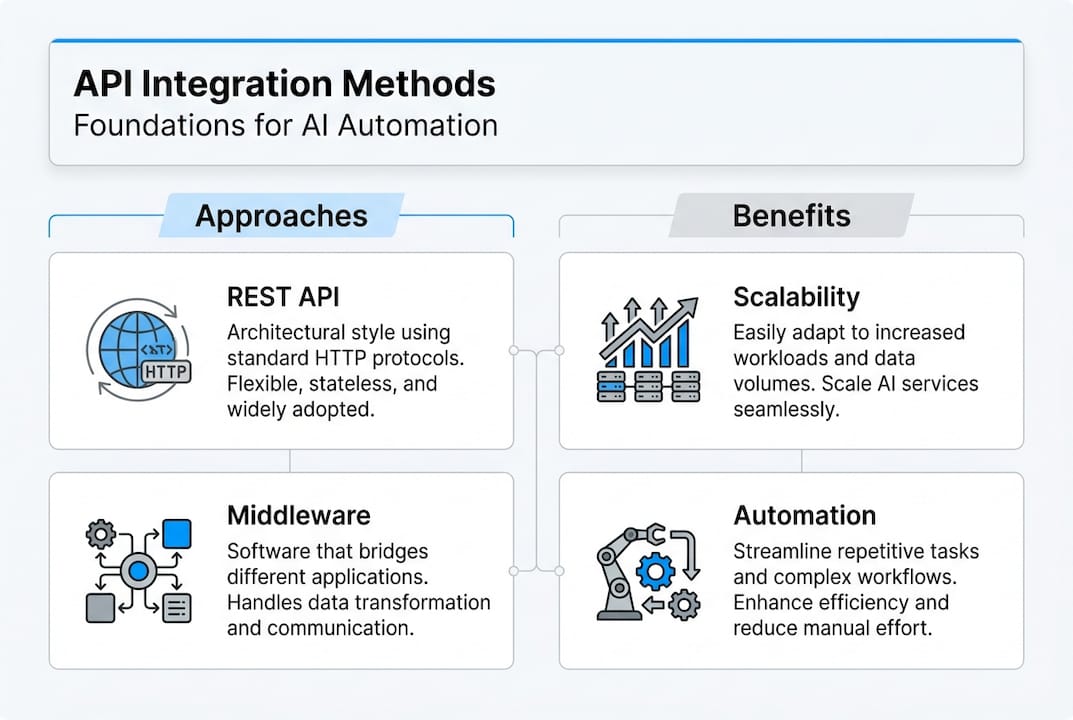
Methodologies include point-to-point, iPaaS, middleware, API orchestration with marketplaces offering many prebuilt connectors, each suited to different scale and complexity needs. Point-to-point connections work well for simple two-system integrations but become unmanageable as you add platforms. Integration Platform as a Service solutions like Zapier or MuleSoft provide visual builders and prebuilt connectors, reducing development time significantly.
Middleware acts as a translation layer between incompatible systems, handling protocol conversion and data transformation. API orchestration platforms coordinate multiple API calls into complex workflows, essential when AI agents need to gather information from several sources before making decisions. Modern API marketplaces offer thousands of prebuilt integrations, letting you connect popular services in minutes rather than weeks.

HTTP methods serve specific purposes in AI workflows. GET requests fetch training data or retrieve customer information for personalization. POST operations create new records when AI agents generate content or log interactions. PUT updates existing entries as agents modify statuses or enrich data. DELETE removes outdated information to maintain data hygiene.
Authentication types vary by security requirements. API keys suit internal integrations where you control both endpoints. OAuth excels for user-facing applications requiring delegated access to third-party services. JWT tokens enable microservices architectures where multiple components verify identity without central coordination.
Pro Tip: Always test integrations in sandbox environments with production-like data volumes before going live, and implement comprehensive monitoring from day one to catch issues before they impact users.
Successful API integration accelerates automation deployment, reduces manual data entry errors, and enables AI systems to access real-time information. For businesses following a step-by-step AI automation guide, mastering these methodologies transforms theoretical AI capabilities into practical business value.
Challenges and nuances in API integration for AI workflows
Edge cases include rate limits, timeouts, auth failures, data inconsistencies, and LLM hallucinations leading to integration errors, creating reliability challenges that demand careful planning. Rate limits restrict how many requests you can make per minute or hour, forcing you to implement queuing and throttling mechanisms. Timeouts occur when remote systems respond slowly, requiring retry logic with exponential backoff to avoid overwhelming struggling services.
Authentication failures happen when tokens expire, credentials rotate, or permissions change unexpectedly. Your integration must detect these conditions and refresh credentials automatically or alert administrators. Data inconsistencies arise when source systems use different formats, units, or validation rules than your AI expects, necessitating robust transformation and validation layers.
LLMs show under 40% success on web API tasks, accuracy drops as complexity rises, highlighting a critical challenge when AI agents autonomously call APIs. Large language models sometimes hallucinate API endpoints, parameter names, or data structures that don't exist, causing integration failures. They may misinterpret documentation or construct syntactically correct but semantically meaningless requests.
Choosing between integration approaches involves tradeoffs:
| Approach | Pros | Cons | Best for |
|---|---|---|---|
| REST APIs | Simple, stateless, widely supported, human-readable | Limited real-time capabilities, overhead on frequent calls | Standard CRUD operations, data retrieval |
| SOAP APIs | Strong typing, built-in security, formal contracts | Verbose XML, steeper learning curve, slower parsing | Enterprise systems, financial transactions |
| Edge computing | Low latency, reduced bandwidth, offline capability | Limited processing power, complex deployment | IoT devices, real-time AI inference |
| Cloud integration | Scalable, managed infrastructure, easy updates | Network dependency, potential latency, ongoing costs | Centralized AI models, batch processing |
| Custom code | Complete control, optimized performance, no vendor lock-in | High development cost, maintenance burden, longer time to market | Unique requirements, competitive differentiation |
| iPaaS platforms | Fast deployment, prebuilt connectors, visual tools | Subscription costs, less flexibility, vendor dependency | Standard integrations, rapid prototyping |
Edge versus cloud decisions depend on latency requirements and data sensitivity. Edge deployments process locally, crucial for real-time AI applications like autonomous vehicles or industrial automation. Cloud integrations centralize logic and scale elastically, ideal for batch processing or applications tolerating 100-500ms latency.
REST dominates modern integrations due to simplicity and JSON compatibility with JavaScript and Python AI frameworks. SOAP persists in regulated industries requiring formal contracts and WS-Security standards. WebSocket protocols suit AI chatbots and live collaboration tools needing bidirectional streaming.
Pro Tip: Implement exponential backoff starting at 1 second and doubling with each retry up to 60 seconds, cache frequently accessed data for 5-15 minutes, and monitor error rates to detect degraded APIs before they cause widespread failures.
Common error patterns include:
- 401 Unauthorized responses indicating expired or invalid authentication tokens
- 429 Too Many Requests signals when you exceed rate limits
- 500 Internal Server Errors suggesting problems on the remote system
- Timeout exceptions when responses take longer than configured wait periods
- Schema validation failures when data structures don't match expectations
For AI agent deployment guide implementations, these challenges demand robust error handling, human oversight for critical operations, and comprehensive testing across realistic edge cases before production release.
Practical strategies to optimize and scale API integration for AI
Semantic layers and declarative languages boost AI orchestration accuracy and efficiency with up to 73% to 142% improvement, transforming how AI agents interact with APIs. Semantic APIs describe endpoints using structured metadata that LLMs can interpret reliably, reducing hallucination rates and improving task completion. Declarative languages let you specify what outcome you want rather than how to achieve it, enabling AI to reason about the best API sequence.
Production best practices ensure reliability at scale. Caching reduces redundant API calls by storing frequently accessed data in memory for configurable periods, cutting latency and costs. Exponential backoff prevents overwhelming struggling services by progressively increasing wait times between retries. Comprehensive monitoring tracks response times, error rates, and throughput, alerting you to degraded performance before users notice.
AI-focused API marketplaces and Model Context Protocol tools provide agent-ready integrations optimized for autonomous operation. These platforms offer semantic descriptions, built-in error handling, and usage analytics tailored to AI workflows. They reduce integration time from weeks to hours by providing tested connectors and standardized interfaces.
Automation yields 5% to 10% revenue growth and saves 3 hours per week per sales rep, demonstrating measurable business impact. Companies implementing robust API integration for AI automation report significant efficiency gains:
| Metric | Before integration | After integration | Improvement |
|---|---|---|---|
| Manual data entry time | 12 hrs/week | 2 hrs/week | 83% reduction |
| Process completion time | 48 hours | 6 hours | 87.5% faster |
| Error rate | 8% | 1.2% | 85% fewer errors |
| Customer response time | 4 hours | 15 minutes | 93.75% improvement |
| Operational cost per transaction | $4.50 | $0.80 | 82% cost savings |
These benchmarks reflect real-world deployments across industries from e-commerce to financial services. The most successful implementations combine technical optimization with organizational change management, ensuring teams understand how to leverage automated workflows effectively.
Top optimization tactics for reliable AI automation include:
- Use circuit breakers to prevent cascading failures when dependent services go down
- Implement request deduplication to avoid processing the same operation multiple times
- Set up fallback mechanisms that gracefully degrade functionality when APIs are unavailable
- Monitor API deprecation notices and plan migrations before endpoints shut down
- Use asynchronous processing for non-critical operations to improve responsiveness
- Implement data validation at integration boundaries to catch errors early
- Leverage webhook subscriptions instead of polling when real-time updates are available
- Document all integrations thoroughly so team members can troubleshoot effectively
For businesses exploring AI domain expert operators or AI multi-agent teams, these strategies ensure agents operate reliably across diverse platforms. Semantic APIs reduce the cognitive load on LLMs, letting them focus on business logic rather than API mechanics. Declarative orchestration enables complex multi-step workflows where agents coordinate actions across systems without brittle hardcoded sequences.
Scaling requires attention to quotas and costs. Most APIs impose rate limits that constrain throughput, necessitating request queuing and prioritization logic. Usage-based pricing models mean higher automation volumes increase costs, making caching and optimization financially important. Monitor API consumption patterns to identify opportunities for batching requests or reducing unnecessary calls.
The combination of technical best practices, semantic tooling, and business-focused metrics creates API integrations that deliver sustained value as your AI automation scales from pilot projects to enterprise-wide deployment.
Explore AI agent platforms for advanced API integration
Transitioning from optimization strategies to practical implementation, AgentsBooks offers a comprehensive platform for advanced API integration with autonomous AI agents. The platform enables businesses to deploy AI domain expert operators that seamlessly connect with external services, databases, and business applications through robust API integration capabilities.
AgentsBooks supports AI multi-agent teams that coordinate complex workflows across multiple platforms, handling authentication, data transformation, and error recovery automatically. The platform provides developer-friendly tools including REST APIs, SDKs, and extensive documentation that accelerate deployment from weeks to days. By leveraging AgentsBooks' integration infrastructure, you can focus on defining business logic while the platform manages the technical complexity of reliable API orchestration. Explore how AgentsBooks can transform your AI automation workflows with production-ready integration capabilities.
Frequently asked questions
What is API integration in simple terms?
API integration connects different software applications so they can share data and trigger actions automatically, enabling your AI tools to access information from CRMs, databases, and other business systems. It creates a unified workflow where systems communicate seamlessly without manual data transfer.
What are the biggest challenges in AI-related API integration?
LLM hallucinations cause AI agents to construct invalid API requests or misinterpret documentation, while rate limits and authentication failures disrupt automation workflows. Data inconsistencies between systems and timeout errors during high-load periods create additional reliability challenges requiring robust error handling.
How does API integration improve business efficiency?
Automation through API integration eliminates manual data entry, reduces errors by 85%, and accelerates processes by up to 87.5% according to industry benchmarks. Sales teams save 3 hours weekly per representative, while businesses see 5% to 10% revenue growth from improved operational efficiency.
How do I fix authentication failures in API integrations?
Implement automatic token refresh logic that detects 401 errors and requests new credentials before retrying, and set up monitoring alerts when authentication fails repeatedly. Store credentials securely using environment variables or secret management services, and document token expiration periods to schedule proactive renewals.
What's the best way to start with API integration for AI workflows?
Begin by identifying one high-value automation task connecting two systems, research their API documentation thoroughly, and test the integration in a sandbox environment with realistic data. Start with a proven methodology like those covered in AI workforce management explained guides, then expand to more complex workflows as you gain confidence and measure results.