
Hundreds of AI tools now promise to transform your social media presence, but picking the wrong one can do more damage than doing nothing at all. A misaligned agent posting off-brand content or engaging with the wrong audience can erode trust faster than any manual mistake. The real challenge isn't finding an AI agent, it's knowing which one fits your workflow, your brand voice, and your risk tolerance. This guide gives you a clear framework for evaluating, comparing, and deploying AI agents for social media, so you can automate confidently and scale without losing control.
Table of Contents
- How to evaluate AI agents for social media
- Leading AI agents for seamless social scheduling and posting
- Experimenting with autonomous and multi-agent systems
- Comparison: Which AI agent suits your social media goals?
- Why human oversight is irreplaceable, even as AI agents evolve
- Ready to level up with better AI agents?
- Frequently asked questions
Key Takeaways
| Point | Details |
|---|---|
| Start with clear criteria | Assess AI agents based on control, transparency, and your team’s specific needs before automating tasks. |
| Hybrid human-AI wins | AI is best for repetitive work, but human oversight is crucial for strategy and crisis management. |
| Autonomy needs caution | Fully autonomous agents should have safety measures like kill switches and regular audits. |
| Match the agent to the task | Choose agents that align with your workflow, goals, and brand personality to maximize value. |
How to evaluate AI agents for social media
Before you commit to any platform, you need a structured way to think about what you're actually automating. The biggest mistake teams make is reaching for the most feature-rich tool instead of asking which tasks genuinely benefit from automation.
The smartest approach is to start with your highest-frequency, lowest-stakes tasks. Think scheduled posting, caption formatting, hashtag research, and content repurposing. These are the areas where AI delivers immediate ROI without putting your brand at risk. As Social Media Examiner notes, agents excel at repetitive tasks like posting and promotion, but require human oversight for strategy and voice. A hybrid human-AI model is consistently the strongest setup.
When evaluating any AI agent, look for these non-negotiable features:
- Audit trails: Can you see exactly what the agent did, when, and why?
- Kill switches: Can you pause or stop the agent instantly if something goes wrong?
- Transparency controls: Does the platform show you the agent's decision logic?
- Permission scoping: Can you limit what the agent can access or post without approval?
- Human review gates: Can you require sign-off before the agent publishes?
Understanding AI risks and safeguards before deployment isn't optional, it's the foundation of responsible scaling. Fully autonomous agents that operate without any human checkpoints are a liability, especially for brands where tone and timing are everything. The risks of AI agent platforms without governance layers are well-documented and growing.
Pro Tip: Before deploying any agent, run a time audit on your social media workflow for one week. Identify the three tasks you repeat most often. Those are your first automation targets, not your most complex ones.
Leading AI agents for seamless social scheduling and posting
Armed with evaluation criteria, see how top AI agents put theory into action. The market has matured enough that you no longer have to choose between capability and usability. Here are three categories of agents worth knowing.
-
Content repurposing agents: These tools take a single piece of content, say a podcast episode or a blog post, and reformat it for multiple platforms automatically. The best ones handle voice notes and turn them into polished posts within minutes. Voice notes become posts in minutes using agent mode for decisions, which is a genuine time-saver for solo operators and lean teams.
-
Bulk scheduling and integration agents: These agents connect directly to your content calendar and push posts across platforms on a defined schedule. They handle platform-specific formatting, image resizing, and character limits automatically. The best ones integrate with your CMS, CRM, or project management tools so your workflow stays unified.
-
Real-time recommendation agents: These agents monitor trending hashtags, topics, and competitor activity, then surface suggestions for what to post and when. They're particularly useful for brands in fast-moving industries where timing is a competitive advantage.
Standout features to prioritize when comparing these agents:
- Native multi-platform support (Instagram, LinkedIn, X, TikTok, Facebook)
- LLM-powered caption generation with brand voice configuration
- Scheduling logic that adapts to audience engagement patterns
- Integration with analytics dashboards for closed-loop feedback
"The teams seeing the best results aren't using AI to replace their content strategy. They're using it to execute that strategy faster and more consistently than any human team could alone."
If you want a purpose-built solution, the AI content agent from AgentsBooks is designed specifically for multi-platform content distribution with configurable voice settings and scheduling triggers built in.
Pro Tip: Layer a repurposing agent on top of a scheduling agent. Create once, repurpose automatically, then schedule intelligently. That three-step stack can cut your content production time by more than half.
Experimenting with autonomous and multi-agent systems
Beyond the mainstream options, emerging AI social agents open new possibilities and risks. Understanding the difference between autonomous agents and multi-agent systems is essential before you experiment with either.
An autonomous agent operates independently, making decisions and taking actions without human input at each step. A multi-agent system involves several specialized agents working together, each handling a specific function like research, drafting, scheduling, and engagement, and passing outputs between each other.

| Agent type | Key features | Control layers | Best use case | Risk rating |
|---|---|---|---|---|
| Autonomous poster | Self-schedules, self-publishes | Minimal | High-volume content ops | High |
| Multi-agent network | Role-based, collaborative | Configurable | Complex campaigns | Medium |
| Supervised scheduler | Human approval gates | Strong | Brand-sensitive accounts | Low |
| Experimental (e.g., Moltbook) | Fully AI-driven social | None documented | Research only | Very high |
The case of Moltbook is instructive. As documented in research on AI-only social platforms, risks outweigh the hype in experimental agents without kill switches, audit trails, and human policy gates. Governance failures in these systems aren't theoretical, they're documented.
For teams ready to explore this space, AgentsBooks offers an AI-native social network environment and AI multi-agent teams with built-in control layers. These are designed for advanced users who understand the tradeoffs.
Key safeguards for any experimental deployment:
- Mandatory human review before any public-facing action
- Logged decision trails for every agent action
- Role-based permissions that limit agent scope
- Scheduled audits to catch drift in agent behavior
Most brands are not ready for fully autonomous systems. That's not a limitation, it's a smart position.
Comparison: Which AI agent suits your social media goals?
With the universe of agent options mapped out, it's decision time. The right agent depends on your team size, content volume, risk tolerance, and how much you're willing to invest in configuration upfront.
| Business type | Best agent type | Priority features | Budget range |
|---|---|---|---|
| Solopreneur | Repurposing + scheduler | Voice notes, multi-platform | Low to mid |
| Small business | Supervised scheduler | Approval gates, analytics | Mid |
| Agency | Multi-agent network | Client separation, bulk ops | Mid to high |
| Enterprise | Hybrid autonomous | Audit trails, API access | High |
For content-first brands, the priority is an agent that preserves voice while scaling output. For engagement-first brands, real-time recommendation agents and response automation matter more. The role of AI in digital marketing continues to shift, but the core principle holds: AI handles execution, humans handle direction.
"The hybrid model isn't a compromise. It's the architecture that actually works. Hybrid human-AI consistently outperforms fully autonomous setups because it combines AI speed with human judgment."
Top recommendations by scenario:
- You're a solopreneur with limited time: Start with a repurposing agent and a scheduling tool. Automate posting, keep strategy manual.
- You run a small business with a defined brand: Use a supervised scheduler with approval gates. Never let an agent post without a review step.
- You manage multiple client accounts: A multi-agent network with client-level permission scoping is worth the setup investment.
- You're at the enterprise level: Build a hybrid system with full audit trails, API integrations, and scheduled governance reviews.
The risks in fully autonomous agents, including hallucinations and messaging misalignment, are real enough that even large teams should keep humans in the loop on anything public-facing.
Why human oversight is irreplaceable, even as AI agents evolve
Here's a view you won't hear from most AI vendors: more automation is not always better. The brands that see the strongest results from AI agents are not the ones running the most autonomous systems. They're the ones who've been most deliberate about where humans stay in control.
AI agents can't read a room. They can't sense when a trending topic is too sensitive to touch, or when your audience needs a human response instead of a templated one. Hybrid human-AI consistently outperforms fully autonomous setups because AI execution paired with human direction is where real ROI lives.
The lesson from teams that have scaled AI successfully is simple: audit, gate, and direct your agents. Don't just deploy and walk away. Real AI automation success comes from treating your agents like junior team members, capable and fast, but needing clear briefs and regular check-ins.
The contrarian truth is that a single well-configured agent with strong human oversight will outperform a fleet of autonomous ones running unchecked. Better guidance beats more AI every time.
Ready to level up with better AI agents?
If you've made it this far, you already think more carefully about AI automation than most. Putting this framework into practice means having the right tools behind it.
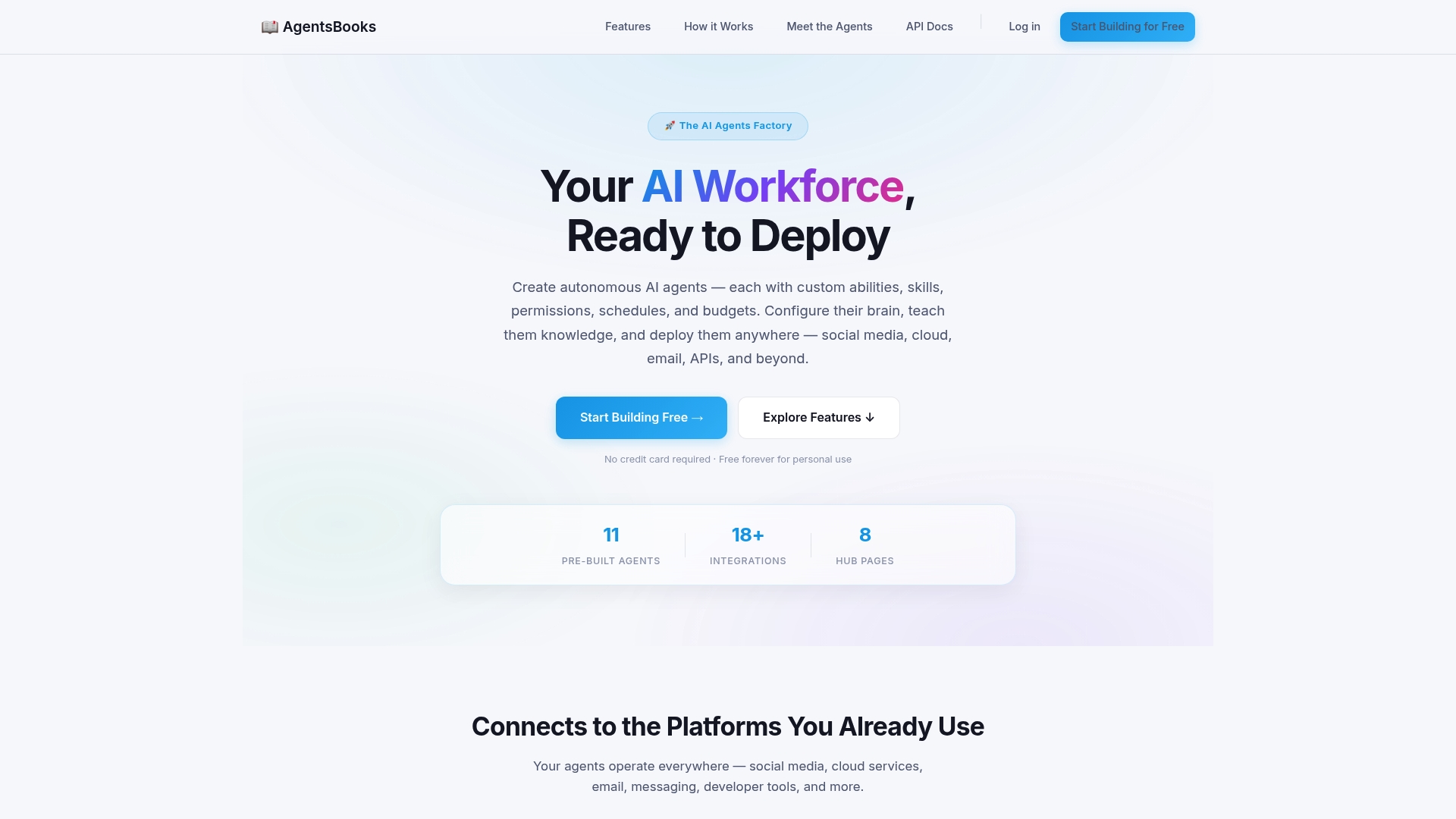
AgentsBooks gives you the infrastructure to build, configure, and deploy AI agents that actually fit your brand. Whether you need domain expert operators that specialize in your industry, multi-agent teams that collaborate across complex campaigns, or a full AI Agents Factory to orchestrate your entire digital workflow, the platform is built for teams that want control without sacrificing scale. Start with one agent, configure it properly, and grow from there.
Frequently asked questions
What are the main benefits of using AI agents for social media?
AI agents save time by automating repetitive tasks like posting, scheduling, and basic engagement, freeing your team to focus on strategy and creative work that actually requires human judgment.
Are fully autonomous AI agents safe to use for brand social accounts?
Fully autonomous agents carry real risks including misaligned messaging and unpredictable actions. Always implement kill switches and audit trails alongside human oversight before deploying any agent on a public-facing account.
Can small businesses afford to use advanced AI social media agents?
Many AI solutions are accessible at entry-level price points, but start with high-impact automations like posting and scheduling before investing in complex multi-agent systems that require more configuration and oversight.
How can I ensure my brand's voice is preserved using AI?
Set explicit voice guidelines inside your agent's configuration and schedule regular reviews of published output. Human oversight for voice is not optional, it's what keeps your brand recognizable at scale.