
Many marketing professionals believe AI will completely replace human marketers, automating every campaign decision from strategy to execution. This misconception overlooks AI's true value as a powerful augmentation tool rather than a replacement. AI enhances digital marketing by processing vast datasets, predicting customer behavior, and optimizing campaigns in real time, but it still requires human creativity, strategic thinking, and oversight to deliver meaningful results. This guide explores how AI core mechanics in digital marketing include predictive analytics, natural language processing, and machine learning for forecasting outcomes, content generation, and audience targeting. You'll learn practical implementation steps, common pitfalls to avoid, and strategies for measuring AI's impact on your marketing ROI.
Table of Contents
- Key takeaways
- Understanding AI technologies transforming digital marketing
- How to implement AI in digital marketing: a phased roadmap
- Risks and challenges of AI adoption in digital marketing
- Maximizing ROI: human-AI collaboration and measuring success
- Discover advanced AI-powered marketing solutions with AgentsBooks
- FAQ
Key Takeaways
| Point | Details |
|---|---|
| Core AI technologies | Predictive analytics, natural language processing, and machine learning enable forecasting, content creation, and real time optimization while humans provide strategy and oversight. |
| Phased implementation | A structured rollout with data governance audits and pilots reduces risk and builds confidence. |
| Human oversight matters | Human creativity and governance are essential to prevent data quality problems and excessive automation. |
| Efficiency and personalization | Adopting AI at scale improves campaign efficiency and delivers more tailored experiences for customers. |
Understanding AI technologies transforming digital marketing
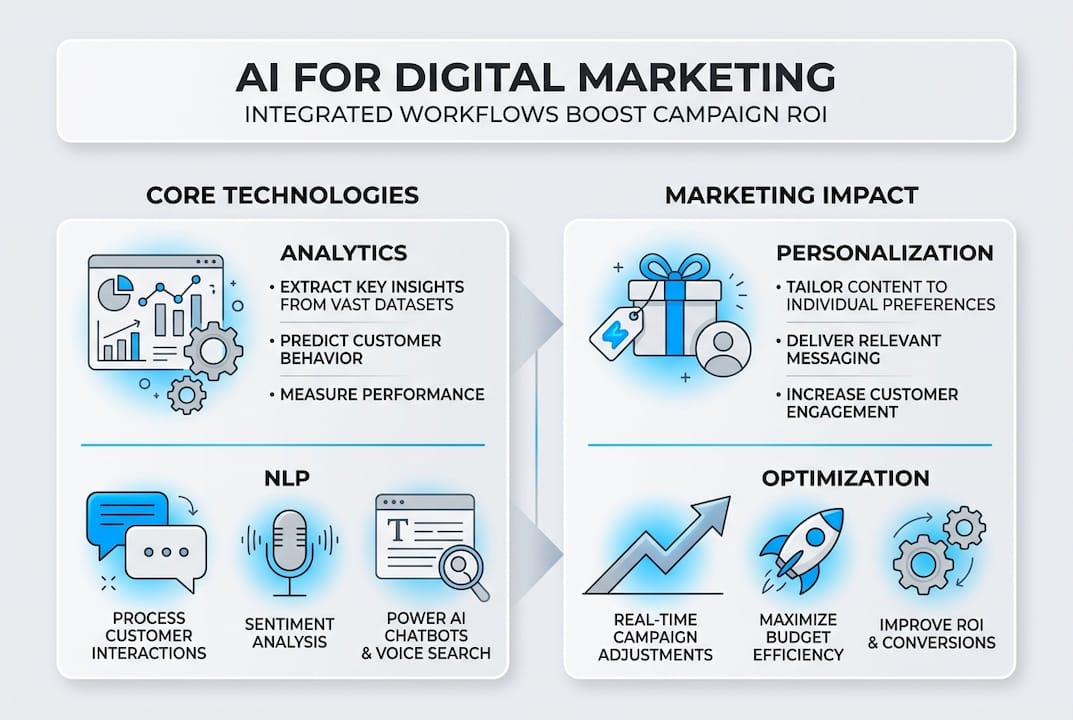
Three core AI technologies power modern digital marketing innovation. Predictive analytics uses historical data patterns to forecast future outcomes like customer churn probability, lifetime value projections, and return on ad spend. This technology helps you allocate budgets more effectively by identifying which channels and audiences will generate the highest returns before you spend a dollar.

Natural language processing enables machines to understand and generate human language at scale. Marketing teams use NLP to analyze customer sentiment across social media, generate personalized email copy, and create product descriptions that resonate with specific audience segments. The technology processes thousands of customer reviews in minutes, extracting themes and emotional tones that would take human analysts weeks to compile.
Machine learning algorithms identify complex patterns in customer behavior that humans might miss. These systems continuously improve campaign performance by testing variables like ad creative, bidding strategies, and audience segments, then automatically adjusting based on what drives conversions. ML excels at dynamic optimization across multiple channels simultaneously, something impossible for manual campaign management.
Each technology serves distinct marketing functions. Predictive analytics guides strategic planning and budget allocation. NLP streamlines content creation and customer communication analysis. ML handles tactical optimization and real-time bidding decisions. Understanding these differences helps you select the right AI tools for specific marketing challenges rather than adopting technology for its own sake.
The ai marketing agency approach combines all three technologies into integrated workflows. This creates compound benefits where predictive insights inform content strategies, ML optimizes distribution, and NLP personalizes messaging at scale. The synergy between these AI capabilities produces results beyond what any single technology delivers alone.
Pro Tip: Start by mapping your current marketing workflows to identify which AI technology addresses your biggest bottleneck. If you struggle with audience targeting, prioritize ML tools. If content production limits your output, focus on NLP solutions first.
How to implement AI in digital marketing: a phased roadmap
Successful AI adoption follows a structured progression rather than wholesale replacement of existing systems. Implementation follows phases with foundation work including audits and tool selection, implementation through pilot programs, and scaling with optimization. This methodical approach reduces risk while building organizational confidence in AI capabilities.
The foundation phase begins with a comprehensive audit of your current data infrastructure and marketing technology stack. Assess data quality, completeness, and accessibility across customer touchpoints. Poor data quality undermines even the most sophisticated AI, so address gaps before investing in new tools. Evaluate existing platforms for AI integration capabilities, as native integrations typically perform better than standalone solutions.
Tool selection requires aligning AI capabilities with specific marketing objectives. Define clear success metrics before evaluating vendors. A predictive analytics platform that forecasts customer churn serves retention goals differently than an NLP tool optimizing ad copy for conversions. Request proof of concept demonstrations using your actual data rather than vendor case studies, as performance varies significantly across industries and datasets.
Pilot programs test AI tools on controlled campaigns before full deployment. Select a single channel or audience segment where you can measure impact clearly. Run parallel campaigns with and without AI assistance to establish baseline comparisons. Document both successes and failures during pilots, as learning from limitations proves as valuable as celebrating wins. Most organizations need three to six months of pilot testing before confident scaling decisions.
Scaling involves expanding successful AI applications across additional channels, campaigns, and teams. Budget allocation typically increases from 15-40% for AI tools as organizations move from pilots to full implementation. This investment covers software licensing, data infrastructure upgrades, and team training. Gradual scaling prevents overwhelming your team while allowing time to develop AI management expertise.
The configure ai brains business automation approach emphasizes customization over generic deployment. Configure AI systems with your brand voice, compliance requirements, and strategic priorities built into decision algorithms. Generic AI tools produce generic results, while customized implementations deliver competitive advantages.
Pro Tip: Create a dedicated AI steering committee with representatives from marketing, IT, legal, and finance. This cross-functional oversight ensures AI implementation addresses technical requirements, regulatory compliance, and business objectives simultaneously.
Risks and challenges of AI adoption in digital marketing
AI implementation carries significant risks that require proactive management. 60% of AI pitfalls come from integration failures where systems fail to communicate effectively, creating data silos and inconsistent customer experiences. Poor data quality and over-automation cause unreliable decisions that waste budgets and damage brand reputation. Understanding these challenges helps you build safeguards before problems emerge.
Data quality issues follow the garbage in, garbage out principle. AI systems trained on incomplete, biased, or outdated data produce flawed recommendations that hurt campaign performance. A predictive model trained on historical data from three years ago might miss recent market shifts, leading to misallocated budgets. Regular data audits and cleaning processes must become standard practice, not one-time exercises during initial implementation.
Over-automation creates robotic customer experiences that alienate audiences. AI-generated content lacking human review often misses cultural nuances, uses inappropriate tone, or makes factual errors. Fully automated customer service responses frustrate users when systems cannot handle complex queries or show empathy. Balance efficiency gains against the need for authentic human connection in customer relationships.
Integration failures occur when AI tools cannot access necessary data or communicate with existing marketing platforms. These technical barriers prevent AI from delivering promised capabilities. A content generation tool disconnected from your customer data management platform cannot personalize messaging effectively. Before purchasing AI solutions, verify integration capabilities with your current technology stack through technical testing, not vendor promises.
Brand consistency suffers when multiple AI tools generate content without centralized governance. Different systems might use varying brand voices, create conflicting messages, or make incompatible promises to customers. Establish clear brand guidelines that AI systems must follow, with human review processes catching deviations before publication.
Effective AI governance requires clear policies defining where automation enhances marketing and where human judgment remains essential. Document decision rights, approval workflows, and escalation procedures before deploying AI at scale.
The managing ai at scale framework addresses these risks through structured oversight. Implement monitoring systems that flag anomalies in AI outputs, establish regular performance reviews, and maintain human veto power over automated decisions. This governance structure prevents small AI errors from becoming major brand crises.
Risk mitigation also requires ongoing team education. Marketing professionals need training to recognize AI limitations, interpret system recommendations critically, and intervene when automation produces poor results. Invest in building AI literacy across your marketing organization, not just among technical specialists.
Maximizing ROI: human-AI collaboration and measuring success
The highest performing marketing organizations recognize that human-AI collaboration produces 2.4x better outcomes than either humans or AI working independently. This synergy emerges when humans provide strategic direction, creative vision, and emotional intelligence while AI handles data processing, pattern recognition, and optimization at scale. Understanding how to orchestrate this collaboration determines whether AI investments generate substantial returns or disappointing results.
Humans excel at strategic thinking that AI cannot replicate. You understand market dynamics, competitive positioning, and brand values in ways algorithms miss. Use your judgment to set campaign objectives, define target audiences, and establish brand guardrails that guide AI operations. AI then optimizes tactics within these strategic parameters, testing variables and adjusting approaches faster than manual management allows.
AI processes vast datasets to surface insights humans would never discover manually. Machine learning algorithms identify micro-segments with high conversion potential, predict optimal timing for customer outreach, and detect emerging trends in search behavior. Your role involves interpreting these insights within broader business context and deciding which opportunities warrant investment. AI suggests possibilities, humans make strategic choices.
Measuring AI's true impact requires causal analysis rather than simple correlation. CMOs adopt AI slower due to governance fears and difficulty isolating AI contributions from other marketing activities. Implement control groups where some campaigns use AI while comparable campaigns do not, measuring performance differences. This approach reveals whether AI genuinely improves results or simply correlates with successful campaigns that would have performed well anyway.
Causal measurement prevents overestimating AI value. An AI tool might recommend targeting an audience segment that was already trending toward conversion. Without control groups, you might credit AI for results that would have occurred regardless. Rigorous measurement methodology ensures you invest in AI capabilities that truly drive incremental performance rather than expensive placebos.
| Collaboration Model | Human Role | AI Role | Outcome Quality |
|---|---|---|---|
| Human-only | Strategy, execution, optimization | None | Baseline performance, limited scale |
| AI-only | Minimal oversight | All decisions and execution | Fast but often misaligned with brand values |
| Human-AI partnership | Strategy, oversight, creative direction | Data analysis, optimization, execution | 2.4x better results with scalable efficiency |
The managing ai at scale approach emphasizes governance structures that formalize human-AI collaboration. Define decision rights clearly, specifying which choices AI makes autonomously and which require human approval. Marketing teams using this framework report higher AI satisfaction and better performance outcomes.
External research from McKinsey on AI personalization demonstrates how combining human creativity with AI's analytical power creates customer experiences neither could achieve alone. Personalization engines suggest relevant content, but humans design the overall customer journey and emotional narrative that builds lasting relationships.
Pro Tip: Establish weekly AI performance reviews where marketing teams examine automated decisions, override poor choices, and feed corrections back into systems. This continuous improvement loop trains AI to make better decisions while keeping humans engaged in oversight.
Discover advanced AI-powered marketing solutions with AgentsBooks
Transforming AI concepts into operational marketing capabilities requires platforms purpose-built for professional deployment. AgentsBooks delivers ai domain expert operators that function as specialized marketing team members, each configured with deep expertise in specific platforms and tactics. These AI operators manage campaigns across social media, email, content distribution, and advertising channels with minimal human intervention.
Build ai multi agent teams where specialized operators collaborate on complex campaigns. One agent analyzes audience data and identifies high-value segments while another generates personalized content and a third optimizes distribution timing. This coordinated approach mirrors how human marketing teams divide responsibilities but executes at machine speed and scale.
The ai marketing agency framework provides turnkey solutions for professionals seeking immediate AI capabilities without lengthy implementation projects. Access pre-configured agents trained on marketing best practices, then customize them with your brand guidelines, compliance requirements, and strategic priorities. Deploy AI marketing operations in days rather than months, accelerating your competitive advantage.
FAQ
What is the main benefit of AI in digital marketing?
AI dramatically improves personalization and campaign efficiency through real-time data analysis that humans cannot match at scale. It enables marketers to target audiences with precision while optimizing ad spend dynamically across channels. The technology processes millions of customer signals simultaneously, adjusting campaigns based on performance patterns as they emerge.
How do I start integrating AI into my marketing strategy?
Begin with a comprehensive data audit to assess quality and accessibility across your marketing systems. Identify specific marketing goals where AI capabilities like predictive analytics or content optimization can drive measurable improvement. Pilot AI tools on small, controlled campaigns before expanding to full-scale implementation, using this testing phase to build team expertise and confidence.
What are common pitfalls to avoid when using AI in marketing?
Poor data quality undermines even sophisticated AI systems, producing unreliable recommendations that waste budgets. Over-automation without human oversight creates robotic customer experiences that damage brand relationships and miss cultural nuances. Integration failures prevent AI tools from accessing necessary data, while inadequate governance allows inconsistent brand messaging across automated channels.
Can AI completely replace marketers?
AI supports marketers by automating repetitive workflows and processing vast datasets but cannot replace strategic human judgment and creativity. The technology lacks emotional intelligence, cultural awareness, and the ability to understand complex brand positioning that requires human insight. Collaboration between humans and AI yields the best marketing results, with humans providing strategic direction while AI handles optimization and execution at scale.
How do I measure the success of AI-driven campaigns?
Use causal measurement techniques with control groups to isolate AI's true impact from other factors affecting campaign performance. Compare results between AI-assisted campaigns and similar campaigns without AI to determine incremental value. Combine quantitative AI analytics with qualitative human assessment of brand consistency and customer satisfaction for balanced performance evaluation.