
AI-driven content sharing isn't just a buzzword anymore. In 2026, businesses are slashing content costs by 99.8% while simultaneously boosting engagement through intelligent personalization. If you think AI is too complex or expensive for your marketing stack, you're missing a massive opportunity. This article breaks down exactly how agentic AI systems work, why personalized content drives sales, and what pitfalls to avoid when automating your content workflows. You'll walk away with a clear roadmap for implementing AI-powered content sharing that delivers measurable ROI without sacrificing quality.
Table of Contents
- How AI Drastically Cuts Content Sharing Costs And Scales Production
- How AI-Powered Personalization Boosts Engagement And Sales
- Understanding Agentic AI Workflows And Best Practices For Content Sharing
- Common Pitfalls And How To Maintain Quality With AI-Driven Content Sharing
- Discover AgentsBooks AI-Powered Content Sharing Solutions
- Frequently Asked Questions
Key takeaways
| Point | Details |
|---|---|
| Cost reduction | AI systems can reduce content production expenses by up to 99.8% compared to traditional methods |
| Personalization impact | Tailored content and calls-to-action perform 202% better than generic alternatives |
| Agentic workflows | Multi-agent AI systems automate complex content creation and distribution with minimal human input |
| Quality control | Human oversight remains essential to maintain brand consistency and prevent errors |
| Strategic implementation | Clear workflows and performance monitoring are critical for successful AI deployment |
How AI drastically cuts content sharing costs and scales production
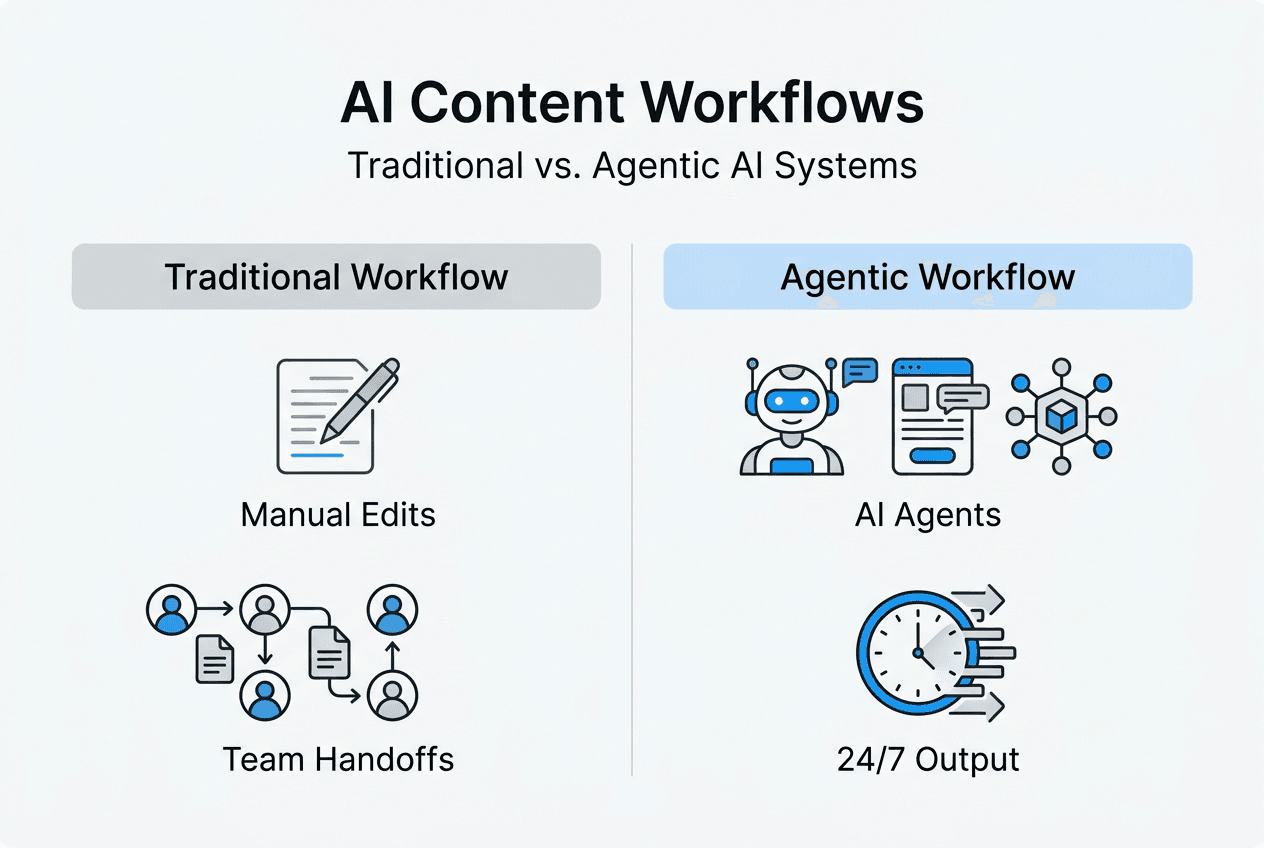
Agentic AI systems use specialized AI agents to autonomously create and share content across multiple platforms. Unlike traditional automation that follows rigid rules, these agents make decisions, adapt to context, and collaborate to complete complex workflows. The cost savings are staggering.
Consider Anyreach's transformation. They reduced content production costs from $2,505 to $4.95 per month, a 99.8% reduction. Their cost per blog post dropped to $0.015, enabling them to produce hundreds of targeted pieces without hiring additional writers. This isn't theoretical. Real businesses are achieving these results right now.
The scalability factor changes everything. Traditional content teams hit capacity limits quickly. Adding more content means hiring more people, which means linear cost increases. AI breaks this model entirely. Once you build effective workflows, producing 10 articles costs roughly the same as producing 100.
Cost comparison: traditional vs. AI content production
| Method | Monthly cost | Cost per article | Scalability |
|---|---|---|---|
| Traditional team | $2,500+ | $50-250 | Limited by headcount |
| Agentic AI system | $5-50 | $0.01-5 | Near infinite |
| Hybrid approach | $500-1,000 | $10-50 | High with quality control |
Here's what makes agentic AI particularly powerful for content sharing:
- Autonomous decision making allows agents to choose optimal posting times and platforms
- Multi-platform distribution happens simultaneously without manual coordination
- Content adaptation occurs automatically for different channels and audiences
- Performance monitoring feeds back into content optimization loops
- Integration with existing tools happens through APIs and webhooks
Businesses can automate social media posts while maintaining brand voice and responding to engagement patterns. The AI doesn't just post content. It analyzes what works, adjusts timing, and refines messaging based on real performance data.
Pro Tip: Start by automating your most repetitive content tasks like social media scheduling or email newsletters. Monitor output quality closely for the first month and refine your prompts and workflows based on what you learn. Don't automate everything at once.
The agentic AI cost savings extend beyond direct production costs. You eliminate bottlenecks, reduce project management overhead, and free your team to focus on strategy rather than execution. The ROI compounds quickly when you factor in speed and consistency improvements.

How AI-powered personalization boosts engagement and sales
Generic content doesn't cut it anymore. Your audience expects experiences tailored to their interests, behavior, and stage in the buyer journey. AI makes this level of personalization achievable at scale.
The numbers tell a compelling story. Personalized CTAs perform 202% better than generic ones. Conversion rates increase by 10 to 15% when AI drives personalization. Businesses leveraging AI personalization report 10 to 20% higher sales ROI and up to 8x better marketing returns. These aren't marginal improvements. They're transformative.
Consider what personalization actually means in practice. AI analyzes individual user data like browsing history, past purchases, email engagement, and demographic information. It then tailors content elements in real time. A returning customer sees different messaging than a first-time visitor. Someone who abandoned a cart gets targeted follow-up content. Geographic location influences product recommendations.
Here's what AI-powered personalization enables:
- Dynamic content blocks that change based on user attributes
- Personalized email subject lines and body content for each recipient
- Adaptive website experiences that highlight relevant products or services
- Customized social media ads targeting specific audience segments
- Intelligent content recommendations based on consumption patterns
The frustration factor matters too. Research shows 76% of customers feel frustrated when digital experiences aren't personalized. You're not just missing an opportunity to boost engagement. You're actively annoying your audience when you serve them irrelevant content.
"AI personalization isn't about creepy tracking. It's about respecting your audience's time by showing them what actually matters to them. When done right, it feels helpful, not invasive."
Building AI personal brand growth strategies around personalization creates compound effects. As your AI learns more about your audience, recommendations improve. Better recommendations drive more engagement. More engagement generates more data. The cycle reinforces itself.
Pro Tip: Begin with one personalization element like customized email greetings or location-based content. Test it thoroughly, measure the impact, then expand to more sophisticated personalization as you build confidence and gather data.
The AI personalization benefits extend beyond immediate conversions. You build stronger customer relationships when people feel understood. Loyalty increases. Lifetime value grows. Word-of-mouth referrals improve because customers have genuinely positive experiences worth sharing.
Understanding agentic AI workflows and best practices for content sharing
Agentic AI workflows operate fundamentally differently than traditional automation. Instead of rigid if-then rules, you orchestrate multiple specialized agents that collaborate to achieve complex goals. Understanding this architecture helps you implement effective systems.
Each agent in an agentic system handles specific tasks. One agent might research trending topics. Another drafts content. A third optimizes for SEO. A fourth schedules and publishes. They pass information between stages, make autonomous decisions within their domains, and adapt based on feedback. The orchestration layer coordinates these agents into coherent workflows.
The engineering lifecycle for multi-agent AI workflows includes tool-first design and externalized prompt management. This means you define tools and capabilities before building agents, then manage prompts separately from code. This separation makes workflows easier to maintain and improve over time.
Best practices for agentic AI content workflows:
- Define clear task boundaries for each agent to prevent overlap and confusion
- Establish explicit handoff criteria between workflow stages
- Implement quality gates that require human approval for critical decisions
- Use structured data formats for inter-agent communication
- Monitor agent performance with specific metrics for each task type
- Version control your prompts and workflows like you would code
- Build feedback loops so agents learn from performance data
- Start simple with linear workflows before adding complex branching
- Document your agent configurations and decision logic thoroughly
The choice between task grouping and individual agents impacts efficiency significantly. Grouping related tasks into single agents reduces coordination overhead but limits specialization. Individual agents for each micro-task maximize optimization but increase complexity. Most successful implementations find a middle ground.
Agent architecture comparison
| Approach | Pros | Cons | Best for |
|---|---|---|---|
| Single generalist agent | Simple to manage, low overhead | Limited optimization, prone to errors | Small-scale operations |
| Multiple specialized agents | Highly optimized, scalable | Complex coordination, higher setup cost | Enterprise content operations |
| Hybrid model | Balanced performance and complexity | Requires careful planning | Most business use cases |
Human-in-the-loop oversight remains critical even with advanced AI. Agents can drift from brand guidelines, miss cultural nuances, or generate factually incorrect content. Regular review catches these issues before they reach your audience. The goal isn't eliminating humans. It's amplifying their impact by handling repetitive work automatically.
Building multi-agent AI teams requires upfront planning but pays dividends in reliability and output quality. You're essentially creating a digital workforce that operates 24/7 without fatigue or inconsistency.
Pro Tip: Map your content workflow on paper before building any AI agents. Identify decision points, quality criteria, and handoffs. This planning phase prevents costly rework and helps you spot potential issues before they become problems.
The principles of managing AI at scale apply directly to content workflows. As you add more agents and increase output volume, governance becomes essential. You need monitoring dashboards, performance benchmarks, and clear escalation procedures when agents produce unexpected results.
Common pitfalls and how to maintain quality with AI-driven content sharing
Even well-designed AI systems fail when businesses skip critical planning steps or ignore warning signs. Understanding common pitfalls helps you avoid expensive mistakes and maintain content quality as you scale.
The biggest mistake is launching without a clear AI strategy. You need defined goals, success metrics, and quality standards before deploying any automated content system. Otherwise, you're just creating content noise without purpose. Over-reliance on AI without human oversight risks poor quality and brand inconsistency.
Top pitfalls in AI content sharing:
- Unclear goals and success metrics leading to directionless content production
- Garbage-in garbage-out syndrome from poorly structured input data and prompts
- Over-automation without quality gates allowing errors to reach audiences
- Inconsistent brand voice when agents aren't properly trained on guidelines
- Ignoring performance data and failing to iterate on what works
- Skipping human review cycles that catch nuanced errors
- Using generic AI models without customization for your specific needs
- Neglecting to update agent knowledge as your business evolves
The garbage-in garbage-out problem deserves special attention. AI agents are only as good as the information and instructions you provide. Vague prompts produce vague content. Outdated knowledge bases generate irrelevant recommendations. Incomplete brand guidelines result in inconsistent messaging.
Human-in-the-loop review serves multiple purposes beyond catching errors. It provides training data for improving agent performance. It ensures cultural sensitivity and brand alignment that AI might miss. It maintains the authentic voice that builds genuine connections with audiences. You're not babysitting the AI. You're steering it toward better outcomes.
Quality maintenance requires systematic approaches. Set up regular content audits where you review a sample of AI-generated output against your standards. Track metrics like engagement rates, conversion performance, and audience feedback. When you spot patterns of underperformance, trace them back to specific agents or workflow stages.
The common AI content pitfalls often stem from treating AI as a magic solution rather than a tool requiring thoughtful implementation. Success comes from combining AI efficiency with human judgment and creativity.
Pro Tip: Create a quality checklist specific to your brand and content types. Have your AI agents reference this checklist during content creation, then have humans verify compliance before publication. Update the checklist quarterly based on what you learn.
Balancing automation with oversight means identifying which decisions require human input and which can safely run autonomously. Publishing a social media post might be fully automated after initial setup. Launching a major campaign probably needs human approval. Define these boundaries clearly in your workflows.
Discover AgentsBooks AI-powered content sharing solutions
Ready to implement what you've learned? AgentsBooks provides the infrastructure to build, deploy, and manage agentic AI systems for content sharing without extensive technical expertise.
Our AI domain expert operators give you pre-configured agents specialized for content marketing tasks. These aren't generic chatbots. They're purpose-built tools that understand content strategy, SEO optimization, and audience engagement.
Need more sophisticated workflows? Our AI multi-agent teams enable complex collaboration between specialized agents. Research, writing, optimization, and distribution happen in coordinated workflows you design.
The platform makes it simple to automate social media posts and blog writing with AI agents that learn your brand voice. You maintain creative control while eliminating repetitive execution work. Three-step deployment means you're creating value in hours, not months. The tools scale with your needs, from solo entrepreneurs to enterprise marketing teams.
Frequently asked questions
What is agentic AI and how does it help with content sharing?
Agentic AI uses autonomous agents that make decisions, collaborate, and adapt to complete complex tasks without constant human direction. For content sharing, this means agents can research topics, draft posts, optimize for platforms, schedule publication, and analyze performance automatically. Unlike traditional automation that follows fixed rules, agentic systems handle unexpected situations and improve through experience.
How can AI personalization improve customer engagement?
AI analyzes individual user data to tailor content, recommendations, and calls-to-action for each person. This relevance dramatically increases engagement because people see content that actually matters to them. Personalized experiences perform 202% better than generic ones and drive 10 to 15% higher conversion rates. Customers also feel more valued when brands demonstrate understanding of their needs.
What are the risks of relying solely on AI for content creation?
AI can generate factually incorrect information, miss cultural nuances, drift from brand guidelines, and produce generic content lacking authentic voice. Without human oversight, these issues reach your audience and damage credibility. AI also struggles with truly creative thinking and strategic decisions that require business context. The best approach combines AI efficiency with human judgment and creativity.
How do I start implementing AI for content sharing in my business?
Begin by mapping your current content workflow and identifying repetitive tasks suitable for automation. Start with one specific use case like social media scheduling or email personalization rather than trying to automate everything. Choose tools that integrate with your existing systems and provide clear documentation. Run pilot projects with close monitoring before scaling. Measure results against specific goals and iterate based on what you learn.
Can AI replace human content marketers entirely?
No. AI excels at execution, data analysis, and scaling repetitive tasks, but humans provide strategic thinking, creative direction, brand intuition, and relationship building that AI cannot replicate. The most effective approach uses AI to handle time-consuming production work while humans focus on strategy, quality control, and authentic audience connection. Think of AI as amplifying human capabilities rather than replacing them.