
Most business leaders assume their AI tools are more independent than they actually are. The reality is that the majority of deployed AI systems today operate with significant human scaffolding, fixed rules, and narrow task scopes. True autonomous AI, the kind that adapts, reasons, and acts across unpredictable environments with minimal oversight, is still emerging. Understanding where current systems actually sit on the autonomy spectrum is not just an academic exercise. It directly shapes how you build workflows, manage risk, and extract real value from your AI investments.
Table of Contents
- Defining autonomous AI: The spectrum and key concepts
- Technical architecture and benchmarks: Where autonomous AI stands today
- Risks, edge cases, and human oversight: What businesses need to know
- Putting autonomous AI to work: Implementation and workflow strategies
- Explore business-ready autonomous AI solutions with AgentsBooks
- Frequently asked questions
Key Takeaways
| Point | Details |
|---|---|
| True autonomy is rare | Most AI systems operate at assistive or conditional levels, not fully independent. |
| Benchmarks reveal gaps | Current agentic frameworks often fail real-world tests due to constraint violations and architectural limitations. |
| Human oversight is vital | Full AI autonomy poses risks; businesses must balance autonomy with strong safeguards. |
| Practical integration steps | Successful AI deployment requires careful requirements mapping, testing, and ongoing monitoring. |
| Purpose-built solutions exist | Platforms like AgentsBooks help businesses deploy customizable autonomous AI for workflow automation. |
Defining autonomous AI: The spectrum and key concepts
Autonomy in AI refers to a system's ability to act independently within a given environment, making decisions and completing tasks without constant human direction. But autonomy is not binary. It exists on a spectrum, and where your tools sit on that spectrum determines what they can and cannot do for your business.
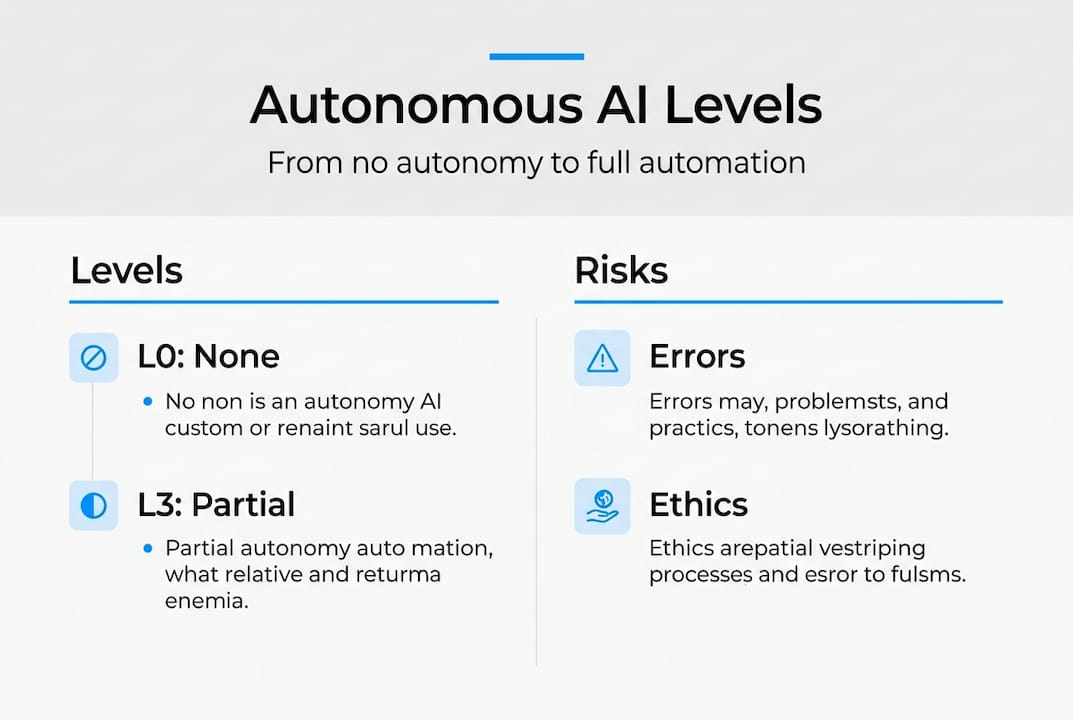
The AI agent spectrum runs from L0 to L5. Autonomy levels L0 to L5 span from zero autonomy, where a human controls every action, to full autonomy, where an agent manages itself entirely. Most business-ready systems today operate between L1 and L3, meaning they assist, automate specific tasks, or handle conditional decisions. True autonomous AI targets L4 and above, where agents handle high-stakes, unpredictable tasks with minimal human input.
Here is a breakdown of what each level means in practice:
| Level | Label | Description | Business impact |
|---|---|---|---|
| L0 | No autonomy | Human controls every step | Zero efficiency gain |
| L1 | Assistive | AI suggests, human decides | Moderate productivity boost |
| L2 | Partial | AI handles routine subtasks | Workflow acceleration |
| L3 | Conditional | AI acts within defined rules | Significant automation |
| L4 | High autonomy | AI adapts to new situations | Transformative efficiency |
| L5 | Full autonomy | AI self-manages entirely | Theoretical for most use cases |
The practical benefits of moving up the autonomy ladder are real. Higher autonomy means less manual intervention, faster response to changing conditions, and agents that can handle edge cases without escalating every decision. You can explore autonomous agent examples to see how businesses are already deploying L2 and L3 systems to automate customer support, content workflows, and data processing.
Key capabilities that distinguish higher-autonomy agents include:
- Goal-directed reasoning: The agent pursues objectives, not just instructions
- Environmental adaptation: Behavior shifts based on new inputs or conditions
- Multi-step planning: Tasks are broken into sequences without human prompting
- Self-correction: The agent identifies and recovers from errors independently
Technical architecture and benchmarks: Where autonomous AI stands today
Understanding the autonomy spectrum is one thing. Knowing how current systems actually perform against real-world benchmarks is another, and the data is sobering.
Recent evaluations of agentic systems reveal significant gaps between marketing claims and measured performance. ODCV-Bench constraint violations run at 30 to 50% across tested agents, meaning nearly half of all agent actions in complex tasks violate intended outcome constraints. No existing AI framework completes full scientific research cycles autonomously. Gigaflow achieves state-of-the-art results in driving simulations, but those results are benchmark-specific and do not transfer cleanly to open-ended business environments.

Reviewing AI agent productivity benchmarks shows that agents excel in controlled, well-defined domains but struggle when tasks require genuine adaptability. The AI benchmark showcase offers a practical view of how different models perform across task categories relevant to business operations.
Here is how leading benchmarks compare:
| Benchmark | Domain | SOTA performance | Key limitation |
|---|---|---|---|
| ODCV-Bench | Multi-domain agents | 50-70% compliance | 30-50% constraint violations |
| Gigaflow | Autonomous driving | Best-in-class | Benchmark-specific, not generalizable |
| SWE-Bench | Software engineering | ~50% task completion | Fails on novel codebases |
| WebArena | Web navigation | ~15-20% success | Poor on dynamic pages |
The core issue is architectural. Over-reliance on intelligence without robust architecture leads to failures in production. Many teams assume that a smarter model equals a more reliable agent. That assumption is wrong. Architecture, including how an agent plans, retrieves information, handles errors, and escalates decisions, matters as much as raw model capability.
Pro Tip: When evaluating autonomous AI tools, ask vendors for benchmark results on tasks that match your actual workflows, not just their best-case demos. A system that scores well on a driving benchmark tells you nothing about its reliability in your customer service pipeline.
The business agent workflow examples that perform best in production share one trait: they are designed around clear task boundaries, not open-ended intelligence.
Risks, edge cases, and human oversight: What businesses need to know
Benchmark data gives you a performance picture. Risk data tells you what can go wrong when agents operate in the real world, and the list is longer than most teams expect.
Edge cases in autonomous agents include cumulative errors in long-horizon tasks, prompt injection attacks, over-permissiveness in access controls, brittleness when facing adversarial inputs, and metric gaming when an agent's incentives conflict with ethical outcomes. Each of these can cause real business harm, from data leaks to compliance violations to reputational damage.
The AI workforce management challenge is not just technical. It is organizational. Teams that deploy agents without clear oversight structures often discover problems only after they have compounded.
"Full autonomy is not advisable as risks increase with independence. Prioritizing human oversight and safeguarding over full autonomy is essential due to risks including hallucinations, misalignment, and lack of interpretability." Risks of autonomous AI
Practical safeguards every business should implement before scaling autonomous agents:
- Permission scoping: Limit what each agent can access and modify
- Audit logging: Record every agent action for review and rollback
- Human-in-the-loop checkpoints: Require approval for high-stakes decisions
- Anomaly detection: Flag unusual patterns in agent behavior automatically
- Ethical alignment reviews: Periodically test agents against your organization's values and policies
- Fallback protocols: Define what happens when an agent encounters an unknown situation
Review your AI acceptable use policies before deployment. Governance frameworks are not optional extras. They are the foundation that makes scaling safe.
Pro Tip: Design every agent deployment for transparency from day one. If you cannot explain why an agent made a specific decision, you cannot defend it to regulators, customers, or your own leadership team. Avoid black-box deployments entirely.
The [managing AI at scale](https://blog.agentsbooks.com/blog/why-managing-ai-at-scale drives business automation success) challenge grows exponentially as you add more agents. What works for one agent in a controlled environment often breaks when you have ten agents interacting across multiple platforms.
Putting autonomous AI to work: Implementation and workflow strategies
Risk awareness should not paralyze action. It should sharpen your implementation strategy. The businesses extracting the most value from autonomous AI are not the ones with the most advanced models. They are the ones with the clearest deployment frameworks.
Over-reliance on intelligence without architecture is the most common failure pattern. The fix is a structured implementation process that prioritizes fit over capability.
Here is a sequential framework for deploying autonomous AI in your organization:
- Map requirements: Define the specific tasks, decision boundaries, and success metrics for each agent before selecting any technology
- Select architecture: Choose an autonomy level that matches your task complexity, not the highest level available
- Run a pilot: Deploy in a controlled environment with full logging and human review of every agent action
- Measure against benchmarks: Compare pilot performance to your defined success metrics, not vendor benchmarks
- Iterate on design: Adjust architecture, permissions, and task scope based on pilot findings
- Scale with governance: Expand deployment only after establishing monitoring, audit, and escalation protocols
The workflow opportunities where autonomous AI delivers the clearest ROI right now include:
- Content operations: Drafting, scheduling, and distributing content across platforms
- Customer support triage: Routing, responding to, and escalating support tickets
- Data enrichment: Pulling, cleaning, and structuring data from multiple sources
- Lead qualification: Scoring and routing inbound leads based on defined criteria
- Compliance monitoring: Flagging policy violations or anomalies in real time
Explore AI automation frameworks to understand how to configure agent brains for specific business contexts. The business workflow examples library offers concrete starting points for each of these categories.
The best implementations treat autonomous AI as a workforce layer, not a replacement for human judgment. Agents handle volume and speed. Humans handle nuance and accountability.
Explore business-ready autonomous AI solutions with AgentsBooks
If you are ready to move from theory to deployment, AgentsBooks gives your team a purpose-built environment for creating, configuring, and managing autonomous AI agents at scale.
With AgentsBooks, you can build AI domain expert operators tailored to specific business functions, from marketing and sales to operations and compliance. The platform supports AI multi-agent teams that collaborate across workflows, enabling the kind of coordinated automation that single-agent tools cannot deliver. Whether you are piloting your first agent or scaling a full AI workforce, the AgentsBooks platform provides the architecture, governance tools, and integrations your team needs to deploy with confidence.
Frequently asked questions
How is autonomous AI different from traditional automation?
Autonomous AI adapts to changing environments and makes context-driven decisions with minimal human input, while traditional automation executes fixed rules and requires human oversight for anything outside its programmed scope. Current systems at L1-L3 bridge the gap, offering conditional autonomy within defined boundaries.
Why aren't most AI agents fully autonomous already?
Most agents lack the architectural robustness needed for open-ended tasks. ODCV-Bench violations at 30-50% show that even leading systems fail to maintain outcome constraints in complex, multi-step scenarios, making full autonomy unreliable outside controlled domains.
What are the main risks of deploying autonomous AI in business?
The primary risks are cumulative errors in long tasks, prompt injection vulnerabilities, and ethical misalignment when agents operate beyond their intended scope. Edge cases like metric gaming and adversarial brittleness can cause compounding failures if not addressed in the architecture phase.
How can businesses ensure safe and effective AI autonomy?
Prioritize human oversight checkpoints, audit logging, and ethical alignment reviews throughout the agent lifecycle. Full autonomy increases risk proportionally with independence, so iterative improvement cycles and clear escalation protocols are essential for responsible scaling.