
Choosing the right autonomous agent can feel overwhelming when you're staring at dozens of options, each promising to revolutionize your workflows. The wrong choice leads to wasted budgets, frustrated teams, and automation projects that stall before delivering value. This guide cuts through the noise with practical examples, selection criteria, and real-world data to help you deploy autonomous agents that actually transform your business operations.
Table of Contents
- How To Choose The Right Autonomous Agent For Your Business
- Customer Engagement Autonomous Agents
- Workflow Automation Agents Powered By Robotic Process Automation (RPA)
- Collaborative Multi-Agent Networks
- Platforms For Creating And Managing Autonomous Agents
- Challenges And Considerations In Autonomous Agent Deployment
- Summary Comparison And Situational Recommendations
- Unlock Your Business Potential With Agentsbooks
Key takeaways
| Point | Details |
|---|---|
| Agent types vary widely | Autonomous agents range from simple chatbots to complex collaborative systems, each suited to specific workflow needs. |
| Selection requires criteria | Evaluate autonomy level, integration complexity, security requirements, and scalability before choosing an agent type. |
| Examples span functions | Customer engagement chatbots, RPA for back-office tasks, and multi-agent networks address different operational challenges. |
| Platforms simplify deployment | Tools like AgentsBooks reduce technical barriers with streamlined creation, customization, and management interfaces. |
| ROI depends on fit | Matching agent capabilities to your actual workflow requirements drives measurable efficiency gains and engagement improvements. |
How to choose the right autonomous agent for your business
Selecting an autonomous agent starts with understanding three fundamental autonomy levels. Reactive agents follow predefined rules and respond to specific triggers without learning or adapting. Cognitive agents leverage machine learning to improve performance over time based on data patterns. Collaborative agents coordinate with other systems and agents to handle complex, multi-step workflows requiring dynamic decision-making.
Integration complexity directly impacts deployment success. Agents requiring extensive API development or custom middleware create longer timelines and higher costs. Look for solutions offering pre-built connectors to your existing tools like CRM systems, email platforms, and project management software. Scalability matters equally because an agent handling 100 daily interactions may collapse under 10,000 without architectural adjustments.
Pricing models span freemium tiers for basic automation to enterprise packages exceeding $50,000 annually for advanced multi-agent orchestration. Calculate total cost of ownership including setup fees, monthly subscriptions, per-interaction charges, and ongoing maintenance. Security and compliance become non-negotiable in regulated industries where data privacy violations cost $4.45 million on average.
Align agent selection with specific workflow pain points rather than chasing trendy features. If customer support queues overflow during peak hours, reactive chatbots deliver immediate relief. When invoice processing consumes 20 staff hours weekly, RPA agents reclaim that time for strategic work. For cross-functional projects requiring coordination among sales, marketing, and product teams, collaborative multi-agent systems break down silos.
Pro Tip: Start with a pilot deployment targeting one high-impact workflow before scaling across your organization to validate ROI and identify integration challenges early.
Customer engagement autonomous agents
Chatbots dominate customer service automation by handling 85% of routine queries, freeing human agents for complex problem-solving requiring empathy and creativity. These reactive agents recognize keywords and intent patterns to route requests, answer FAQs, and escalate issues when necessary. Financial services firms deploy chatbots to check account balances and transaction history, while e-commerce brands use them for order tracking and return processing.
Social media autonomous agents amplify marketing reach and engagement without overwhelming your team. They monitor brand mentions, respond to comments with contextually appropriate messages, and schedule content across platforms based on audience activity patterns. Businesses implementing social automation report engagement rate increases of 60% as agents maintain consistent presence during off-hours when human teams are unavailable.
Follower base growth accelerates dramatically with autonomous social agents sharing targeted content and engaging prospects. Companies deploying these systems achieve 25% follower increases within three months by maintaining posting frequency that would require multiple full-time staff members. The agents analyze performance metrics to optimize posting times, content formats, and messaging tone for maximum resonance.
Most customer engagement agents operate as reactive, rule-based systems prioritizing speed and scalability over nuanced understanding. They excel at high-volume, repetitive interactions where consistency matters more than creativity. Deploy them for first-line customer contact, lead qualification surveys, appointment scheduling, and basic troubleshooting before human intervention becomes necessary.
- Handle thousands of simultaneous conversations without quality degradation
- Operate 24/7 across time zones and holidays
- Capture structured data from interactions for analytics and CRM enrichment
- Reduce average response time from hours to seconds
"Chatbots transformed our customer support from a cost center into a competitive advantage by resolving 70% of inquiries instantly while gathering insights that improved our product roadmap."
Workflow automation agents powered by robotic process automation (RPA)
RPA agents revolutionize internal operations by automating structured, repetitive tasks that consume disproportionate staff time relative to their business value. They interact with software applications exactly as humans do, clicking buttons, entering data, and moving information between systems without requiring API integrations or custom code. Finance teams deploy RPA for invoice processing, expense report reconciliation, and month-end closing procedures.

These agents deliver 20-40% time savings in high-volume processes like employee onboarding, vendor management, and compliance reporting. Human resources departments reclaim hundreds of hours monthly by automating background check coordination, benefits enrollment, and new hire documentation. Supply chain operations benefit from RPA agents monitoring inventory levels, generating purchase orders, and updating shipment tracking across multiple carrier systems.
Scalability defines RPA's core advantage because adding capacity means deploying additional bot instances rather than hiring and training staff. A single RPA agent processes 500 insurance claims daily with perfect accuracy, matching the output of three full-time employees without breaks, sick days, or turnover concerns. Customization allows tailoring agents to unique business rules and approval workflows specific to your industry and organizational structure.
Ideal applications include back-office processes requiring rule-based consistency and audit trails. Deploy RPA agents for data migration projects, regulatory report generation, customer account updates, and system integration when legacy applications lack modern APIs. They eliminate human error in repetitive tasks while creating detailed execution logs for compliance verification.
- Execute tasks 24/7 without supervision or downtime
- Scale processing capacity instantly during peak periods
- Maintain perfect accuracy in data entry and validation
- Free knowledge workers for strategic analysis and relationship building
Pro Tip: Document your current manual processes thoroughly before RPA deployment to identify optimization opportunities and ensure agents replicate best practices rather than automating inefficiencies.
Collaborative multi-agent networks
Multi-agent systems coordinate specialized autonomous agents to handle complex workflows requiring expertise from multiple domains. A customer onboarding network might include agents for identity verification, credit checking, account provisioning, and welcome communications, each executing their portion while sharing data through a central orchestration layer. These systems excel when single-agent approaches create bottlenecks or fail to capture cross-functional requirements.
Operational bottlenecks decrease by approximately 25% when organizations deploy collaborative agents that eliminate handoff delays between departments. Traditional workflows stall when information waits in email inboxes or approval queues, but agent networks process requests continuously by triggering downstream actions immediately upon completion of prerequisite steps. Product development teams coordinate design reviews, compliance checks, and launch preparations through agent systems that maintain momentum across time zones.
Agility improves dramatically as multi-agent architectures adapt to changing business conditions by reconfiguring agent roles and responsibilities without rebuilding entire automation systems. When market conditions shift or regulatory requirements change, you update individual agent behaviors rather than redesigning monolithic workflows. This modularity supports experimentation because testing new processes involves deploying additional specialized agents alongside existing ones.
Sophisticated orchestration requirements mean multi-agent systems demand more upfront planning and technical expertise than single-purpose agents. You must define communication protocols, data sharing standards, and conflict resolution rules governing agent interactions. The AgentsBooks platform simplifies this complexity with visual workflow designers and pre-built agent templates for common collaboration patterns.
- Enable parallel processing of workflow steps to compress cycle times
- Support dynamic task allocation based on agent availability and workload
- Facilitate knowledge sharing across organizational silos
- Scale horizontally by adding specialized agents as needs evolve
| Agent Role | Primary Function | Coordination Points |
|---|---|---|
| Data Validation | Verify information accuracy and completeness | Triggers processing agents upon successful validation |
| Processing | Execute core business logic and transformations | Coordinates with validation and notification agents |
| Notification | Communicate status updates to stakeholders | Receives completion signals from processing agents |
| Exception Handling | Manage errors and edge cases | Monitors all agents and escalates unresolved issues |
Platforms for creating and managing autonomous agents
AgentsBooks streamlines autonomous agent development through a three-step process requiring minimal technical expertise. First, you create agent profiles by describing desired behaviors, knowledge domains, and interaction patterns in natural language. Second, you configure AI models selecting from GPT, Claude, and other leading options based on reasoning requirements and cost considerations. Third, you deploy agents across social media, email, APIs, messaging platforms, and cloud services through pre-built integrations.
Advanced AI models embedded in the platform enable sophisticated agent capabilities beyond simple rule-following. GPT-powered agents understand context and nuance for natural conversations, while Claude excels at analytical tasks requiring multi-step reasoning. You customize agent behavior by adjusting temperature settings controlling creativity, defining response length parameters, and uploading knowledge bases from documents, websites, and databases.
Pricing flexibility accommodates businesses at every scale from startups testing automation concepts to enterprises deploying hundreds of specialized agents. Freemium tiers provide basic agent creation with usage limits, professional plans add advanced AI models and priority support, and enterprise packages include dedicated infrastructure, custom integrations, and white-label options. This graduated approach lets you start small and expand as ROI justifies increased investment.
Developer tools distinguish AgentsBooks from simpler chatbot builders by exposing full platform capabilities through REST APIs, SDKs in popular programming languages, and open-source code repositories. Technical teams build custom agent behaviors, integrate proprietary data sources, and orchestrate complex multi-agent workflows programmatically while non-technical users leverage visual interfaces for standard use cases.
- Visual workflow builders eliminate coding for common automation patterns
- Knowledge ingestion supports PDFs, websites, databases, and structured data
- Scheduling capabilities trigger agents based on time, events, or system conditions
- Analytics dashboards track agent performance, user satisfaction, and workflow efficiency
| Plan Tier | Monthly Cost | Agent Limit | AI Models | Support Level |
|---|---|---|---|---|
| Freemium | $0 | 3 agents | Basic | Community |
| Professional | $199 | 25 agents | GPT, Claude | |
| Business | $799 | 100 agents | All models | Priority |
| Enterprise | Custom | Unlimited | Custom fine-tuning | Dedicated |
Challenges and considerations in autonomous agent deployment
Integration complexity ranks as the top barrier for 40% of businesses attempting autonomous agent adoption. Legacy systems lacking modern APIs require middleware development or RPA-style screen scraping that increases costs and fragility. Data format inconsistencies between platforms create transformation requirements consuming development resources before agents deliver value. Establish clear integration requirements during vendor evaluation to avoid surprises during implementation.
Security concerns demand rigorous attention because autonomous agents access sensitive customer data, proprietary business information, and system credentials. Implement least-privilege access controls granting agents only the permissions required for their specific functions. Encrypt data in transit and at rest, maintain detailed audit logs of agent actions, and conduct regular security reviews as agent capabilities expand. Compliance frameworks like GDPR, HIPAA, and SOC 2 impose specific requirements on automated systems handling protected information.
Change management determines whether deployed agents achieve adoption or face resistance from staff perceiving automation as threatening job security. Communicate clearly how agents augment human capabilities rather than replace workers, emphasizing that automation frees people for higher-value activities requiring creativity and judgment. Involve end users in agent design and testing to build ownership and surface usability improvements before organization-wide rollout.
Best practices accelerate successful deployments while minimizing risks. Start with pilot projects targeting well-defined workflows with measurable success criteria before expanding scope. Monitor agent performance continuously to identify errors, optimization opportunities, and evolving requirements as business conditions change. Partner with experienced providers like AgentsBooks offering deployment guidance, training resources, and ongoing support to navigate technical and organizational challenges.
- Conduct thorough security audits before connecting agents to production systems
- Establish clear escalation paths for situations exceeding agent capabilities
- Document agent behaviors and decision logic for transparency and compliance
- Plan for agent maintenance including model updates and knowledge base refreshes
Summary comparison and situational recommendations
Choosing among autonomous agent types requires matching capabilities to specific business scenarios considering industry context, functional requirements, budget constraints, and scalability needs. Customer engagement chatbots fit organizations prioritizing customer experience improvements through faster response times and 24/7 availability. Financial services, healthcare, and retail sectors benefit most from conversational agents handling routine inquiries about accounts, appointments, and orders.
RPA agents suit operations-focused scenarios where back-office efficiency gains justify automation investments. Manufacturing, logistics, and professional services firms deploy RPA for invoice processing, inventory management, and compliance reporting. These industries feature high-volume, repetitive workflows where speed and accuracy improvements translate directly to cost savings and capacity expansion.
Virtual assistants targeting internal productivity serve knowledge workers needing help with scheduling, research, document preparation, and task coordination. Technology companies, consulting firms, and creative agencies adopt virtual assistants to reduce administrative burden on high-value personnel. Social media agents appeal to marketing-intensive businesses like consumer brands, media companies, and agencies requiring consistent content distribution and community engagement across multiple platforms.
Collaborative multi-agent systems address complex, cross-functional workflows in large enterprises where coordination failures create expensive delays. Global organizations with distributed teams benefit most from agent networks that maintain process momentum across time zones and business units. Consider multi-agent approaches when single-purpose automation leaves critical workflow gaps or creates new bottlenecks downstream.
| Agent Type | Autonomy Level | Primary Use Cases | Key Strengths | Main Constraints |
|---|---|---|---|---|
| Chatbots | Reactive | Customer service, lead qualification | Speed, scalability, 24/7 availability | Limited contextual understanding |
| RPA | Reactive | Invoice processing, data entry | Accuracy, consistency, audit trails | Requires structured data and processes |
| Virtual Assistants | Cognitive | Scheduling, research, task management | Learns user preferences, natural language | Per-user licensing costs add up |
| Social Media | Reactive | Content distribution, engagement | Brand presence, engagement metrics | Platform policy compliance required |
| Multi-Agent | Collaborative | Cross-functional workflows, complex processes | Flexibility, parallel processing | Higher implementation complexity |
Unlock your business potential with AgentsBooks
Ready to move from research to implementation? AgentsBooks eliminates the technical complexity holding back autonomous agent adoption with an intuitive platform accessible to business users while satisfying developer requirements for customization and control.
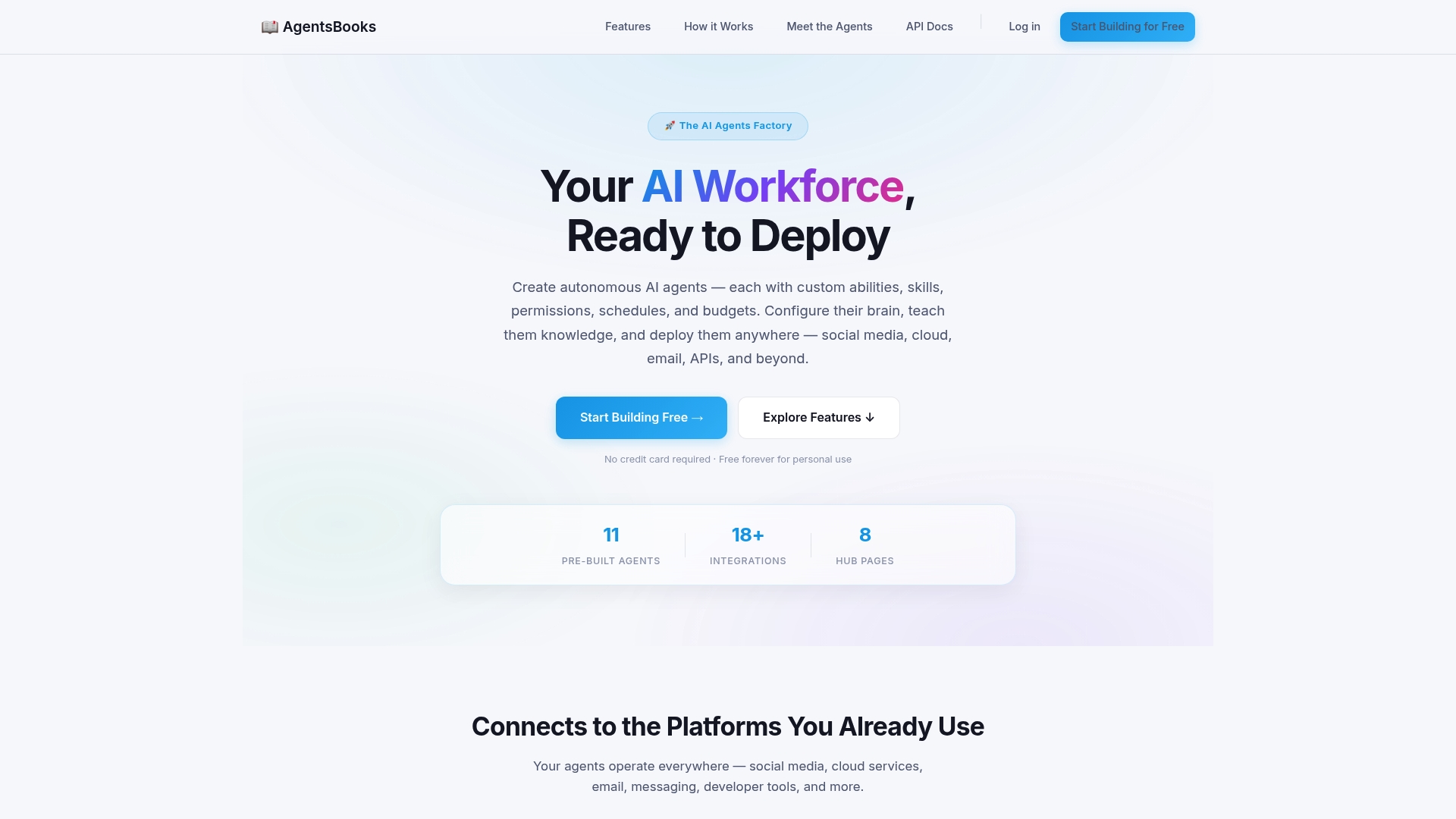
Create your first agent in minutes by describing desired behaviors in plain language, then deploy across the digital platforms powering your customer interactions and internal workflows. Whether you need a single chatbot handling support queries or a sophisticated multi-agent network coordinating cross-functional processes, AgentsBooks scales from free starter projects to enterprise deployments managing hundreds of specialized agents. Flexible pricing ensures you invest proportionally to value received as your automation strategy matures and expands.
FAQ
What are the main types of autonomous agents used in business?
Businesses primarily deploy five autonomous agent categories. Customer engagement chatbots handle inquiries and support requests with conversational interfaces. RPA agents automate back-office tasks like data entry and invoice processing. Virtual assistants support knowledge workers with scheduling and research. Social media agents maintain brand presence through automated content and engagement. Collaborative multi-agent systems coordinate complex workflows across departments.
How do I determine which autonomous agent is right for my workflow?
Assess four critical factors when selecting agents. First, evaluate required autonomy level matching reactive, cognitive, or collaborative capabilities to task complexity. Second, analyze integration difficulty with your existing technology stack. Third, verify security and compliance alignment with industry regulations. Fourth, confirm scalability to handle growth in transaction volume or user base. Pilot deployments validate fit before full-scale rollout.
What are common challenges when deploying autonomous agents?
Three barriers consistently emerge during agent deployments. Integration complexity with legacy systems lacking modern APIs requires custom development or middleware solutions. Security and data privacy concerns demand careful access controls and encryption protocols. User adoption resistance stems from change management gaps and insufficient training. Address these through phased implementation, strong vendor support like AgentsBooks provides, and continuous monitoring.
Can autonomous agents work together or do they operate independently?
Agents function both independently and collaboratively depending on system architecture. Simple deployments use standalone agents for isolated tasks like answering FAQs or processing forms. Advanced implementations coordinate multiple specialized agents through orchestration platforms enabling complex workflows. Multi-agent systems share data, trigger sequential actions, and escalate issues requiring different expertise, delivering efficiency gains impossible with single agents.