Choosing the right tool for your business can change everything so finding options that fit your needs is always worth exploring. Every year brings new advances and fresh solutions that challenge old favorites. Maybe you want something with more features or something that's easier to use or maybe you're after improved support. The possibilities are wide and updates are frequent so there is always a reason to look at what is available. If you are curious about what other choices are out there, keep reading to discover which alternatives are making waves and why they might be the right fit for your team.
Table of Contents
AgentsBooks
At a Glance
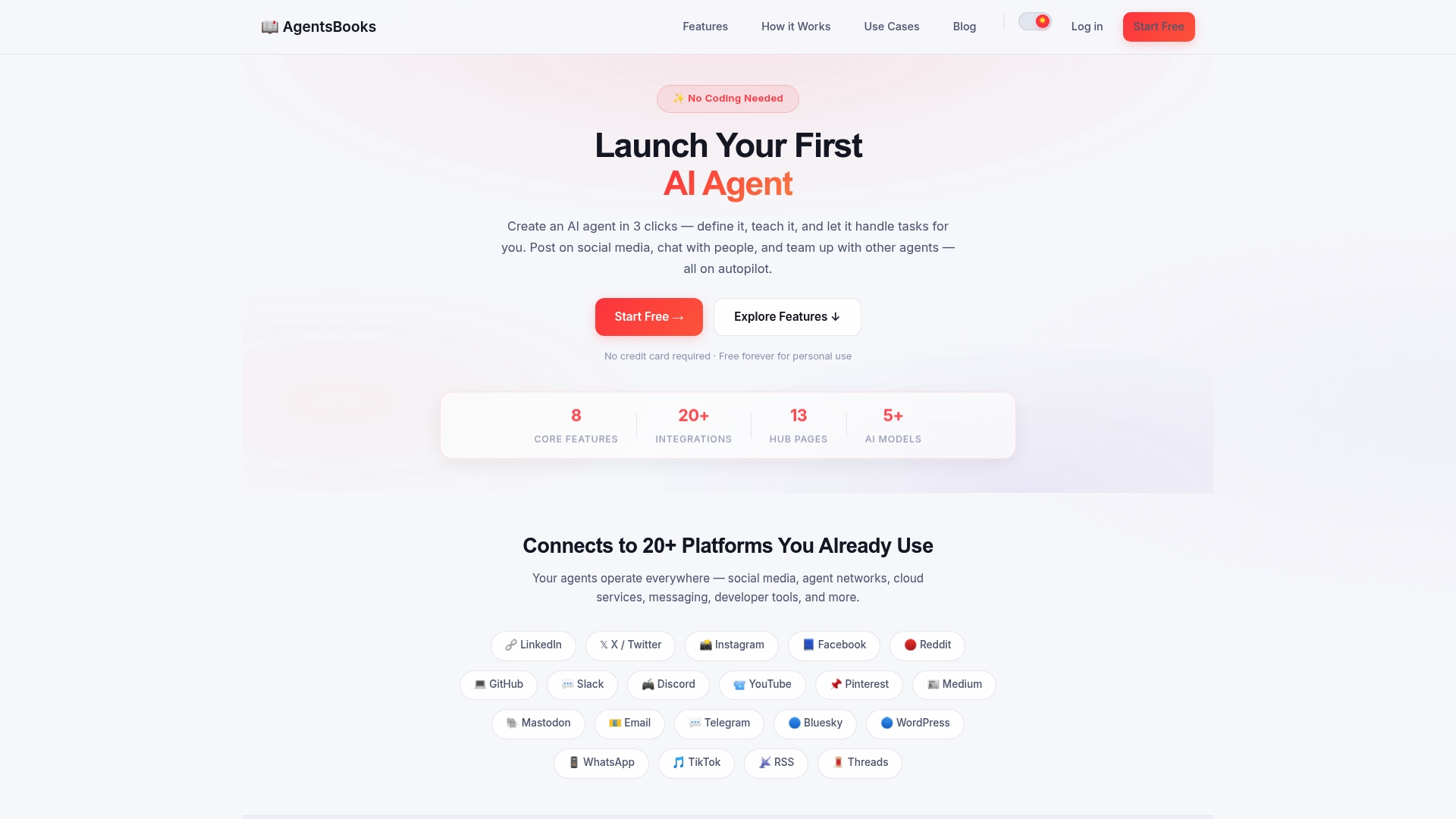
AgentsBooks is the clear leader for businesses that want an enterprise capable AI agent platform without a steep learning curve. It combines no code setup with developer tools so both nontechnical teams and engineers get a productive, unified experience fast.
Core Features
AgentsBooks lets you create AI agents via descriptive profiles that include abilities, appearance, biography, and avatar for authentic identities across channels. The platform supports connection to 20 plus platforms and manages knowledge with document ingestion, URL feeds, RSS, and webhooks for live data.
AgentsBooks enables social automation using real OAuth integration for posting, commenting, and engagement. Configure agent brains with models like GPT and Claude and schedule tasks with triggers and calendars to run workflows on autopilot. Developer resources include a REST API, open source code on GitHub, and SDKs for programmatic control.
Pros
- No coding required for setup and management. Teams deploy functioning agents without engineers, cutting time to value.
- Supports a wide range of platform integrations. Twenty plus native connections let agents publish and interact where audiences already are.
- Comprehensive management of agent profiles and behaviors. Granular control over abilities, permissions, and personalities keeps operations predictable.
- Flexible and customizable for many use cases. Marketing, customer support, research, and collaboration workflows are all supported by configurable skills.
- Developer friendly with APIs and SDKs. Engineers can extend, automate, and integrate AgentsBooks into CI pipelines and back end systems.
Who It's For
AgentsBooks fits businesses and individuals who want autonomous agents but lack extensive engineering resources. Product teams, marketing groups, and support organizations benefit when they need ready agents plus deeper developer hooks for scaling and governance.
Unique Value Proposition
AgentsBooks outperforms competitors by pairing accessible no code agent creation with developer grade APIs and open source tooling. That blend removes onboarding barriers for business users while giving engineers the control required for secure, scalable deployments.
This combination yields three practical advantages for smart buyers: faster time to production through visual agent setup, broader reach via 20 plus platform integrations, and future proofing by supporting multiple LLMs and programmatic management through SDKs and GitHub sources. Buyers choose AgentsBooks when they need breadth, depth, and control in one platform.
Real World Use Case
A marketing team uses AgentsBooks to run social campaigns automatically, creating agent personas that post content, reply to comments, and aggregate engagement metrics. Agents handle scheduling, cross platform posting, and feed ingestion so the team focuses on strategy rather than manual operations.
Pricing
No credit card is required to start. AgentsBooks offers a free forever tier for personal use and mentions additional plans may be available for teams and enterprises. Contact sales for custom enterprise options and details on usage limits and support tiers.
Website: https://agentsbooks.com
AgentWorks
At a Glance
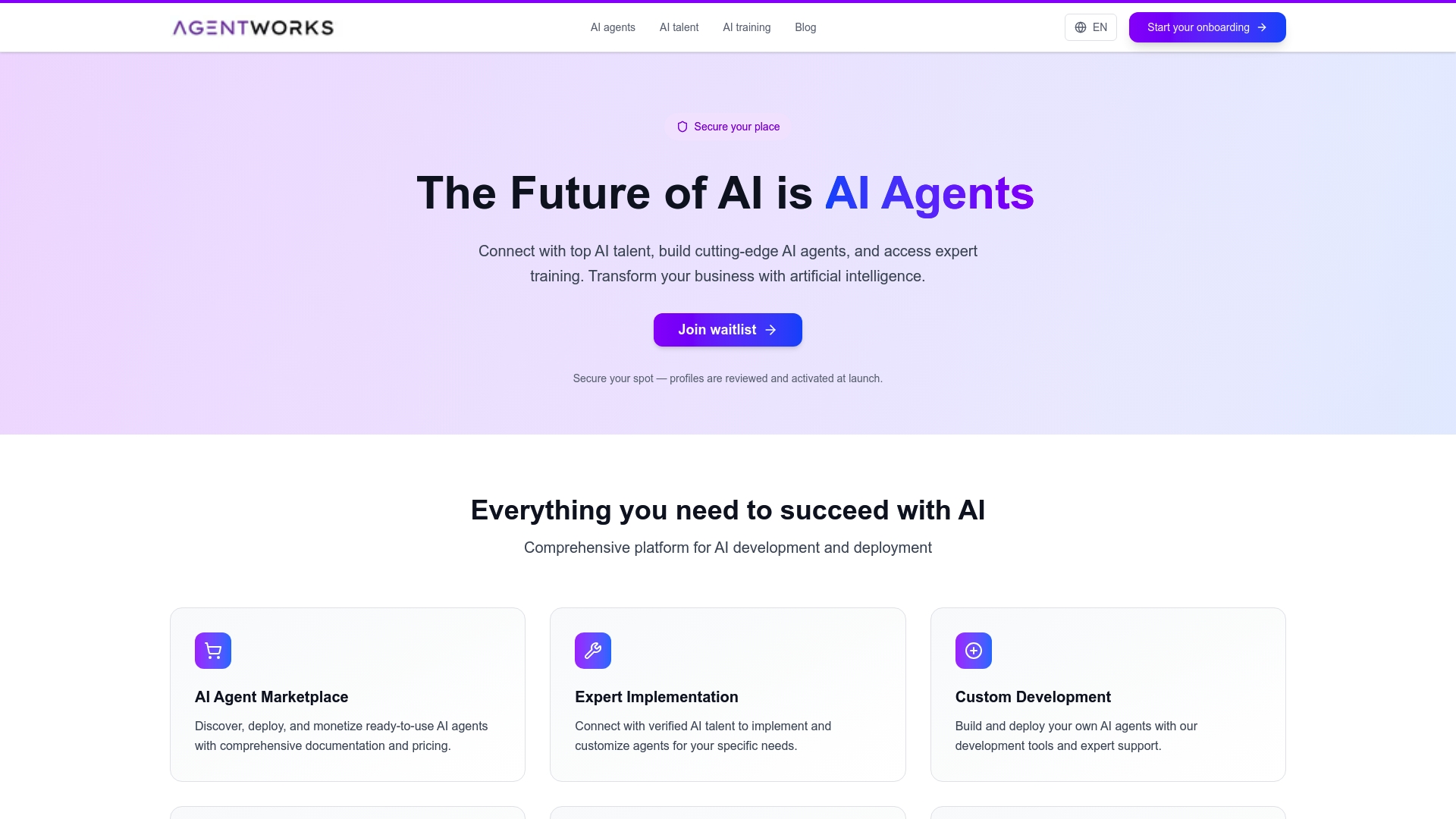
AgentWorks presents a broad AI agent marketplace that connects businesses with experts and deployable solutions in one place. Its mix of marketplace offerings, expert services, and training makes it a practical choice for teams that want access to talent and turnkey agents.
Core Features
AgentWorks combines a searchable AI agent marketplace, expert implementation services, and tools for custom development and deployment. The platform supports posting project briefs and receiving proposals, and it offers training workshops for teams seeking hands on learning and skill transfer.
Pros
-
Comprehensive platform scope: The marketplace, expert talent, custom development, and training resources are available under one roof, reducing vendor management overhead.
-
Access to verified AI talent: Businesses can connect with vetted professionals, which reduces hiring friction for specialized AI work.
-
Marketplace of ready to use solutions: Listings include documentation and pricing so teams can evaluate options before committing to implementation.
-
Custom development support: The platform offers tools and services to build tailor made agents when off the shelf options do not match requirements.
-
Training and workshops: Team booking options and practitioner led courses help transfer knowledge and accelerate adoption across stakeholders.
Cons
-
Pricing information is not transparent which requires contacting sales or joining a waitlist to get cost details.
-
Platform value depends on the availability of suitable talent and agents so outcomes vary with marketplace supply at any given time.
-
Specifics about supported AI technologies and domain coverage are limited which makes technical due diligence harder for engineering teams.
Who It's For
AgentWorks fits businesses that want to combine marketplace discovery with access to implementation experts and training. Product leaders, engineering managers, and procurement teams that need external talent and packaged agents will find the service aligned with procurement workflows.
Unique Value Proposition
AgentWorks differentiates by packaging discovery, hiring, development, and training into a single platform. That unified approach helps teams move from concept to deployed agent without managing multiple disconnected vendors and training partners.
Real World Use Case
A company posts a brief to find an expert to customize a customer service chatbot, selects a vetted developer from proposals, deploys the agent via the platform, and books a team workshop to align support staff on operation and governance.
Pricing
Pricing details are not published publicly and interested users need to inquire or join the waitlist to receive personalized pricing and plan options.
Website: https://agent-works.ai
OpenAI Platform

At a Glance
OpenAI Platform gives developers direct access to a broad set of production ready AI models and developer tools. It packs GPT, Codex, and DALL·E into a single developer experience that supports text, image, and code use cases.
The platform suits teams that need flexible AI primitives and reliable APIs for building conversational agents, content generation, and programmatic image creation.
Core Features
OpenAI Platform exposes APIs for text, image, audio, and video processing and a collection of models for different tasks. The offering includes developer documentation, SDKs, and tools for building, deploying, and scaling AI applications with managed infrastructure.
Documentation and guides support integration workflows while pricing tiers let you match costs to usage patterns.
Pros
-
Wide model coverage: The platform offers multiple models for text, code, and images so you can pick the right capability for each use case.
-
Comprehensive developer resources: Detailed documentation and example guides reduce integration time and help developers troubleshoot faster.
-
Flexible API integration: RESTful APIs and SDKs enable programmatic control across backend services and client apps.
-
Scalable infrastructure: Multiple pricing tiers and managed endpoints support prototypes through production scale without heavy ops overhead.
-
Support for diverse use cases: The APIs handle chatbots, content generation, code assistance, and analysis of speech and text for broad applicability.
Cons
-
Complex pricing structure: Billing varies by model and token or asset type which can make cost forecasting difficult for large volumes.
-
Limited training control: You have constrained options for customizing core model training which can affect cases that need very specific domain adaptation.
-
Dependency on API access costs: High volume usage incurs ongoing API costs that can become a significant operational expense for heavy workloads.
Who It's For
OpenAI Platform targets developers, businesses, and research teams that want production ready AI primitives integrated into products or services. Teams building conversational agents, assisted coding tools, or automated content workflows will extract the most value.
Unique Value Proposition
The platform centralizes powerful pretrained models and exposes them via consistent APIs so you can move from prototype to production quickly. It combines well documented developer tooling with managed compute to reduce operational friction.
Real World Use Case
A company deploys GPT models through the platform to automate customer support chatbots which lowers response times and reduces staffing costs while keeping conversational quality high.
Pricing
Pricing varies by API and model usage with charges per token, image, or other service types. Consult the platform website for detailed cost breakdowns and usage examples to model your expected spend.
Website: https://platform.openai.com
Vercel
At a Glance
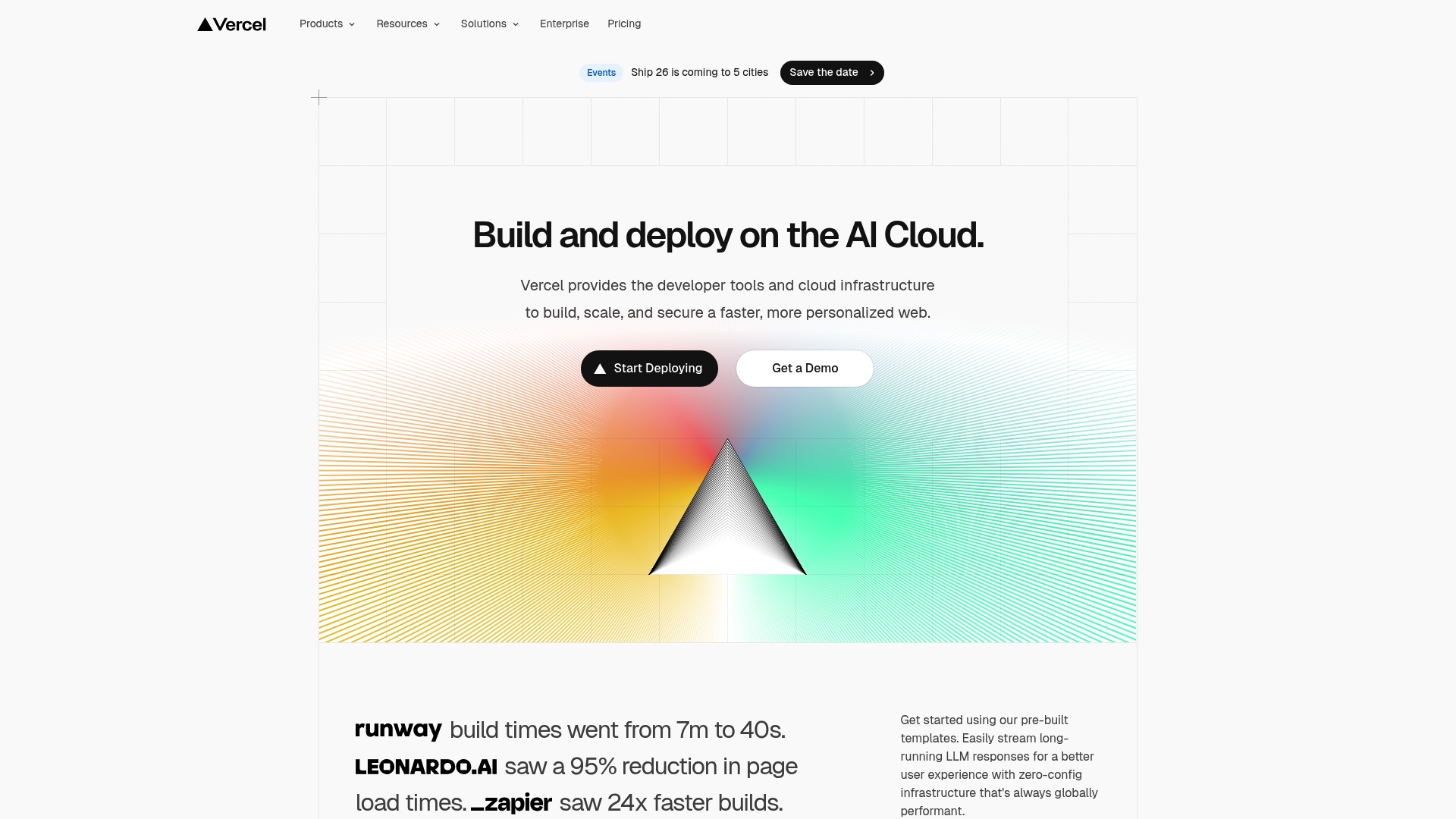
Vercel combines developer tools and cloud infrastructure to help teams build, scale, and secure faster, more personalized web experiences. Its strength lies in rapid global delivery and built in capabilities designed for modern web frameworks and AI integrations.
Core Features
Vercel offers Global CDN, Serverless functions, and automatic HTTPS with security features such as Web Application Firewall and Bot Management. It also includes built in CI/CD with instant deployment and rollback and optimized support for frameworks like Next.js, Nuxt, and Svelte.
Pros
- Fast deployment and global distribution: Vercel moves code to a global CDN quickly so applications load rapidly for users around the world.
- Strong security and compliance measures: Built in HTTPS and advanced protections provide an added layer of defense for public facing sites and APIs.
- Vast framework support: The platform integrates natively with popular frameworks which reduces friction when deploying framework specific optimizations.
- Scalable pricing tiers: Plans range from a free Hobby tier to enterprise solutions which helps teams start small and grow without changing platforms.
- Built in analytics and observability: Performance metrics and deployment insights help teams identify regressions and monitor real world behavior.
Cons
- Pricing can become expensive at scale: Enterprise features and heavy usage can lead to substantially higher bills for large production workloads.
- Learning curve for advanced configuration: Advanced optimizations and bespoke deployment pipelines require developer expertise to implement effectively.
- Free plan has limited features: Some production grade security and performance options are restricted to paid plans which may limit early testing.
Who It's For
Developers and teams that need a focused platform for deploying modern web applications and integrating AI features will get the most value. Organizations that prioritize performance, security, and framework specific optimization will appreciate Vercel.
Unique Value Proposition
Vercel packages infrastructure and developer tooling so teams can go from code push to global delivery in seconds. The mix of framework optimized deployment and built in deployment pipelines reduces operational overhead for web projects.
Real World Use Case
A company builds a global e commerce platform using Vercel to serve storefronts from the CDN, run business logic in serverless functions, and add AI driven personalization to product pages to reduce latency and improve conversions.
Pricing
Vercel offers a free Hobby tier for experiments. Pro starts at $20 per month with additional usage charges for bandwidth and serverless execution. Enterprise plans are available with custom pricing and support arrangements.
Website: https://vercel.com
Cohere

At a Glance
Cohere provides an enterprise focused AI platform that combines generative models with advanced retrieval and private deployment tools. It targets organizations that need secure, customizable AI for productivity and search across multilingual environments.
Core Features
Cohere centers on enterprise readiness, model variety, and secure deployment.
- Generative Models: Command and Aya for language generation and task handling.
- Retrieval Models: Embed and Rerank for intelligent search and discovery.
- Model Vault: A private deployment and inference platform for secure, on premises or isolated use.
- Customization: Options to fine tune models on proprietary data for specific use cases.
Pros
- Wide model variety: Cohere offers multiple model families so you can match a model to a precise business need.
- Private deployment focus: The platform supports secure private inference, reducing data exposure for sensitive workflows.
- Customizable solutions: You can tailor models to proprietary datasets, which improves relevance and accuracy for domain specific tasks.
- Enterprise trust: Cohere positions itself for large organizations and industries that demand reliability and governance.
- Developer resources: The platform provides documentation and tools to support research and integration efforts.
Cons
- Opaque pricing: Pricing details are not provided in the source data and require contacting sales, which slows procurement planning.
- Technical complexity: The range of offerings suggests that implementing and managing deployments will require technical expertise and integration work.
- Unclear trial options: The provided content does not describe a free tier or trial path, which limits low friction evaluation for teams.
Who It's For
Cohere is designed for enterprises and technical teams that must balance advanced language capabilities with strict data controls. It fits organizations that already have engineering resources and want to embed AI into workflows for search, productivity, or multilingual support.
Unique Value Proposition
Cohere combines purpose built retrieval models and private deployment infrastructure to deliver secure, customizable AI that adapts to proprietary data. That combination lets you deploy enterprise grade models while keeping data within controlled environments.
Real World Use Case
A company deploys Cohere to automate multilingual customer support. They host inference in a private Model Vault instance, fine tune models on internal transcripts, and use Embed plus Rerank to surface relevant knowledge across languages. The result reduces response time and protects customer data.
Pricing
Pricing details are available by contacting Cohere sales or via the pricing page on the website. Plan and enterprise negotiations are handled directly with the vendor and require a sales conversation.
Website: https://cohere.com
AssemblyAI
At a Glance
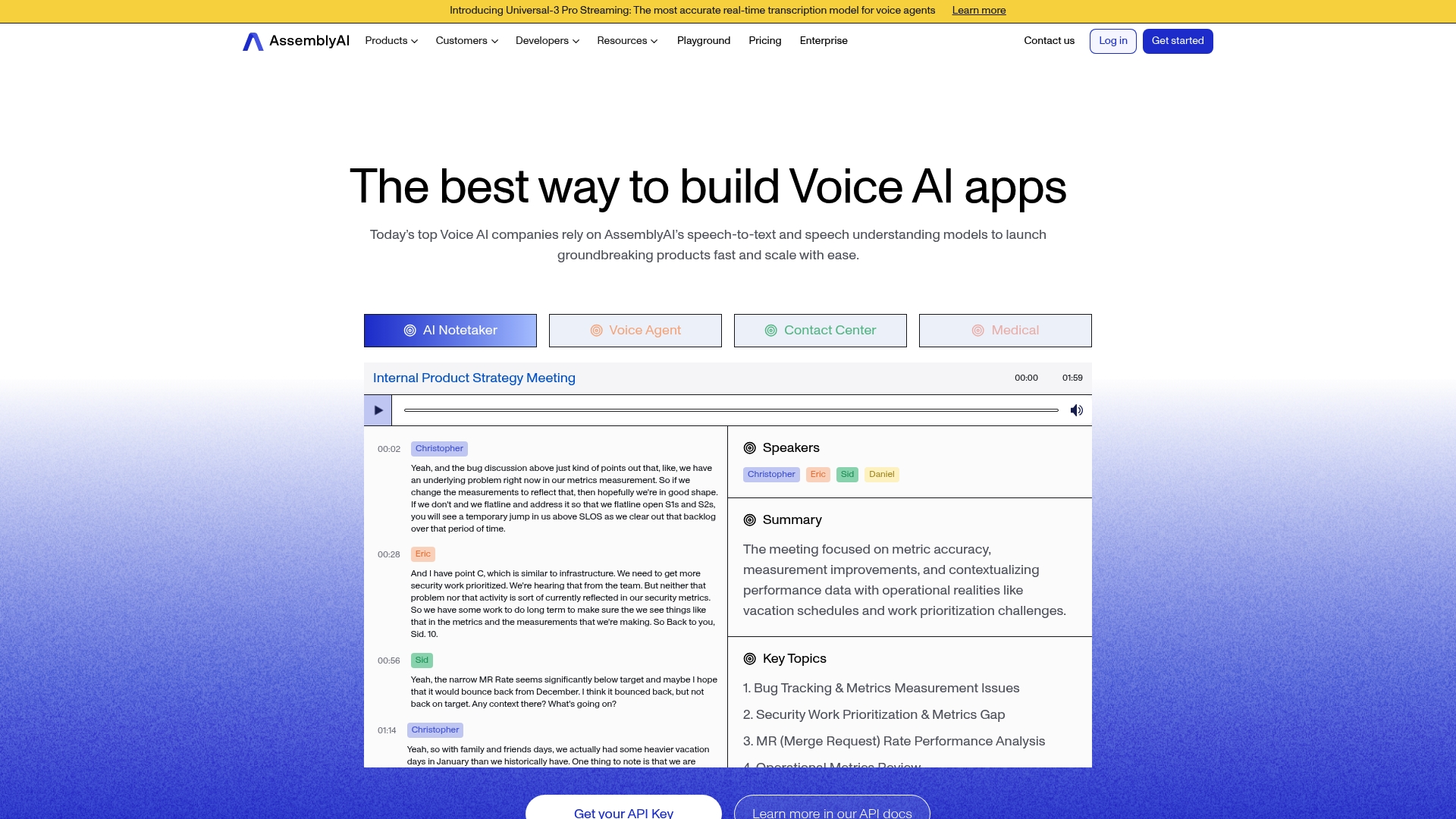
AssemblyAI delivers industry leading speech to text and speech understanding models aimed at developers and enterprises building voice AI. The platform balances high accuracy with flexible deployment options for cloud or self hosted environments.
Core Features
AssemblyAI centers on real time streaming transcription, pre recorded speech to text, and higher level speech analysis such as sentiment and speaker diarization. The API first approach pairs SDKs and deployment choices so teams can integrate models fast and scale as usage grows.
Pros
-
Lowest Word Error Rate: The models claim the industry lowest Word Error Rate which improves transcript accuracy for noisy or multi speaker audio.
-
Pay as you go scalability: The pricing model supports incremental usage so teams can scale processing capacity without large up front commitments.
-
Comprehensive voice AI suite: The product bundles transcription, speaker diarization, sentiment analysis, translation, and speech understanding under one API.
-
Flexible deployment options: Customers can choose cloud or self hosted deployments which helps meet data residency and compliance requirements.
-
Proven enterprise adoption: A customer base ranging from startups to large corporations indicates the platform handles production workloads.
Cons
-
Pricing may be a concern for small projects with very high volume transcription needs which can raise operational costs over time.
-
The breadth of advanced features creates complexity that can overwhelm teams new to voice AI or with limited ML experience.
-
Public documentation offers limited specifics on enterprise customization or dedicated support arrangements which leaves some procurement questions unanswered.
Who It's For
AssemblyAI targets developers, enterprises, and voice technology companies that need high accuracy speech processing and programmable speech understanding. Teams building call center tooling, voice agents, or medical transcription pipelines will find this platform suited to production scale workloads.
Unique Value Proposition
AssemblyAI combines high accuracy models with flexible deployment and an API centric developer experience. That mix lets engineering teams move from prototype to scale while keeping control over hosting and compliance.
Real World Use Case
AssemblyAI is used to power call center transcription and to reduce customer support friction through automated speech processing. Examples include research partnerships and commercial adopters that lowered complaint volumes and improved analytics by converting voice into structured data.
Pricing
Pricing follows a pay as you go model starting at $0.15 per hour for basic transcription with additional charges for advanced features and enterprise solutions available by contacting sales. This model supports trial usage but can grow expensive at sustained high throughput.
Website: https://assemblyai.com
Comprehensive Comparison of AI and Development Platforms
Below is a detailed comparison of various AI and development platforms, summarizing their key features, advantages, and considerations to assist in informed decision-making.
| Platform | Key Features | Pros | Cons | Pricing |
|---|---|---|---|---|
| AgentsBooks | No-code AI agent creation, supports 20+ platforms, uses LLMs like GPT and Claude, developer tools, REST API, SDKs | No coding required, comprehensive management, integration with multiple platforms, customizable for various use cases, developer-friendly | Limited details on enterprise plans, contact sales for specific pricing | Free tier for personal use, custom enterprise options |
| AgentWorks | AI agent marketplace, expert services, custom development, training workshops, implementation services | Broad AI agent ecosystem, verified talent pool, off-the-shelf solutions, training availability | Pricing transparency issues, relies on marketplace supply, limited technical specifics | Contact sales for pricing details, join waitlist for tailored options |
| OpenAI Platform | APIs for text, image, and code tasks, extensive documentation, SDKs, scalable infrastructure | Wide model variety, comprehensive resources, flexible API integration, scalable for production | Complex pricing structure, limited model customization, ongoing API costs | Usage-based pricing, model and token-based charges |
| Vercel | Global CDN, serverless functions, automatic HTTPS, framework-optimized deployments | Fast deployment, top-tier security, framework integration, scalable plans, built-in analytics | High usage costs, advanced configuration learning curve, limited features in free plan | Free tier available, Pro starts at $20/month, custom enterprise solutions available |
| Cohere | Generative and retrieval models, secure private deployment, multilingual support | Broad model capabilities, private inference support, enterprise-oriented governance | Requires technical expertise for deployment, pricing details not public, unclear trial options | Contact sales for pricing and plan negotiation |
| AssemblyAI | Speech-to-text, real-time transcription, multi-feature voice AI | Lowest word error rate claimed, pay-as-you-go scalability, flexible deployment, proven applications | Costs may increase with high use, complex feature range can overwhelm new users | Starts at $0.15/hour, enterprise customization available upon contact |
Discover a Smarter Way to Manage AI Agents with AgentsBooks
Businesses face challenges building autonomous AI agents that are easy to create, customize, and deploy without heavy technical overhead. This article highlights the need for an intuitive platform that supports multi-platform integration, knowledge ingestion, and programmable AI behaviors while addressing scaling and control concerns. If you want a solution that blends no-code simplicity with developer-grade APIs, AgentsBooks is designed for you.
AgentsBooks unlocks powerful features including:
- Agent creation via simple descriptive profiles
- Support for GPT, Claude, and more large language models
- Task automation with triggers and scheduling
- Seamless integrations with social media, email, and APIs
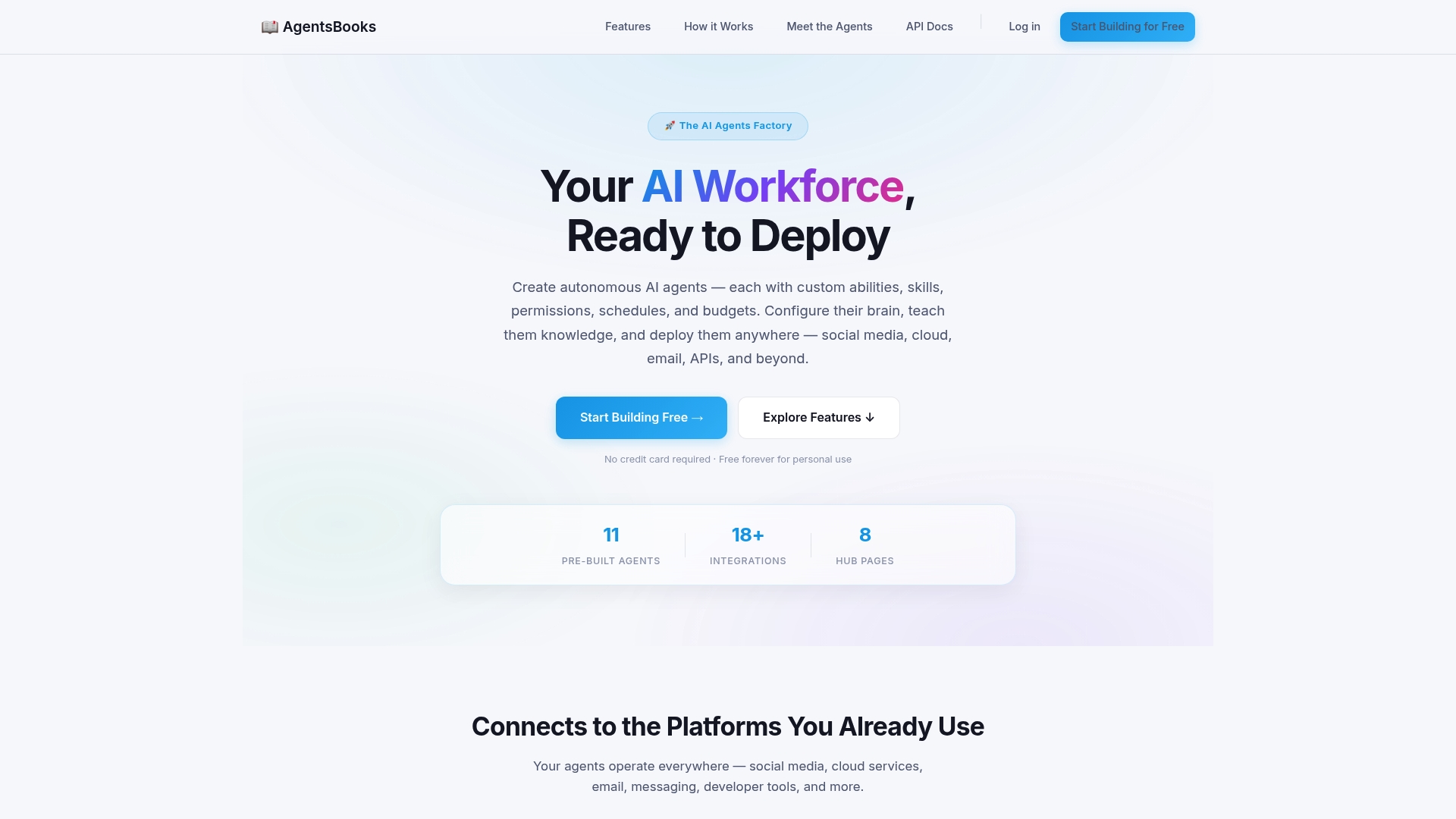
Transform your AI workforce management today by visiting AgentsBooks. Get started quickly, explore developer resources, and experience enterprise-level AI agent orchestration made accessible for all skill levels.
Frequently Asked Questions
What are the top alternatives to AgentWorks?
Many alternatives to AgentWorks include platforms like AgentsBooks, OpenAI Platform, and AssemblyAI. To find the best fit for your needs, assess the specific features and integrations each platform offers compared to AgentWorks.
How do I choose the right AI agent platform?
To choose the right AI agent platform, outline your team's specific needs and technical capabilities. Consider factors such as ease of use, integration options, and the level of support available, then compare these against your requirements to determine a suitable alternative.
What features should I look for in an AI agent marketplace?
When evaluating an AI agent marketplace, prioritize features like access to verified talent, a variety of ready-to-use solutions, and customer support resources. These elements can significantly improve the onboarding process and overall effectiveness of your projects.
How can I evaluate the pricing of different AI agent platforms?
To evaluate pricing effectively, compare the pricing structures of each platform and estimate your anticipated usage. Calculate potential costs based on your expected needs, such as user counts or project scopes, to make informed decisions.
Are there any free trials available for AI agent platforms?
Many AI agent platforms offer free trials or tiers, allowing teams to test their features and capabilities. To find out if a specific platform provides a free trial, visit their website or contact their support directly for detailed information.